The Audience Comes First: An Interview with CIFF Artistic Director Mohamed Tarek
.
VERDICT: After a decade working at the Cairo Intl. Film Festival, Mohamed Tarek steps into the leadership position prioritizing viewers and revitalizing programming.
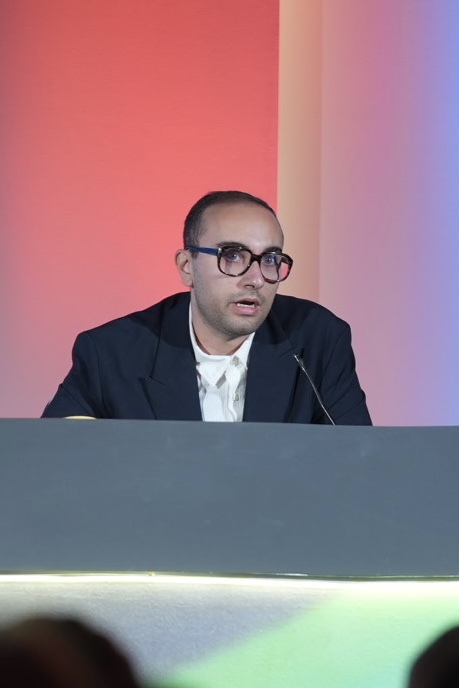
Mohamed Tarek has been involved with the Cairo Film Festival for the last ten years. He started as a participant in film criticism workshops and doing Q&As with filmmakers, becoming deputy Artistic Director in 2022, artistic consultant the following year, and finally the chief programmer. “The 46th edition is very special to me. The Cairo festival is my second home, and through it I discovered and fell in love with cinema from the very first moment,” Tarek told The Film Verdict.
He took on the role immediately, succeeding Essam Zakaria. He works alongside acclaimed actor Hussein Fahmy, who has a long history as president of the festival.
Tarek’s career includes film programming for various festivals such as Dublin International Film Festival, El Gouna Film Festival, and Cinema Akil in the UAE. He is also an alumnus of the Locarno Industry Academy in Beirut and the Durban Talents programme. His appointment comes as a promising testament to his knowledge of the festival’s audience and the hard mission of satisfying all tastes. Ever since his new role was announced during this year’s Berlinale, he and his team have been gearing up for the November festival since February, networking, forming a high level jury, and achieving a strong international presence.
Part of that international cooperation took place at Cannes in May, where CIFF shared a joint Egyptian pavilion in collaboration with the El Gouna Film Festival and the Egypt Film Commission (EFC), aimed to enhance the presence of Egyptian cinema on the international stage and in the prestigious Marché du Film. The Egyptian joint pavilion, Tarek said ”represents an ambitious return [to Cannes], with three major entities joining forces to support the Egyptian film industry. It served as a platform to introduce the two festivals and the commission, engage in discussions with other Arab film festivals on the future of Arab cinema, and highlight Egypt’s appeal as a filming destination.”
Consequently, Tarek started early in the year to build the team and define roles, “ensuring the programming would be varied and capable of attracting distinctive films.”
This year, Tarek and is programming team are betting on a notable group of names, including the Belgian director Marta Bergman with her film The Silent Run in its world premiere, and the Egyptian-Palestinian film titled One More Show by directors Mai Saad and Ahmed Al-Danaf.
“We are also presenting films from countries unfamiliar to Egyptian audiences, such as Zafzifa by Peter Sant from Malta, Kaffarah by Thanvir Chowdhury from Bangladesh, Noah by Ali Tamim from Germany, and Cotton by Rashid Malikov from Uzbekistan,” Tarek added.
Other films he believes enrich the programme are Pasha’s Girls from Mohamed Al Adel, and the documentary by the young Egyptian filmmaker Alaa Mahmoud, Triangle of Love.
“Egyptian cinema represents the beating heart of the festival,” Tarek asserts. “We work on highlighting contemporary Egyptian productions alongside restoring classic films and presenting them to new generations.”
“It is important for Egyptian filmmakers to feel that the festival provides them with a platform that places them within a cinematic movement that renews itself every year. For this reason, Egyptian films appear across various sections: fiction, documentary, and short films.”
Top titles shining in the selection include Once Upon a Time in Gaza by Arab and Tarzan Nasser, winners of the Best Director award at Cannes’ Un Certain Regard; the world premiere of Souraya, Mon Amour by Lebanese filmmaker Nicolas Khoury, a touching portrayal of Souraya, the widow of legendary filmmaker Maroun Bagdadi; and Calle Malaga by award-winning Moroccan filmmaker Maryam Touzani.
Regarding programming, he explains, “This year, we were not concerned with having a large number of titles; rather, we focused on presenting films within a critical context that honors the festival’s audience.” He notes, “This edition includes 15 world premieres and participation from 40 countries, encompassing fiction, documentary, and short films. We also present 22 restored Egyptian classics,” along with “25 short films of various styles and forms, keeping the festival a space for both discovery and the preservation of classics.”
He sees the mission of the festival being to “champion Arab voices” and to allow these projects to be seen by the world. Yet this dedication to Arab cinema does not decrease CIFF’s prestige as an international festival. Tarek believes in the depth of the chosen titles, and not the number of international films included in the programme. “The impact of CIFF is its ability to promote Arab and Egyptian cinema, and this goes hand in hand with its international presence.”
This year, CIFF pays tribute to several Arab figures such as Egyptian actor Khaled El Nabawy, veteran filmmaker Mohamed Abdel Aziz, and cinematographer Mahmoud Abdel Samie. In addition two acclaimed female figures are honoured: Hungarian filmmaker Ildikó Enyedi and French-Palestinian actress Hiam Abbass.
Tarek and his team take pride in celebrating talents that work to build bridges between cultures and countries. Khaled El Nabawy is an example of that, as is Hiam Abbas. Both have “an astonishing career that connects Arabic and global cinema.” Concerning Arab honorees, Tarek believes in the importance of making Cairo “a hub where Arab and Middle Eastern filmmakers are celebrated and acknowledged for their work in the Arab world and on the international scene.”
On the jury, Tarek says, “Choosing the internationally acclaimed director Nuri Bilge Ceylan to head the jury was a very natural decision,” describing him as “one of the world’s most prominent filmmakers and the recipient of major awards.”
For Tarek, the festival is an integrated ecosystem that cannot be judged from one angle. “If the films are the heart pumping blood, there are other organs that keep the body alive: organization, events, the audience, and the industry, “ he told The Film Verdict.
He believes the festival is not just a platform for screenings, but an interactive space for the film industry. “We pay special attention to the Cairo Industry Days (CID), which has become an important platform for developing Arab and African projects. It gives emerging talents opportunities to connect with international producers and distributors, and provides support programs that help transform ideas into actual films.”
“We aim to be the most influential and distinguished, but our goal is not ‘being number one’ in itself. It is a process; we don’t want to enter a race for rankings. We focus on the essence of competition: filmmaking.” He adds that the ambition is to have “a voice that is unique and influential, not just another figure in a festival race.”
Turning to the festival’s attendees: “The biggest challenge is the wide diversity of the festival’s audience.” For Tarek, programming for CIFF reflects Cairo’s diversity, from film students, cinephiles, international guests, filmmakers, local and international press to industry pros. “CIFF’s audience is diverse and possesses an advanced cinematic taste.”
“We have more than forty thousand attendees, some eagerly anticipating the official competition, while others look for the experimental works shown only here… So we were careful to create a balance without compromising the festival’s spirit or losing its identity. For me, the festival resembles an ‘open vision,’ written by cinematic spectrums that appeal to all tastes.”