
The Red Hangar
Hangar rojo
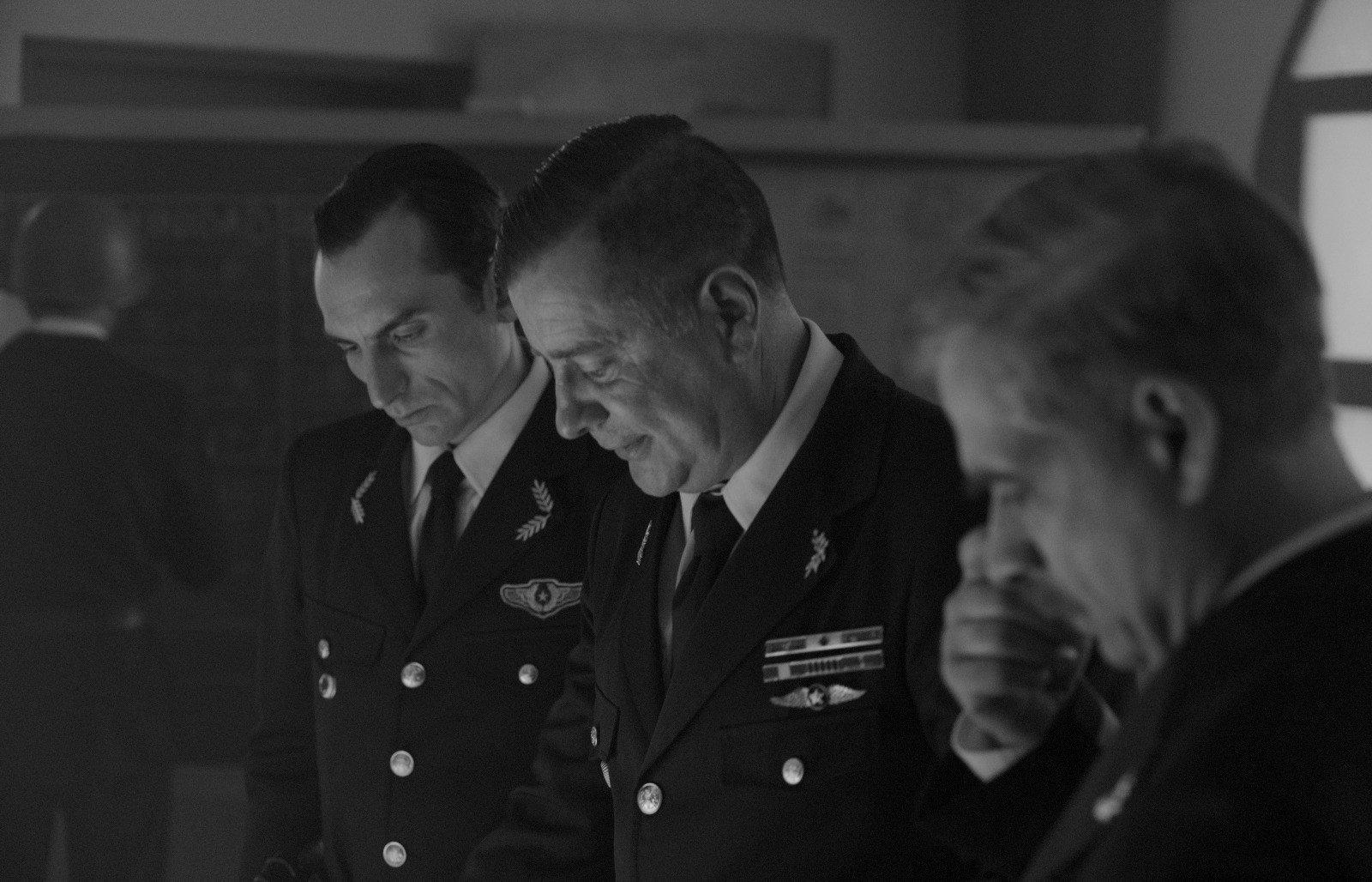
VERDICT: Based on a true story pregnant with contemporary moral questions, ‘The Red Hangar’ is the gripping portrait of a courageous Air Force captain forced to draw the line during Chile’s military coup in 1973, that overturned the Salvador Allende government and democracy.
How far should a military officer who has sworn allegiance to his country’s constitution go in obeying orders from his superiors?
In 81 taut minutes of democratic crisis shot in unforgiving black-and-white, The Red Hangar (Hangar rojo) places the viewer inside the head of Captain Jorge Silva, the rigidly disciplined commander of an Air Force academy, who suddenly finds himself ordered to torture and kill young Allende supporters rounded up during the military coup of 1973. Fighting an epic struggle of conscience while keeping a poker face, actor Nicolas Zarate gives a career-best performance in the leading role that is both fascinating and troubling to contemplate.
While the story, taken from reality, contains plenty of its own inherent tension, director Juan Pablo Sallato and screenwriter Luis Emilio Guzman pare the tale down to its essentials to ratchet up the atmosphere of uneasiness and incipient horror. Like the countdown to a bomb exploding, the story begins in the silence of dawn on Sept. 11, 1973 on an impeccably manicured air force training base. Salvador Allende’s left-wing government (reviled as Communists, traitors and terrorists by the military right) is clearly in trouble, and a coup is expected at any time. Still the base is unprepared for the unannounced arrival of a truckload of beaten-up protesters. Ordered to house them, without the luxury of toilets and beds, Silva puts them up on the floor of an empty airplane hangar. He reasons that he is a member of the military and duty-bound to follow the orders of his superiors.
Lit like a silent movie actor by D.P. Diego Pequeno’s stark lighting that seems to slash his face, Zarate’s sharp features attract and repel in equal measure. Although he seems totally repressed and unreachable, he melts into a human being in the presence of his wife Rosa (Catalina Stuardo), a history teacher who loves him. In just two measured scenes of controlled emotion, their tenderness towards each other strikes a welcome human chord. Perhaps Silva will not follow all the terrible, escalating orders from his old nemesis, now commanding officer, Col. Jahn (Marcial Tagle)?
Despite the fact that Jahn has doubts about Silva’s loyalty, his reputation is stainless and his work as former head of Intelligence makes him an exceptional interrogator and psychologist. When Jahn craftily demands he interrogate the prisoners, he manages to get the info without physical violence during a chilling confrontation with two scared young men. But Jahn wants more cruelty – perhaps a session on the electrified bed springs we glimpse through an open door; or a shot in the back at an “escaping terrorist.” Silva’s dilemma grows from scene to chilling scene, and it is clear his own life and liberty are in danger as well.
Besides his wife, the only other human relationship ascribed to Capt. Silva is his kindness to a cadet named Hernandez, a farm boy who has joined the Air Force to learn parachute diving with the legendary parachutist Silva. In a climactic night scene laden with finality, Hernandez drives a truckload of prisoners to the stadium for further interrogation, not knowing that Silva has orders to stop the truck and kill some of them en route. Music and editing build suspense as they drive into the deserted city, until the Captain’s intentions become clear in a powerful ending.
The end titles offer a little welcome clarification of what happened next to Silva, leaving audiences with much to ponder about military responses in times of crises, when real courage is demanded.
Director: Juan Pablo Sallato
Screenplay: Luis Emilio Guzman
Producers: Juan Ignacio Sabatini, Juan Pablo Sallato
Cast: Nicolas Zarate, Boris Querciq, Marcial Tagle, Catalina Stuardo, Aron Hernandez
Cinematography: Diego Pequeno
Production design: Nicolas Grum
Editing: Valeria Hernandez, Sebastian Brahm
Music: Alberto Michelli, Matteo Marrella
Sound design: Stefano Polidoro
Production companies: Villano Producciones (Chile) in coproduction with Brava Cine (Argentina), TVN (Chile), Rain Dogs (Italy), Caravan (Italy), Berta Film (Italy)
World sales: Premium Films/MPM Premium
Venue: Berlin Film Festival (Perspectives)
In Spanish
81 minutes