
Roya
Roya
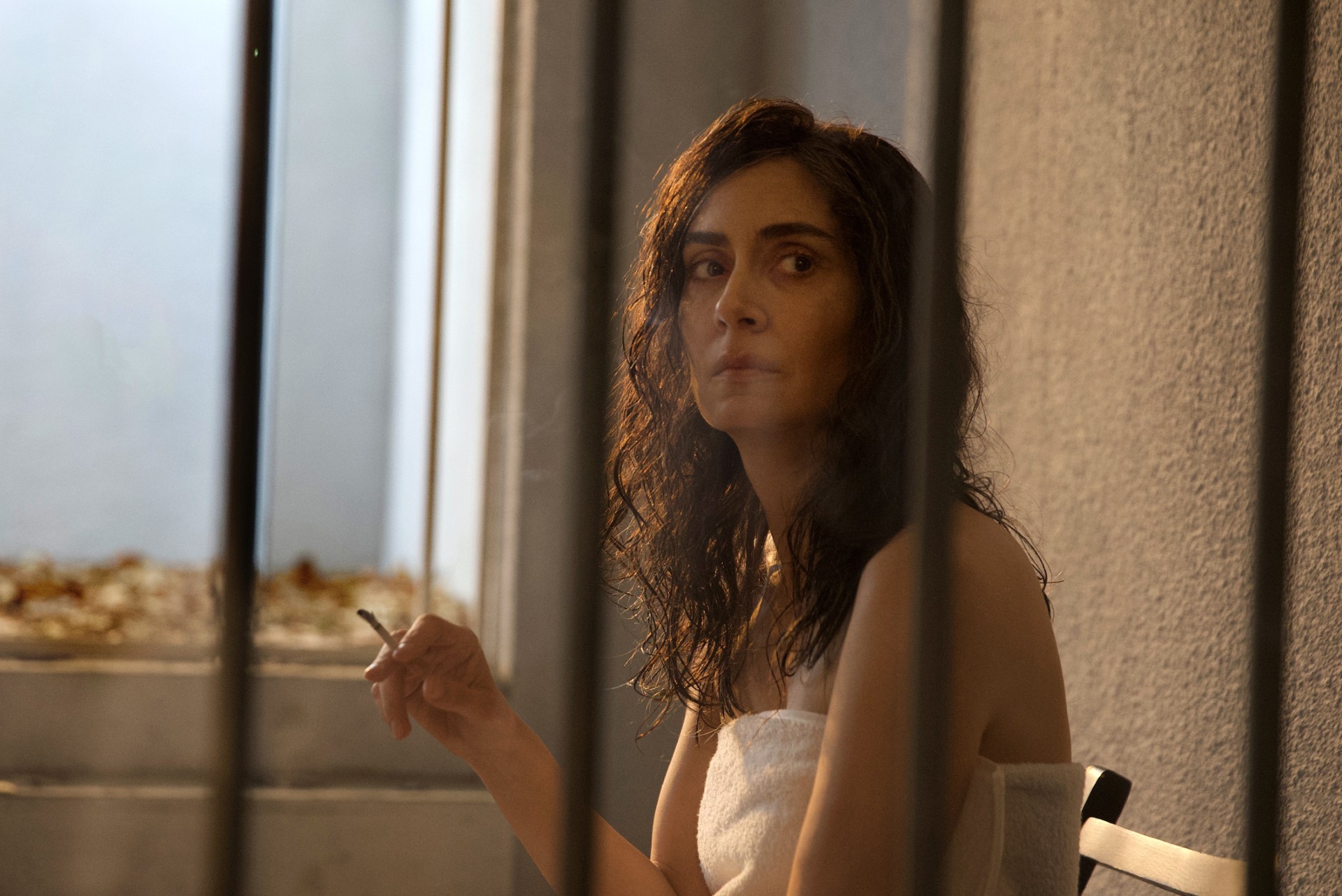
VERDICT: Bravely defying government restrictions, Iranian writer-director Mahnaz Mohammadi draws on her own prison experiences in this gripping, Kafka-esque, artfully time-scrambled thriller.
A gripping, Kafka-esque psychological thriller rooted in real events, Roya takes us inside the traumatised mind of a dissident Iranian woman being held in a solitary confinement cell. Writer-director Mahnaz Mohammadi is drawing on personal experience here, having been arrested multiple times for protesting against human rights abuses in Iran. Banned from leaving the country since 2010, she was detained again a year later on charges of plotting against the state and working for illegal foreign media organisations. Her five-year jail sentence was later overturned, but she spent several months inside Tehran’s notorious Evin prison, where this drama takes place.
A sometime actor, activist and documentary director, Mohammadi is currently banned from making films. Which makes her second dramatic feature, shot without official permission, inside and outside Iran, not just a technically impressive work but also a courageous one. Particularly brave right now, with the Iranian people still reeling from a brutal government crackdown on mass street protests over the past two months. Islamic Republic officials have admitted to killing around 3,000 of their own citizens, but other credible sources put the death toll closer to 30,000. The pattern is depressingly familiar: every few years the regime crushes any serious public dissent using armed militias, torture, censorship, detention, forced confession, farcical show trials and mass executions.
World premiering at the Berlin film festival this week, Roya could hardly be more timely, especially with escalating threats of a US military attack on Iran. That said, it works just as well as a compelling art-house suspense thriller about the horrors of totalitarianism than as direct commentary on current geopolitical events. The non-linear plot becomes fuzzy and cryptic in places, but this is a deliberate design choice which repays patient viewing. Alongside Jafar Panahi’s thematically similar It Was Just an Accident (2025), Mohammadi’s quietly furious prison saga adds to the ongoing chorus of insider voices taking laudable personal risks by criticising one of the world’s most murderous, misogynistic, authoritarian regimes.
Roya opens with an attention-grabbing sequence set in the bowels of a grubby jail. Bordering on torture-porn, this suffocating, sense-jarring scene-setter is shot from the viewpoint of the unseen protagonist, a female prisoner known only by her grimly ironic label “guest 2648”, as she is roughly manhandled from her tiny cell, dragged to an interrogation room, then pressured to sign a confession to vaguely defined crimes. When she hesitates, she is assailed with insults and death threats, then beaten by members of Unit 400, a shadowy branch of the Iranian Revolutionary Guard Corps infamous for thuggery and dirty tricks (both groups have been proscribed as terrorist organisations outside Iran). Meanwhile, one of her interrogators briefly drops his bullying tone to take a family phone call confirming plans for his child’s birthday party. The banality of evil in full effect.
Switching to more conventional third-person viewpoint around the 20-minute mark, Roya finally reveals the haunted, anguished face of its eponymous heroine (angular Turkish beauty Melisa Sözen) for the first time. In an unexpected twist, it appears she is leaving jail on temporary compassionate grounds, to attend her sister’s funeral, whose mysterious death is never fully explained. The ceremony is a quietly beautiful family affair filmed in frosty, sunny woodland. But even in these painfully private moments, Roya remains under near-constant surveillance from sinister regime informers, and must wear an electronic ankle tag to confirm her location at all times.
Meanwhile, Mohammadi feeds viewers fragmentary clues about the charges against Roya, a teacher arrested for encouraging female students to defy the regime’s oppressive dress codes. She also ran a photo studio taking evidence of women scarred, burned and blinded, presumably by state militia, which is raided by police in a slow-motion flashback sequence. Adding a bitter edge to Roya’s guilty burden, relatives of her students echo the demands of her jailers by demanding she makes a full confession, sacrificing herself to save others. “You provoked them to burn their headscarves,” one claims. “Your only choice is to confess.”
However, this temporary return to freedom is not quite what it seems. Mohammadi gradually unravels these naturalistic scenes into a more impressionistic non-linear collage of dreams, memories and hallucinations. Roya’s visits to her dying father (Hamidreza Djavdan) feel like hazy half-remembered flashbacks, with a vague euthanasia subplot that remains hazy, while her journeys through the semi-deserted city have a nightmarish otherness, with sinister stalkers on every street corner, and dead bodies slumped on subway station platforms.
As Roya repeatedly returns to an eerie basement apartment full of flickering lights and ominous noises, there are strong hints here that she never left her prison cell at all, and these events are taking place inside her head. While some viewers may be left confused here, the effect is fully intentional, as Mohammadi explains in her Berlin film festival press notes. “Trauma, memory don’t move in a straight line,” she says. “They surface, fade, overlap, and interrupt one another.”
Roya is made with poise, elegance and craft. Sözen gives a hypnotic, almost wordless performance, her emotions mostly conveyed in gaunt, piercing expressions. Ashkan Ashkani’s cinematography is loaded with moments of lyrical beauty: armies of ants carrying a dead scorpion, water droplets dancing on glass, shadows and silhouettes, solar halos and lens flare. The soft amber glow of winter sunlight is a recurring motif. Music and sound design are also crucial, a steady churn of clanking, droning, mechanical noises amplifying the paranoid mood. Mohammadi ends Roya’s story with a small act of defiance, a flicker of hope in the darkness. She also saves a killer pay-off for the end credits: “written in Cell Block 2A of Evin Prison”.
Director, screenwriter: Mahnaz Mohammadi
Cast: Melisa Sözen, Maryam Palizban, Hamidreza Djavdan, Mohammad Ali Hosseinalipour, Bacho Meburishvili, Gholamhassan Taseiri
Cinematography: Ashkan Ashkani
Editing: Esmaeel Monsef
Music: Andrius Arutiunian
Sound design: Ensieh Leyla Maleki
Production design: Alborz Malekpour
Producers: Farzad Pak, Kaveh Farnam, Bady Minck, Alexander Dumreicher-Ivanceanu
Production companies: Pak Film (Germany), Media Nest (Czech)
World sales: Totem Films, Paris
Venue: Berlin Film Festival (Panorama)
In Farsi
92 minutes