
‘Water Deer’ Wins Nongshim Shin Ramyun Award at JEONJU
.
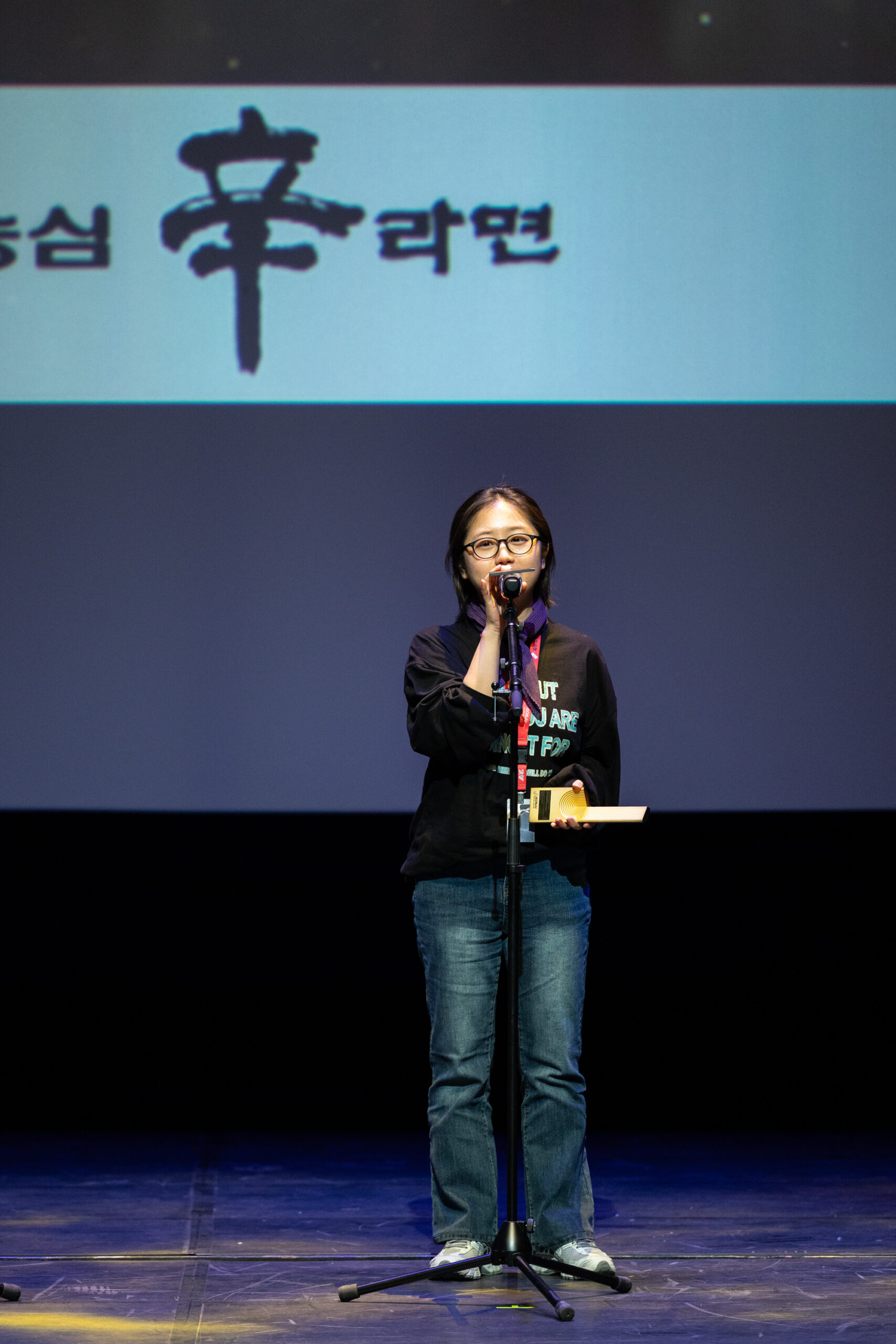
VERDICT: Korean director Yu Soyoung reflects on filmmaking after winning a special prize at JEONJU IFF with her feature debut, 'Water Deer'.
At the Award Ceremony held on May 5, the Jeonju International Film Festival celebrated the winners of its 27th edition. Marking its second year, the Nongshim Shin Ramyun Award was presented to a standout director from the Korean Competition section. Director Yu Soyoung received the honor for her feature debut, Water Deer, a delightful and poignant documentary about her mother, Gong-soon. The young filmmaker also appears in the film, capturing intimate and honest moments between mother and daughter.
Before the interview began, Yu pulled out a gift she had made for the audience. It was a pair of work gloves commonly used by manual laborers, printed with a smiley caricature of her mother. It perfectly symbolizes the kind of hard labor Gong-soon has endured and the high spirits that make her life so inspiring.
Interview by Hyo-jin Cho.
The Film Verdict: Congratulations on the award! Are you having a great time at the Jeonju IFF this year?
Yu Soyoung: Yes. My mom and I spent the last few days traveling around Jeonju. She loved the city so much that she kept saying, “I want to live here!” She was not very interested in watching other films, but now that she has headed back home, I’m excited to catch up on as many titles as possible in the time remaining.
TFV: How did it feel to receive the award for a promising director?
YS: I really didn’t expect any award. Browsing through the award list, I thought the only thing that seemed “maybe possible” was the Best Actor Prize for my mom, but it didn’t happen. When my name was called for the Nongshim Shin Ramyun Award, I couldn’t even make a speech. Now that I think about it, since Shin Ramyun is a product that has been around for such a long time,* maybe the award is telling me that I should keep making films for a very long time.
*This year marks the beloved instant noodle’s 40th anniversary.
TFV: Tell me about Water Deer. How did the project start and what does it mean to you?
YS: When I was making my first short film, Water Celery, I was a 9-to-6 office worker. Only on weekends, I filmed this middle-aged woman selling water celery on street. The six months I spent working on it really made me happy, which is why I decided to make another film.
She also reminded me of my mom in the way she always kept her nails polished and dressed up for this humble job when she didn’t have to. Then it hit me that I might know more about this celery seller than I did my own mother. So, I started interviewing mom, which eventually became Water Deer. But if I really think about it, I wasn’t doing it to understand her per se. I just wanted to do a good job so she would be proud of me.
TFV: What was your mother’s reaction upon first watching of the film?
YS: I showed her the sound-mixed version in April, and she kept telling me, “You did a good job,” about a hundred times. But I had shown her different versions throughout the process, asking for her opinions and sometimes permission, because there were scenes, for example, where her panties were showing. She would go, “Why not? A film should be fun to watch. Just leave it in.”
TFV: What was it like to watch your film premiere with the audience?
YS: I was so surprised by this 20-something man sitting next to me. He cried his eyes out during the screening. I had thought the film would mostly resonate with middle-aged women, but it turned out to touch the hearts of many different viewers — although that was my hope while making the film. My mom always told me to make this film to be like Ode to My Father, the 5th highest-grossing film in South Korea, which is “the best movie ever” for a lot of people her age that makes them cry. That was such huge pressure. (laughs) But in the end, I knew that the audience reception is out of my hands and that the only thing I can do is to edit the film sincerely, wholeheartedly.
TFV: When Gong-soon explains how she came to have her name and then bursts out laughing, it becomes one of the film’s most poignant scenes. What did you think of it while filming? Were there any other moments you were surprised to capture?
YS: That scene was the first time I heard the story behind her name. For a long time, I felt ashamed of my mom’s name Gong-soon because of its derogatory connotation, and for some reason, whenever I talked about it, I end up laughing. During the interview, I was trying so hard to hold the camera still while silently laughing across from her that she also started laughing uncontrollably to the point of shedding tears. It was a fun moment, but when I revisited the footage for editing, it felt deeply sad. I knew right away this had to stay in the film.
I was also really taken aback watching her work on sites. She was such a commanding boss, even among all these tough, experienced men. She is not like that at home and rarely talks about her work. I witnessed a completely different side of her.
Another thing was the footage she took of herself when I was away in France. She recorded her life constantly, in the mornings and evenings. Her persistence really struck me. I came to respect her diligence and commitment even more. I truly feel that Water Deer is primarily made by my mom.
TFV: The film is about your mother, but at the same time, it is a story about you as a filmmaker. How did you manage the distance, or lack thereof, between you and the subjects of your documentary?
YS: For the first two years of shooting, I did what I did with the celery seller, approaching my mom like a stranger would; I stayed out of her sight and avoided talking on camera. But eventually, it became clear to me that it was a wrong approach if I wanted to make a strong feature-length story out of it. It had to be a feature because my mom wanted it to have a theatrical release. (laughs) So, I completely changed the concept and made it not just about her but about us, having more conversations with her and filming the time we spent together.
Huge thanks to my editor, Yeonjeong Lee, who helped me stay focused on our story and not spiral into something only I cared about. It turned out to be something recognizable as ‘a film,’ as it was incredibly difficult for me to maintain an objective perspective as a filmmaker when dealing with my own family and myself.
TFV: Is there any new project you are working on?
YS: For now, I’m focused on Water Deer. I’m discussing a few possible changes with the editor after watching it on the big screen. I also want to include a sign language interpretation screen in the film. Although the fact that Gong-soon is a CODA (Child of Deaf Adult) and her limited sign language skills are touched on rather lightly in the film, it is a significant part of understanding her and I think having the interpretation would make the film more meaningful.
TFV: What does filmmaking mean to you? How do you plan to approach it?
YS: Filmmaking is about growth for me. I learn so much from it. The subjects, like the water celery seller and my mom, reveal themselves to be deeply respectable upon a closer look. Some people might say manual labor is for those who didn’t study hard, but I don’t see it that way anymore and I’m sure they won’t either after watching my films. I want to keep telling stories about these ordinary people who are in their own ways truly inspiring.
Although I’m not great with words, I’m pretty good at listening. The water celery seller once told me I was very easy to talk to, and she even cried while speaking with me, whereas she said only the “right” things when talking to my producer. I feel proud that there is this one thing I am good at, because the interviewer makes a huge difference when it comes to documentary, and I plan to keep working on it.