
Nagi Notes
Nagi daiari
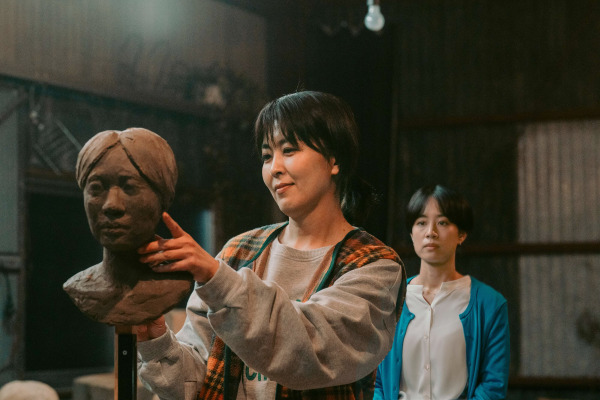
VERDICT: Low-key but spanning a symphony of disturbing themes from personal relations and wildlife conservation to the threat of war, Koji Fukada’s ‘Nagi Notes’ offers a fascinating, multi-faceted perspective on insular Japan today.
Curiously echoing the French comedy The Electric Kiss (La Vénus Electrique) which opened the Cannes Film Festival on a light-hearted, happy-ending, fairy tale note, Nagi Notes, the first film to screen in competition, also centers around the relationship of an artist – in this case, a woman sculptor – and her model. Only in Koji Fukada’s everyday world, the underlying soundscape is the somber sound of the Japanese Defense forces firing live shells in the midst of idyllic mountains, and the local economy based on farming is far from flourishing. But as one character remarks in resignation, “We ended up having to accept the military base, but we got a modern art museum built in return.”
This pretty well sums up the stoicism of the sparse residents of rural Nagi in Okayama Prefecture, an area of virgin hills and mountain trails interrupted by dairy farms on the brink of failure. Cannily filmed in the most ordinary of ways by D.P. Hidetoshi Shinomiya, nature here is shown as an integral part of people’s lives, like the homey weather bulletins read every morning by one of the characters who works in city hall.
According to the festival press material, Fukada adapted his story from a play by Oriza Hirata called Tokyo Notes, which was itself inspired by Ozu’s masterpiece Tokyo Story. One also feels the vibes of Harmonium, Fukada’s 2016 winner of the Un Certain Regard Prize, which showed how the increasingly intrusive presence of an ex-con destabilizes what seems to be a stable family.
In Nagi Notes, too, the story begins with: enter a stranger. Yuri (Shizuka Ishibashi) is a striking young woman in a fashionable raincoat and long skirt who appears on a country road out of nowhere, looking lost. Then a boy on a bicycle, Keita, recognizes her and takes her to Yoriko’s farmhouse down the road. The two women, who were childhood friends, meet many years. Yoriko (Takako Matsu) is a gifted artist who sculpts lifesize wooden figures from life, and unlike most films about art, it is obvious even to the untrained eye of the film viewer that she is a pure-blooded professional. Fukada dedicates several scenes to her labor-intensive work of turning a stump of aged camphorwood into a human likeness, a fascinating process that begins with a chainsaw, progresses to a chisel, and ends with an angry, sometimes destructive knife. Yoriko is a passionate artist, and she will destroy a piece she is not satisfied with.
She has summoned Yuri back to her hometown as a model for what is supposed to be a few days. In these years Yuri has made good as an architect, first studying in Tokyo and then working in Taiwan, though there are signs she feels unsatisfied with her work. As she sits quietly for her portrait in wood, bits of information connect the women in a web of family relationships. Yuri, we learn, was married to Yoriko’s brother until their recent divorce, and is hurting from his rejection. But Yoriko, too, has lost a woman she loved deeply, and carries the pain with her.
These tangled roots grow with the story of Keita and his best friend Haruki, whose boyhood friendship seems poised to turn them into a sexualized “couple”. Their little drama of becoming runaways in a big storm is handled with enormous respect and delicacy that looks at the two boys from many different angles at once. Precipitating their unwise decision to break free and leave home (they are in middle school) is Keita’s distress when he learns his father, who is employed in the military, is soon being transferred to another town. They confide in the outsider Yuri, and seem a little disappointed when she refuses to say whether she and Yoriko are or once were “a couple”.
Further complicating things is Haruki’s attractive single dad (Ken’ichi Matsuyama) whose attention to the unresponsive Yoriko seems like it might shift to the newcomer Yuri. In the midst of all this, Fukada subtly keeps the two women in the foreground, allowing both to earn and hold the viewer’s sympathy as artists and as women. The filmmaker has said he was greatly inspired by Jacques Rivette’s La belle noiseuse, and the relationship between artist and model is engaging throughout.
In the background, the entire story is underscored by that infernal booming of mortar fire from the unseen military base, perhaps a reference to Japan’s new spirit of militarization. The unsettling soundscape which is further contextualized in a radio news bulletin about the Russian war in Ukraine. This off-screen menace
irectly opposes the characters’ enjoyment of nature, the varieties of birds and pristine mountain views.
Director, screenwriter: Koji Fukada
Producer: Terutaro Osanai
Cast: Takako Matsu, Shizuka Ishibashi, Ken’ichi Matsuyama, Waku Kawaguchi, Kiyora Fujiwara
Cinematography: Hidetoshi Shinomiya
Production design: Yukari Otsuki
Editing: Sylvie Lager
Music: Lee Pei Chin
Production companies: Hassaku Labs (Japan), Survivance (France) in association with Star Sands (Japan), Nathan Cinemas (Philippines), MOMO Film (Singapore), Wonderstruck (Japan)
World sales: MK2 Films
Venue: Cannes Film Festival (Competition)
In Japanese
110 minutes