
All of a Sudden
Soudain
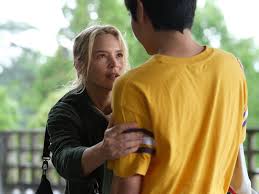
VERDICT: The lives of two idealistic women -- a visionary French caregiver and a Japanese theater director – briefly overlap in 'All of a Sudden', Hamaguchi Ryusuke’s long and challenging manifesto against the inhumanity of capitalism and the possibility of a better world.
All of a Sudden may come as a bit of a surprise to Hamaguchi Ryusuke’s worldwide fanbase, as the Japanese director takes off on a different tack once more, without losing his empathy for the human condition and the pitiful state it’s in, in the age of late capitalism. Premiering in Cannes competition, it follows his poignant tale of a theater director mourning the mysterious death of his wife in Drive My Car (Best Asian Film of 2021; best screenplay at Cannes) and his reflections on nature and human greed in Evil Does Not Exist (2023).
Clocking in at over 3 hours, Hamaguchi’s first French-language film seems to happen (despite its title) in slow motion. The story begins by chronicling the small clashes and upsets in a care facility for the elderly outside Paris, where the establishment’s bright young director Marie-Lou (Virginie Efira, fresh from a leading role in Asghar Farhadi’s Parallel Tales) labors to get the nursing staff on board her ambitious new project. It is called Humanitude and basically aims to treat residents like human beings, while it gets them “vertical”: standing and walking, despite the risks of falls.
And there are other risks involving the balance sheets. She meets with resistance from the home’s board of directors, because a bedridden resident gets more state funding than an active, mobile one. There is also to factor in the cost of training the staff in communications techniques that involve eye contact, touching and talking. The first hour of the film follows Marie-Lou as she fights through a cloud of vexations, which includes professional opposition from the senior nurse Sophie (Marie Bunel).
The narrative hook comes with a chance meeting in the park, where she gets off a tram to assist Tomiko, a severely autistic boy who has run off. This selfless gesture shows a different woman from the professional trying to impose her program on a dubious, underpaid staff. Tomiko’s beeper leads her to his actor-father Goro (Kyozo Nagatsuka) and Mari (Tao Okamato), a luminous young woman who is directing Goro in a play. It’s a one-man show based on the work of radical Italian psychiatrist Franco Basaglia, who proposed dismantling all of Italy’s psychiatric hospitals – and they did. The performance Marie-Lou attends is to revolutionize her life and work.
Mari, for her part, has studied philosophy in France, while Marie-Lou studied anthropology in Japan. The two women hit it off at once and pass an entire night together walking by the river and talking about their lives, their work and their future. This meeting of minds on a high level is carefully scripted and one of the most enjoyable parts of the whole film, with its unexpected flight of intellectual fancy. The fact that two women are exchanging their ideas deserves a cheer.
Then, in a scene really out of left field, Mari grabs a whiteboard and delivers a mini Ted Talk to her new friend on how the modern-day capitalist system works to enslave the masses of “outsiders” by stealing their free time, leading to an overworked, aging population and declining birth rate. It’s a daring thing to insert into a fiction film but it makes sense in the rarefied intellectual atmosphere that has been established. And her argument is very convincing.
Less convincing are some of the crazy coincidences that often interrupt the flow. One of these is the odd discovery that Marie-Lou speaks fluent Japanese. The reason given is that she studied in Japan, but the suspicion is strong that the film’s Japanese co-producers had a determining influence. A related puzzle is why the two women suddenly travel to Kyoto together, at the very moment Mari is very ill. This happens in the blink of an eye, for one wholly unnecessary scene.
In fact, their friendship is threatened by Mari’s illness: an old cancer has returned and metastasized beyond being operable, giving her less than three months to live. Tao Okamato’s utter elegance and self-containment neatly defuse the melodrama, though Hamaguchi has a hard time finding a new idea to close the film’s last hour; everyone simply goes back to business in the nursing home. What one remembers most from All of a Sudden is the uniqueness of the women’s relationship and their shining embrace of human rights — not just emotionally, but with their minds.
Director: Hamaguchi Ryusuke
Screenwriters: Hamaguchi Ryusuke, Léa Dimna based on a book by Maho Isono, Makiko Miyano
Producers: David Gauquié, Julien Deris, Kôsuke Oshida, Yûji Sadai, Renan Artukmaç, Jean-Luc Ormières, Hiroko Matsuda
Cast: Virginie Efira, Tao Okamato, Kyozo Nagatsuka, Kodai Kurosaki, Jean-Charles Clichet, Marie Bunel
Cinematography: Alan Guichaoua
Production design: Mila Preli
Editing: Azuza Yamakazi, Minori Akimoto
Music: Samuel Andreyev
Sound: Thomas Gauder, Pierre Mertens, Paul Heymans
Production companies: Cinefrance Studios (France), Office Shirous (Japan), Bitters End (Japan) in association with Arte France, Tarantuòa, Gap Busters, Heimatfilm, Same Player
World sales: Cinefrance International
Venue: Cannes Film Festival (Competition)
In French, Japanese
196 minutes