The Unknown
L'Inconnue
VERDICT: Arthur Harari’s fascinating and weirdly poignant fantasy ‘The Unknown’ takes body horror to metaphysical levels when an introverted photographer and a mysterious Léa Seydoux awaken from orgasm-induced unconsciousness to find they have exchanged bodies.
It may have been more of a shock for Kafka’s Gregor Samsa to awaken one fine morning to discover he had been transformed into a giant insect, but the characters in The Unknown (L’Inconnue) are not far behind in body horror, when after a violent sexual encounter at a party they discover their genders have undergone a metamorphosis.
Switching bodies is a daring premise for a film about sexual identity, rich as it is in references to modern concepts of gender fluidity, but the film is also intent on exploring a raw and quite frightening primal fear of the opposite sex. Director Arthur Harari, who authored the multi-awarded screenplay Anatomy of a Fall with Justine Triet, here works with co-screenwriters Lucas Harari and Vincent Poymiro to flesh out a kinky can’t-look-away story, without lowering it to the exploitative level of so many horror films. On the contrary, the story vaunts its own sort of poetry as the characters yearn for each other’s bodies, which once were theirs. For this reason it may have less grip on wide genre audiences than on the festival crowd; but in any case, Cannes competition is an auspicious start.
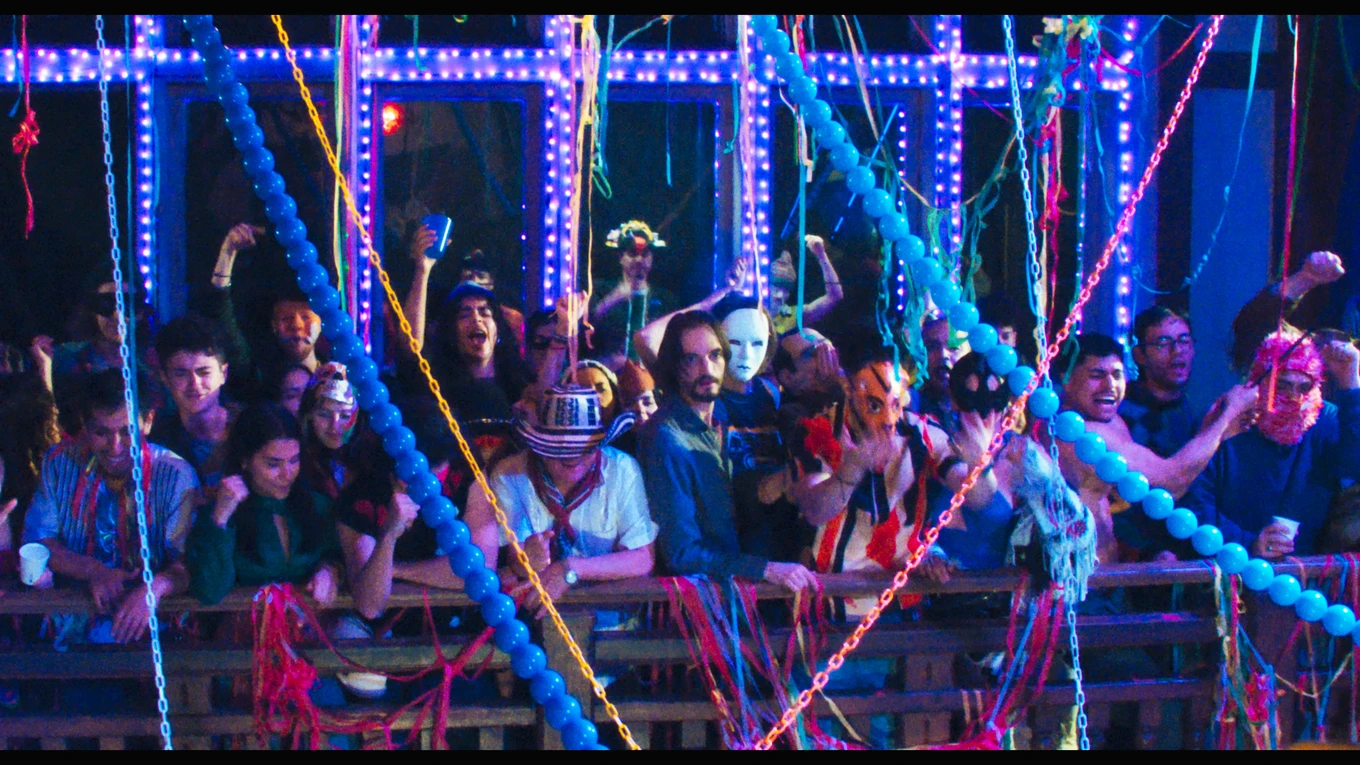
Though the POV keeps shifting, the main consciousness of the story is David Zimmerman (Niels Schneider), a melancholy photographer who is obsessed with the past. He finds the exact location of old French postcards and then photographs the modern eyesore industrial and high-rise architecture that has taken its place. A true recluse, he has to be dragged by his sister Alice and friends to a stunningly colorful masked ball, where a raving crowd demolishes a giant Trump head. Overflowing with masked guests, the party introduces a psychedelic atmosphere that is underlined when David is handed a pill by a stranger.
He takes it. Soon he is following a mysterious woman in a trench coat. Without speaking a word, Eva (Léa Seydoux) leads him into a dark basement and initiates a wild coupling that could be described as animal-like or demonic – the jury is still out on what is going on. David loses consciousness after a howling climax and when he comes to, he is horrified to find himself in Eva’s body.
The apparent senselessness of the changeover leads to all sorts of theories that will keep fantasy audiences entertained while the characters frantically look for a way to turn back into their original selves. As in Kafka’s story (or David Robert Mitchell’s It Follows, a horror film with some notable resemblances), at first everybody presumes the body change is a temporary inconvenience, possibly caused by an evil entity transmitting itself during intercourse. David, now in Eva’s body (the viewer needs to keep close track of who’s who), has some embarrassing encounters with family and friends before he realizes his only chance to change things back is to find Eva, now in his body.
So starts a non-stop chase through a series of French locations. As the situation becomes increasingly complex, panic sets in. A third body change happens, adding another young woman named Malia (Lilith Grasmug, Foreign Language) to the hunt, along with her excitable dad played vividly by director Radu Jude. Eva and David team up to more-or-less work together, they discover another possible victim who hints she has been re-embodied for years. That’s depressing.
Though this part of the film is structured and paced like a thriller, the protags are anything but action heroes. More in the tradition of experimental SF characters, Eva and David are alienated singles living in their own closed worlds. They are unable to communicate with anyone they love and care about, and unable to love each other because of an irremovable physical barrier. Perhaps that is the source of the film’s aura of bittersweet melancholy, a yearning for things just beyond one’s grasp.
There are undoubtedly loose ends in the story, perhaps red herrings to which one looks for meaning where there is none, like David’s Jewishness, the Bob Dylan song “It’s All Over Now, Baby Blue” over the end credits, the unseen evil entity… But despite some annoying trickery, the film reaches a miraculous, wordless conclusion of self-acceptance that feels just right.
Director: Arthur Harari
Screenwriters: Arthur Harari, Lucas Harari, Vincent Poymiro
Producer: Nicolas Anthomé, Lionel Guedj
Cast: Léa Seydoux, Niels Schneider, Valérie Dreville, Radu Jude, Shanti Masud, Jonathan Turnbull, Victoire Du Bois
Cinematography: Tom Harari
Production design: Emmanuelle Duplay
Editing: Laurent Sénéchal
Music: Andrea Poggio
Sound: Julien Tan Ham Sicart, Olivier Goinard, Fanny Martin, Jeanne Delplancq
Production companies: Bathysphere (France), To Be Continued (France)
World sales: Pathé Films
Venue: Cannes Film Festival (Competition)
In French
139 minutes