
Minotaur
Minotaur
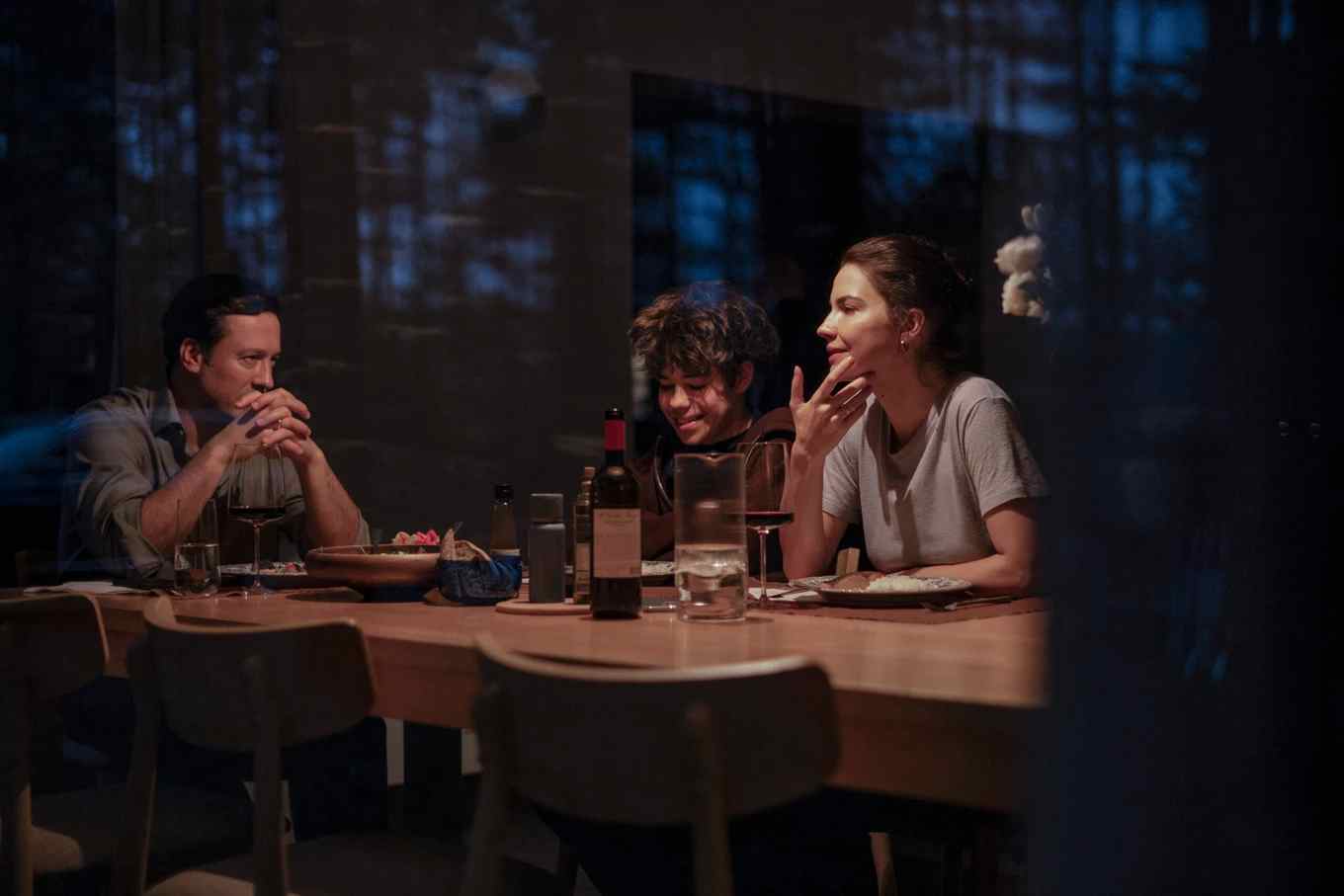
VERDICT: The mystery and ambiguity that director Andrei Zviaguintsev is known for peep out of ‘Minotaur’, in which marital betrayal and murder coincide with signs that the Russian war machine is creaking back to life.
A murder mystery set in Russia in the autumn of 2022, in a forested area presumably in the south, Minotaur is an impeccably stylish marital drama that features a bourgeois couple whose marriage is in crisis, until the sudden disappearance of the wife’s lover reignites the old flame between husband and wife in the emotions of a police investigation. Based on Claude Chabrol’s 1969 film La Femme infidèle, this love triangle has all the smooth suspense, black humor and cynicism of the original.
But Minotaur is much more than a twisted bedroom tale. Making it topical are its constant references to the “partial mobilization” of Russia’s military reservists, who are being rounded up to fight another war in Ukraine. Against a quiet background drumbeat that keeps returning to the soundtrack, the political subtext affords audiences a glimpse into a country that has been banned from film festivals for years, greatly enriching this multi-country coproduction.
Directed by the esteemed Andrei Zviaguintsev, it shares the writer-director’s deep love of nature with films like The Return, the 2003 Golden Lion winner in Venice in which a father takes his sons on a fishing trip through the Russian wilderness, and his 2014 Leviathan set among fishermen in a coastal town, awarded Best Screenplay in Cannes. The new film is very much set within a natural world, filled with denatured people. It opens with a shot of water rippling on a wide and windy lake, a short walk through the woods to the Morozov family’s modern, open-space home.
But there is trouble in this natural paradise. Galina (Iris Lebedeva), the beautiful young wife, resentfully takes brusque orders from her husband Gleb (Dmitriy Mazurov), a self-centered company owner whose aggressive posturing and passing resemblance to Elon Musk do nothing to make him likable. Only their teenage son Seriozha seems well-balanced. Galina is on her phone an awful lot and Gleb is beginning to get suspicious about what she does with herself all day. In a finely orchestrated scene in a fancy restaurant, they dine with two other couples who define the hedonism and tastelessness of their class. That night Galina comes close to telling her husband how unhappy she is. But her affair with a divorced photographer will not remain hidden for long.
Adding to Gleb’s tension are staffing problems in the office, which are about to get worse when his men start getting drafted. He is called to the mayor’s office along with a handful of other business leaders in the community to make a deal: they are being given the option to choose which employees will be called up, so it won’t disrupt their business too much. It is selective slaughter, literally the power of life and death. In a later scene, an official gives a heartfelt patriotic speech to an assembly in uniform that leaves no doubt as to the casualties they are expecting.
Like Zviaguintsev’s tale of corruption Leviathan, the title Minotaur can initially sound like overreach in its reference to Greek mythology. It was a creature part man and part bull who lived in the center of a labyrinth. Every so often the people of Athens were forced by King Minos to sacrifice 14 young nobles to the ravenous monster. In the film, 14 is the number of employees that Gleb is ordered to render to the government draft. But he outwits the authorities by hiring 14 new workers for non-existent jobs, just so he can cull them to fulfil his company’s draft quota.
In the second half of the film, Gleb shows equal mastery in solving the problem of his wife’s infidelity, and he does it in broad daylight surrounded by witnesses. Mazurov plays the entitled businessman without a single crack in the façade. The fact that a simple telephone call to the mayor fixes everything for him brings home, in its outrageous way, how far corruption has gone in Russia. As a police detective who has been investigating the photographer’s disappearance says with a good-humored shrug, “Why do we bother?”
The whole film is exquisitely shot by Zviaguintsev’s regular cinematographer Mikhail Krichman, who goes from spacious interiors haunted by shadows to the diffused green lighting of rain-soaked forests. Also notable is the nearly abstract music score of veteran composers Evgueni and Sacha Galperine, perfectly on theme with its unsettling bursts of notes.
Director: Andrei Zviaguintsev
Screenwriters: Simon Lyashnko, Andrei Zviaguintsev
Producers: Charles Gillibert, Nathanael Karmitz, Marco Perego, Vindhya Sagar, Andrei Zviaguintsev
Cast: Dmitriy Mazurov, Iris Lebedeva
Cinematography: Mikhail Krichman
Production design: Andrey Ponkratov levia
Music: Evgueni Galperine, Sacha Galperine
Sound: Andrei Dergatchev
Production companies: MK2 Productions (France), CG Cinéma (France), Arte France Cinéma, Aslanyurek Film Production (Turkey), Forma Pro Films (Estonia/Latvia), LEAF Entertainment (US), Razor Film Produktion (Germany)
World sales: MK2 Films
Venue: Cannes Film Festival (Competition)
In Russian
160 minutes