
Where the Wind Comes From
Tunis Djerba
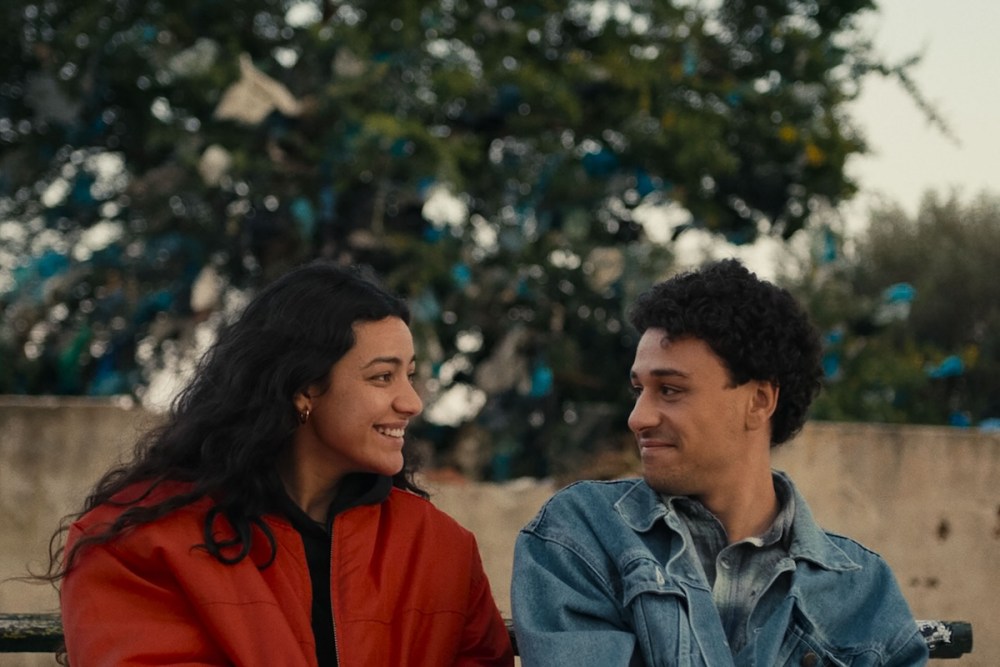
VERDICT: Amel Guellaty’s 'Where the Wind Comes From' is a vibrant road movie combining humor, fantasy, and charismatic performances of two young people determined to imagine their freedom beyond social restraints and economic crisis.
Two close friends travel to Djerba, Tunisia with the plan to pursue an unlikely escape route, in Amel Guellaty’s spirited feature debut. Where the Wind Comes From premiered at Sundance in the World Cinema Dramatic Competition and will compete in the official competition at the Amman International Film Festival. This light comedy-drama offers some laughs without being politically heavy-handed, yet its coming-of-age framework opens onto a colorful examination of imagination and friendship, as well as the shrinking margins where Tunisian youth can move freely beyond repression and economic inequality.
Mehdi (Slim Baccar) and Alyssa (Eya Bellagha) live in a working-class district on the outskirts of Tunis. The two childhood friends are trapped in a cycle of indecision and loss. Mehdi is a shy artist who lacks confidence, approaching life cautiously as he waits for a secure job in the government. Meanwhile, Alyssa is restless, bold, and refuses to accommodate the patriarchal gaze and familial restrictions. Both discover that conforming to bureaucratic expectations and gender roles offers them no future, and is an obsolete way to approach life. After Mehdi’s portrait of Alyssa is selected for an art competition, they both travel to Djerba hoping that the drawing wins him an artistic residency in Germany so they can go to Europe. Alyssa sticks with Mehdi, believing he is her winning ticket to the shores of Europe. When the portrait gets to the final round, they decide to travel through Sousse while heading south to Djerba: this is the start of Guellaty’s road movie.
This road trip allows both protagonists to navigate social and geographical borders. In Sousse, they encounter different visible forms of comfort and freedom where wealth provides access to comfort, status and greater social and sexual freedom. The journey also exposes how the posh Sousse echoes a lot of the societal ills in contemporary post-2011 Tunisian society, such as harassment, class inequality, the attraction of migration — all of which are elements that Guellaty approaches organically in the script rather than placing them under an obvious spotlight.
This is one of the screenplay’s strengths, as the pressures are spotlighted through the contrasting personalities of the characters. For example, Alyssa pushes back against every challenge she faces, yet beneath her rebellion lie grief, fear and a heavy burden, as she is left to care for her depressed mother and younger sister after her father’s death. Playing Alyssa, Eya Bellagha balances humor with rage in a complex, non-archetypal portrayal of Arab women. The character is energy that propels the friends through their journey. Her performance reinforces Guellaty’s argument that Tunisian youth have been overburdened throughout the years in a region where vulnerability is systematically exploited.
Her partner in crime, Mehdi, played by Slim Baccar, presents a very effective counterpart. While Alyssa makes noise (physically and emotionally) to take space in society, Mehdi has survived by strategically making himself smaller, giving the road trip an a complex emotional depth. The strength of this duo is tested on the road, and their platonic friendship is also tested and deepened, which arguably is the film’s way to highlight the shape of freedom. Friendship becomes a private space where both characters do not have to mask a certain role and façade.
Another idea skilfully woven into Guellaty’s filmmaking is imagination as a form of refuge. The fantasies that Alyssa and Mehdi share are visually well-embedded and executed in the film, creating a space in which storytelling becomes a tool for young people deprived of choices, to resist the absolutism of their destinies. This imaginative register is translated through cinematographer Frida Marzouk’s lens, for example, the sharp contrast between Alyssa’s wardrobe, often a warm red colour, while Mehdi’s is a more blueish mist ambiance. A similar contrast emerges between Tunis, where the possibilities for life appear limited, and Sousse where landscapes, wealth, and proximity to Europe gives space for momentary relief.
Where the Wind Comes From describes Europe as a seductive horizon. However, the film avoids asserting that leaving is the solution to all the characters’ problems. This is a smart choice by the director, who allows her protagonists to carry political significance without depriving them of agency or afalling into a preachy, tell-not-show approach. That does not mean that Guellaty offers an easy triumph. She investigates the tiresome moments of despair, while presenting friendship and imagination as forces capable of keeping hope for a better future alive.
Director, screenwriter: Amel Guellaty
Cast: Eya Bellagha, Slim Baccar, Sondos Belhassen, Lobna Noomene
Producers: Asma Chiboub, Karim Aitouna
Cinematographer: Frida Marzouk
Editors: Amel Guellaty, Ghalya Lacroix, Malek Kammoun
Music: Omar Aloulou
Sound: Aymen Labidi
Production designer: Khalil Khoudja
Costume designer: Shehrazad Methenni
Production companies: Atlas Vision Productions, Haut les Mains Productions
International sales: Films Boutique
Arab distribution: MAD Distribution
Venue: Amman International Film Festival
In Arabic
99 minutes