
A Man of His Time
Notre salut
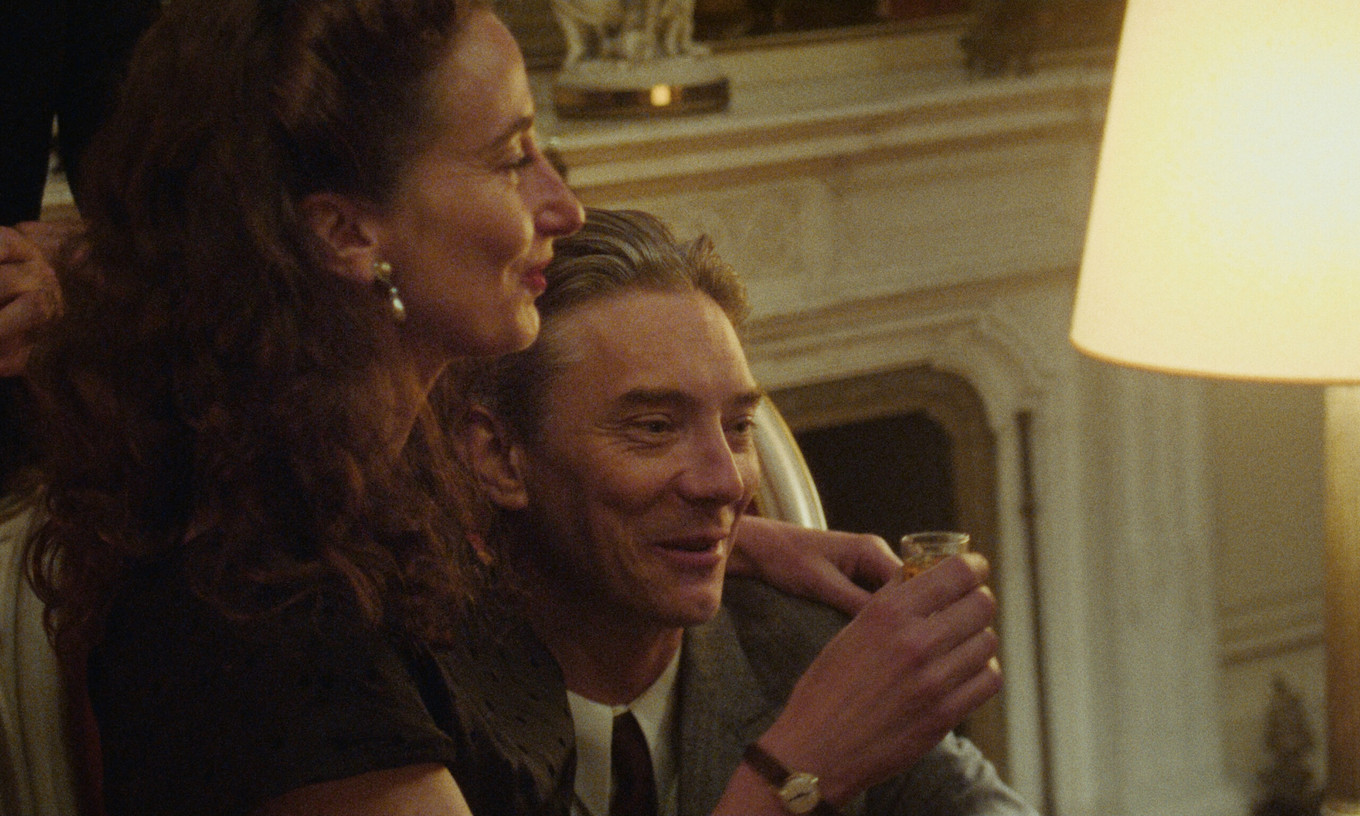
VERDICT: The short-lived Vichy government in France, created in partnership with Nazi Germany during WW2, is brilliantly brought to life through the eyes of a civil servant who makes a career out of conforming to the fascist state, in Emmanuel Marre’s impressive second feature ‘A Man of His Time’.
This year’s Cannes competition will be remembered, among other things, for two extraordinary films that still have something important to say about the Second World War. After Pawel Pawlikowski’s Fatherland used Thomas Mann’s first visit to his native Germany to expose Europe’s bitter post-war aftermath, Emmanuel Marre’s A Man of His Time uncovers the banality of evil at the very heart of the Vichy government, among the morally-lacking under-secretaries of Marshal Pétain’s cabinet.
This portrait of an era unfolds with implacable deliberateness over a two and a half hours, as it explores the rise and fall of Henri Marre, an ambitious would-be leader of men who smooth-talks himself into a job in the Vichy machine. The leisurely pace is set by the regulated lives of civil servants and is likely to be off-putting for many, particularly non-Europeans who may struggle with the basic history that underlies the film. A tighter structure would probably have helped sustain interest.
The original French title is Notre salut (literally, Our Salvation), which is also the title of the book on modern government management self-published by one Henri Marre. He is vividly embodied with pushy self-confidence by Swann Arlaud (who played the lawyer in Anatomy of a Fall). Henri was, in fact, the director’s great-grandfather, and the wartime letters he exchanged with his wife Paulette (Sandrine Blancke) provide the story with a unique background realism.
Yet however intimate the letters may sound, the writer-director shows little interest in becoming the biographer of his ancestors. The net is cast much wider, with Henri a representative “man of his time” who is initially down on his luck, but whose belief in himself, persistence, and willingness – as he announces to a minister – to do absolutely anything in the service of his country, all conspire to get him attached to the ministry of unemployment. This becomes the viewer’s vantage point on how Vichy was run, with its nauseating “partnership” with Nazi Germany and all the attendant compromises this made necessary. These included thousands of workers who were allowed to be snatched by German military forces and transported to Germany as forced labor, piled up like cattle in overcrowded trucks. When one of the officials under Henri uses ministry funds to buy straw and chamber pots to ease the deportees’ horrible journey, he is fined for his compassion by our hero. “Those are the rules,” says Henri archly.
This is just the second feature directed by Emmanuel Marre and an ambitious leap in itself from his first film about a low-cost flight attendant, Zero Fucks Given, codirected by Julie Lecoustre. Working with D.P. Olivier Boonjing and production designer Anna Falguères, he recreates with dazzling verisimilitude France between 1940, when Germany occupied the north of the country and a “free zone” was established in the south supposedly governed by the French, and the Allied liberation in September 1944. While the officials in Vichy live well, Paulette and their three children suffer from hunger and cold, until Henri brings them to live with him. In one of the film’s rare uses of archive footage, huge crowds gather in the streets to salute Pétain. The excited faces look like something out of Leni Riefenstahl. But even the minor characters are carefully individualized, adding to a convincing period look and feel. A tip of the hat to costume designer Prunelle Rulens for Henri’s characteristic dandy look.
There are a few odd moments when the illusion breaks, generally because a modern song is injected or, in a party at the mayor’s house, when Paulette leads the guests in a dance that may or may not be from the Forties, but feels contemporary. The scene is more an expression of freedom on Paulette’s part, which in itself seems unusual in the conservative context, but Sandrine Blancke carries off small acts of rebellion well. As Henri, Arlaud is consistently subordinate to his wife’s strong opinions. It echoes his extreme ethical flexibility on the job. Decision by decision, his survivor’s instinct takes him deeper into following the bosses’ orders, which eventually include building labor camps for foreign workers and excluding Jews from jobs for the “French”.
It’s no spoiler to say Vichy ended with the Allied victory; the American landing in Normandy was a turning point that sent officials like Henri scrambling for cover. The film ends with a mystery, however, and there is no sense of closure, only a little boy for whom the past and future do not exist.
Director, screenwriter: Emmanuel Marre
Producers: Sébastien Andres, Alice Lemaire, Alexandre Perrier
Cast: Swann Arlaud, Sandrine Blancke, Jean-Baptiste Marre, Harpo Guit, Mathieu Perotto, Mathilde Abd-el-Kader
Cinematography: Olivier Boonjing
Production design: Anna Falguères
Costume design: Prunelle Rulens
Editing: Nicolas Rumpl
Sound: Antoine Bailly
Production companies: Michigan Films (Belgium), Kidam (France) in association with Condor Distribution, Les Films Oelleas, Unité, Les Films de Pierre (France), Orange Proximus (Belgium), The Ink Connection, Be TV (Belgium), France 2 Cinéma, RTBF (Belgium)
World sales: Charades
Venue: Cannes Film Festival (Competition)
In French
155 minutes