All About the Money
All About the Money
VERDICT: James “Fergie” Chambers lets it all hang out in this unique portrait of a super wealthy revolutionary.
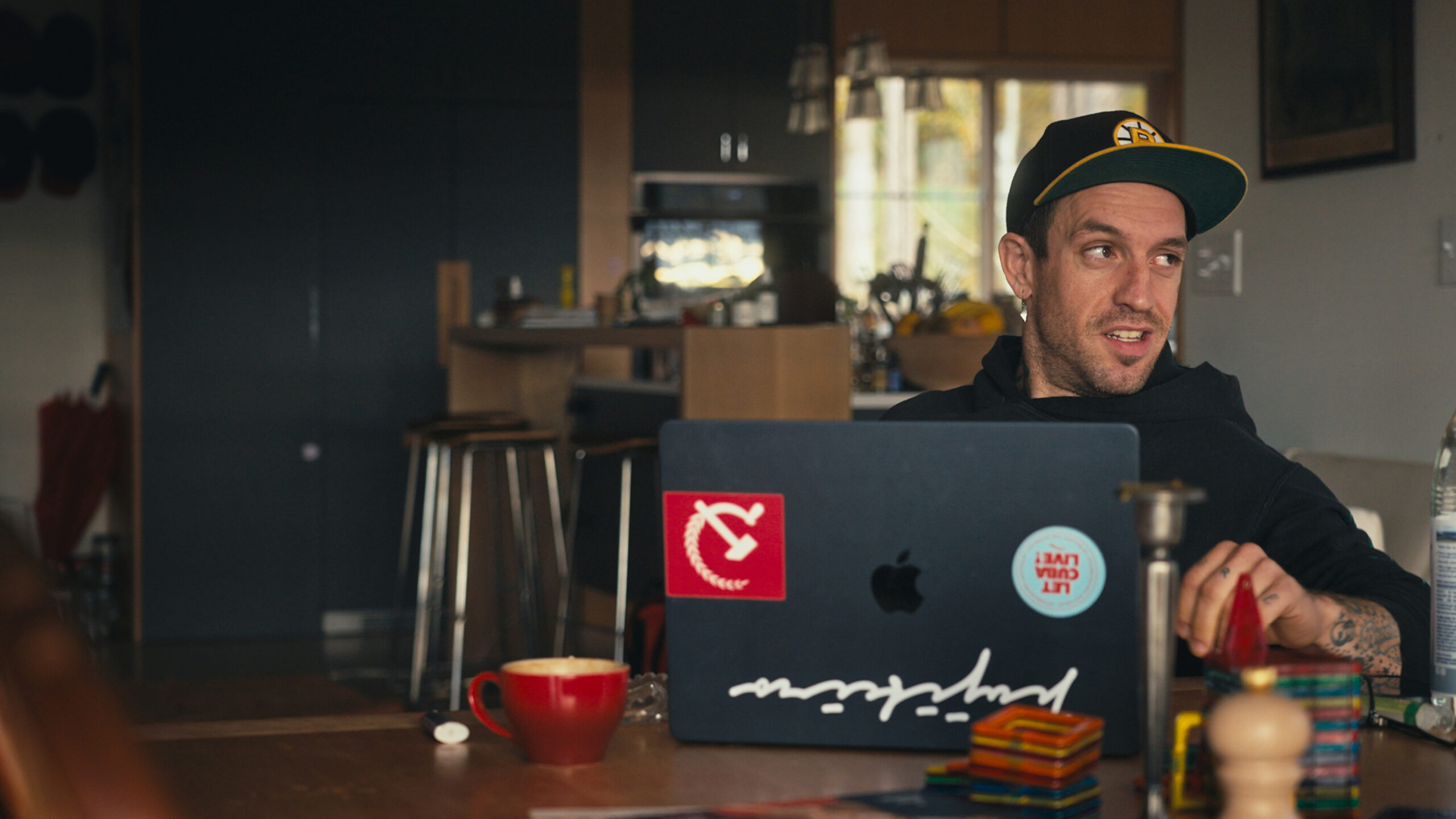
Most people would love to have James “Fergie” Chambers’ problems. The former heir to the Cox dynasty, he’s a millionaire hundreds of times over who has grown disillusioned with capitalism. James declares himself to be a communist activist, even as he continues to live among the 0.01%. Is he a revolutionary dilettante or truly devoted to the cause? Sinead O’Shea’s fascinating documentary All About the Money doesn’t settle on easy answers as it presents a captivatingly complex profile of a man who wants to rage against the very machine he perpetuates.
The film begins two years ago in the bucolic surroundings of Alford, Massachusetts. It’s here that James launches a Marxist-Leninist dream — a fully-funded compound, where he pays the residents to work the land and live collectively. At its heart — in a move that would make both Bob Ferguson and Sensei from One Battle After Another proud — is a jiu-jitsu gym that will “prep professional revolutionaries.” To his credit, James puts his money where his mouth is. He buys a handful of properties and allows a half dozen residents, aligned with his ideals, to live there for free. They’re each given a stipend and commit to trying to enact some kind of vision of a non-capitalist utopia. No one scrutinizes too closely or seems to notice that the commune’s socialist/communist mission is vaguely defined, nor that its existence rests on an uber-wealthy benefactor. Perhaps that’s because no one is more excited than “Fergie” himself, whose allegiance to all things Marx/Lenin runs from the tattoos across his body to following the Russian Orthodox Church. But it doesn’t include living among his fellow agitators.
Everything changes on October 7, 2023. In a heartbeat, James founds Palestine Action US (now known as Unity of Fields) and most of his communist cohorts take to the streets to protest the genocide in Gaza. This soon leads to direct action, resulting in a protest at the offices of weapons manufacturer Elbit in Merrimack, New Hampshire. Arrests are made, charges are laid, and James packs up and moves to Tunisia — a country that coincidentally doesn’t have an extradition treaty with the United States. There he radically changes his life. He converts to Islam and invests millions in a local, debt-ridden football club, saving the team. In short order, he becomes a local celebrity. He watches football matches from his private box, dining on fine food, as fans riot in the stands to his visible enjoyment. Suddenly, it seems as if he’s feasting on life’s excesses in the same way Jordan Belfort might. It hardly looks like the actions of a man ready to tear down the system from which he benefits so abundantly.
So just who, exactly, is the real James “Fergie” Chambers? Allowing himself to be put front and centre of the documentary, James is disarmingly candid about his own failures. He’s the first to admit the inherent hypocrisies and fundamental flaws of a white man from a background of extreme privilege attempting to stoke change among the proletariat. Some may take issue that O’Shea doesn’t interrogate him more intensely, but it’s a canny choice. By not boxing him into an ideal of who he should be, the filmmaker lets James reveal himself as the magnetic, troubling, charming, and maddening person that he is.
The film’s conclusion is marked by two revelatory episodes. The first is a final interview, at James’s request, where he lays bare secrets and traumas of his adolescence that have colored his way of moving in the world as an adult. The final grace note is that, for all his candor, he offers to cover the film’s production cost and pay the director a fee to prevent All About the Money from being seen. O’Shea refuses and James relents. It’s an interesting turn from a man who has long maintained that the wealthy hold on to their power by keeping their indiscretions private, and a man who has spent his life bucking against that rule. And while one suspects this won’t be the last we hear of “Fergie”, his greatest move to come may be the one where we don’t see his hand in it at all.
Director, screenplay: Sinead O’Shea
Producers: Sinéad O’Shea, Claire McCabe, Harry Vaughn, Katie Holly, Sigrid Dyekjaer
Editing: Enda O’Dowd
Music: George Brennan
Production companies: SOS Productions (Ireland), Real Lava (Denmark)
Venue: Sundance Film Festival (World Cinema Documentary Competition)
In English
95 minutes