An Interview with Sinead O’Shea
An Interview With Sinead O'Shea
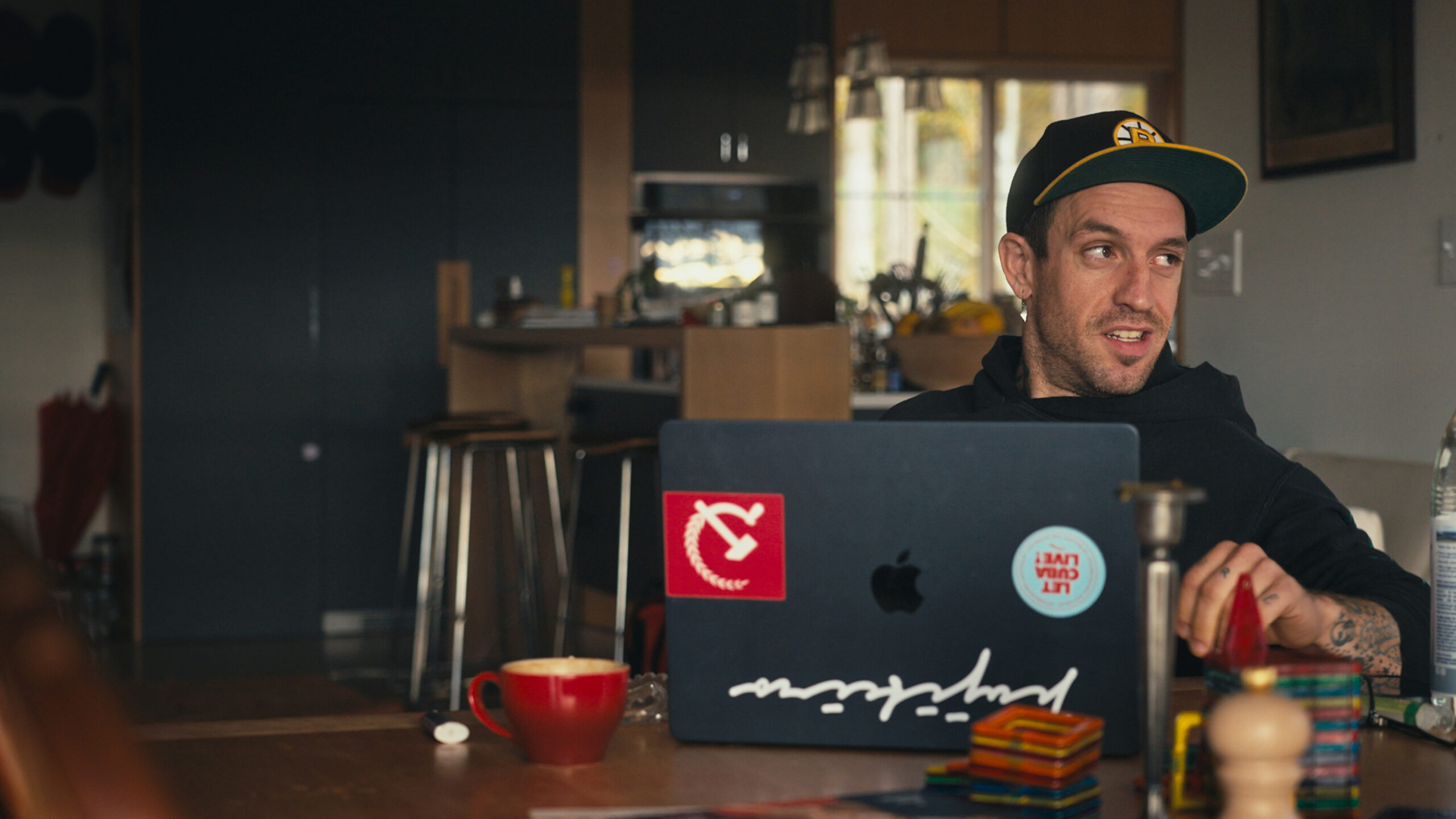
VERDICT: The director of 'All About the Money' discusses profiling the radical politics of James 'Fergie' Chambers.
James “Fergie” Chambers is not your ordinary revolutionary. An heir to the Cox empire, he consciously uncoupled from Cox Enterprises, cashing out his share for hundreds of millions of dollars. From there, he funded a communist compound in Alford, Massachusetts, which serves as the starting point for Sinead O’Shea’s documentary All About the Money, an absorbing piece of reportage in which Fergie himself lets viewers into his world, thoughts, and dreams of dismantling capitalism. We spoke with the director before the film’s world premiere at the Sundance Film Festival and her complex relationship with the man at the centre of her picture.
“I just thought it was an amazing story,” O’Shea says about the decision to pick up a camera and profile Fergie. “This man who was from one of America’s richest families who were so emblematic of the establishment…I was very curious to know more because he was so opposed to their way of being.”
Deeply knowledgeable in Marxist/Leninist theory, highly opinionated, and politically driven, Fergie is not one to take half-measures when it comes to putting his words into action.
”It certainly wasn’t just rhetoric, he was following through,” O’Shea says. The director reached out through Instagram to Fergie, who became a willing subject for the film. “He’s such an interesting person because one of his great principles is that rich people hide in discretion. And one way in which he wants to upset the order is to speak out. So for him, it is a political act to be so frank.”
In an era of deep political division, it may seem counterintuitive or even contradictory for someone like Fergie to pontificate so openly. But there is something refreshing throughout All About the Money in having access to a member of the 0.01% who is frank and unguarded in his views.
“I don’t know how he interacts with other people, but I found him very open. As I say, it is a political position for him to share. And he is someone who wants to be understood. And he is somebody, I think, who’s embodying very complex and sometimes paradoxical positions,” the filmmaker explains. “So I think it’s quite vital to his sense of being to be able to explain [his positions] and to make [them] comprehensible. And I was willing and really enjoyed listening to him.”
As the film progresses, the events in Gaza shift the narrative trajectory, as James Chambers decamps to Tunisia after a direct action protest at Elbit offices leads to some of his comrades being arrested. While there, he invests in a local soccer club, and for a spell visibly enjoys and embraces the accoutrements of the super wealthy. And while some may use this as a weapon to knock Fergie’s dedication to change, O’Shea takes a more measured view.
“He is generally somebody who does own the contradictions of what he’s trying to do. He is definitely a class traitor. But he’s still bound by certain realities of the wealth that he possesses,” she explains. “I felt it was important to just let him articulate that and I also felt it was important for this to be a film that I could leave for others to understand, because I feel the world is teeming right now with opinion pieces and they’re actually not that useful. And what we need is some kind of objective reportage. And that’s become very political. It’s become very political to just tell the truth. And it’s actually very difficult to just gather all this material and present it as faithfully as possible. This film is very difficult to categorize it’s very complex and it’s actually, I think, kind of quite old fashioned almost. It’s actually a document of reality that I witnessed.”
Despite Fergie’s willingness to appear on camera, towards the end of production, he attempted to buy out the film and O’Shea to prevent the movie from being released. The director declined and Fergie relented, but it turns out it wasn’t because he was worried about anything he shared in the movie — rather, he would’ve preferred more of it.
“I wasn’t aligned with Fergie about all his politics, but at the same time, it was not my place to cancel him [or] interrogate [him] because it’s all part of that story. And those political beliefs are absolutely central to him,” O’Shea says. “The reason he didn’t like the film was because he felt there wasn’t enough politics in it. [Fergie felt] I watered down the politics a little. And so I really want to acknowledge that and own it [but] I don’t believe that I did. And we can agree to disagree, which is a phrase he despises. I don’t think I’d watered down his positions, you know, on Israel, say, or on Donbass or Putin, but he felt there just wasn’t enough of it in the film.”
As the picture ends, the future looks uncertain for Fergie, who is currently settled in Ireland. One wonders if he’ll continue to be the public face of the politics he supports, or choose to operate behind the curtain. Even O’Shea can’t venture what Fergie might do next.
“My feeling is that he’s going to [continue] funding a lot of political action [but] he’s done his time sort of articulating his positions,” the director says. “He’s very, very committed, but I think he’s just looking at a way now of doing things in in which he can be as most effective. I feel like I’m going to this premiere tomorrow so blind, you know? What will people think? [Will] people start booing? Will they start cheering? Because that’s the thing with him. I believe he says things that really connect with people.”