Cruel Optimism
.
VERDICT: If Ruben Ostlund directed 'My Dinner with Andre' in Asia, you might get the coolly inquiring 'Cruel Optimism', an experimental film commenting on the visual arts scene.
Somewhere around the middle of Cruel Optimism, a semi-experimental feature film from first-time feature director Shin Mokya, a Gen Z student named Jaewon lashes out at a stranger and then asks her teacher if she’ll become like the artist SeongJae, who she’s been invited to come meet. It’s not a complimentary sentiment.
The student’s not sure she wants to engage in what she describes as “bowing to whoever gives you money, just hoping to become famous”. That is one conversation in a film made of several conversations around and about the art ecosystem. Think of Cruel Optimism as My Dinner with Andre directed by Ruben Ostlund and set in contemporary Asia.
Shin is a much less caustic filmmaker than the Swedish director, though both are interested in the art scene—which, of course, is the milieu that has birthed and supported them. According to a bio provided by the JEONJU Film Festival, the director used to be a journalist which, perhaps, explains his film’s questioning undertone. He’s now an MFA student, another detail reflected in some of the film’s conversations.
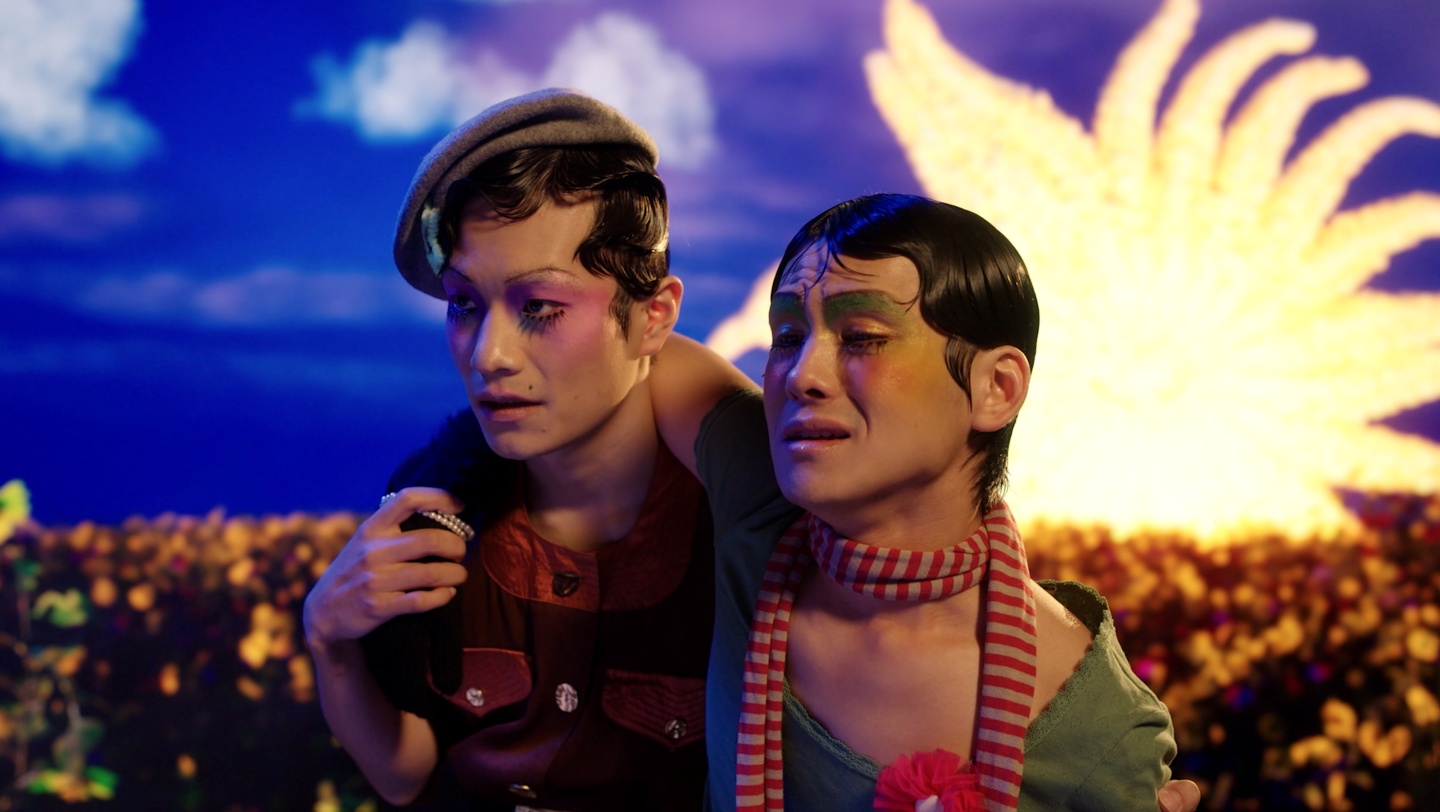
Cruel Optimism, however, is not a succession of conversations exclusively. Between scenes and sometimes within scenes, Shin drops in audiovisual clips and quotations from persons around the global art structure. In this way, the film itself takes the form of an art project itself, a collage, an exhibition of sorts. It is from one of these insertions that the film derives its rather unrevealing title. Cruel optimism, according to an onscreen quotation attributed to the late American culture theorist Lauren Berlant, who published a book in 2011 with that title, refers to the kind of attachment to “a certain object or state with hope, but the attachment actually hinders one’s growth and development and can even become a relationship that ruins one’s life.”
What does this mean in the context of the film we are seeing? Who knows?
The insertions are made without commentary, which is a move that will surely force a certain type of viewer to figure out (or even conjure) a relationship. Could, for example, the Berlant quote be about the affinity some artists have for making peculiar art even though fame and fortune aren’t promised? Or maybe the inserts are riffing on the art scene in general? Or maybe these fragments are included for purely aesthetic reasons. Again, who knows. But even if meaning is scarce, this unconventional arrangement suggests Shin (who is writer and director and editor) may have deliberately crafted a form for his film in a manner that resembles its subject, art, making several interpretations possible. In short: he’s made a visual art piece that comments on the visual arts scene.
This is clever, experimental, filmmaking. But there is a drawback for every cinematic project that engages the head and not quite the heart: limited appeal. So while Cruel Optimism will play exceedingly well in festivals with an affinity for the uncanny, its wafer-thin narrative means all but a specific type of audience are not invited to the party. This may not be a such a terrible thing for director Shin. If some of the dialogue he gives his characters is indicative of his own mindset, then he is obviously aware that (art) projects like the present film can’t have too many fans.
Cast: Moon Hyein, Go Jaehyun, Lee Jooyoung, Jang Yohoon, Kim Minsic
Director, screenwriter, editor: SHIN Mokya
Producer: Kim Youngin
Cinematographer: Jang Wonwoo
Venue: Jeonju International Film Festival (Korean Competition)
In Korean
61 minutes