
Flies
Moscas
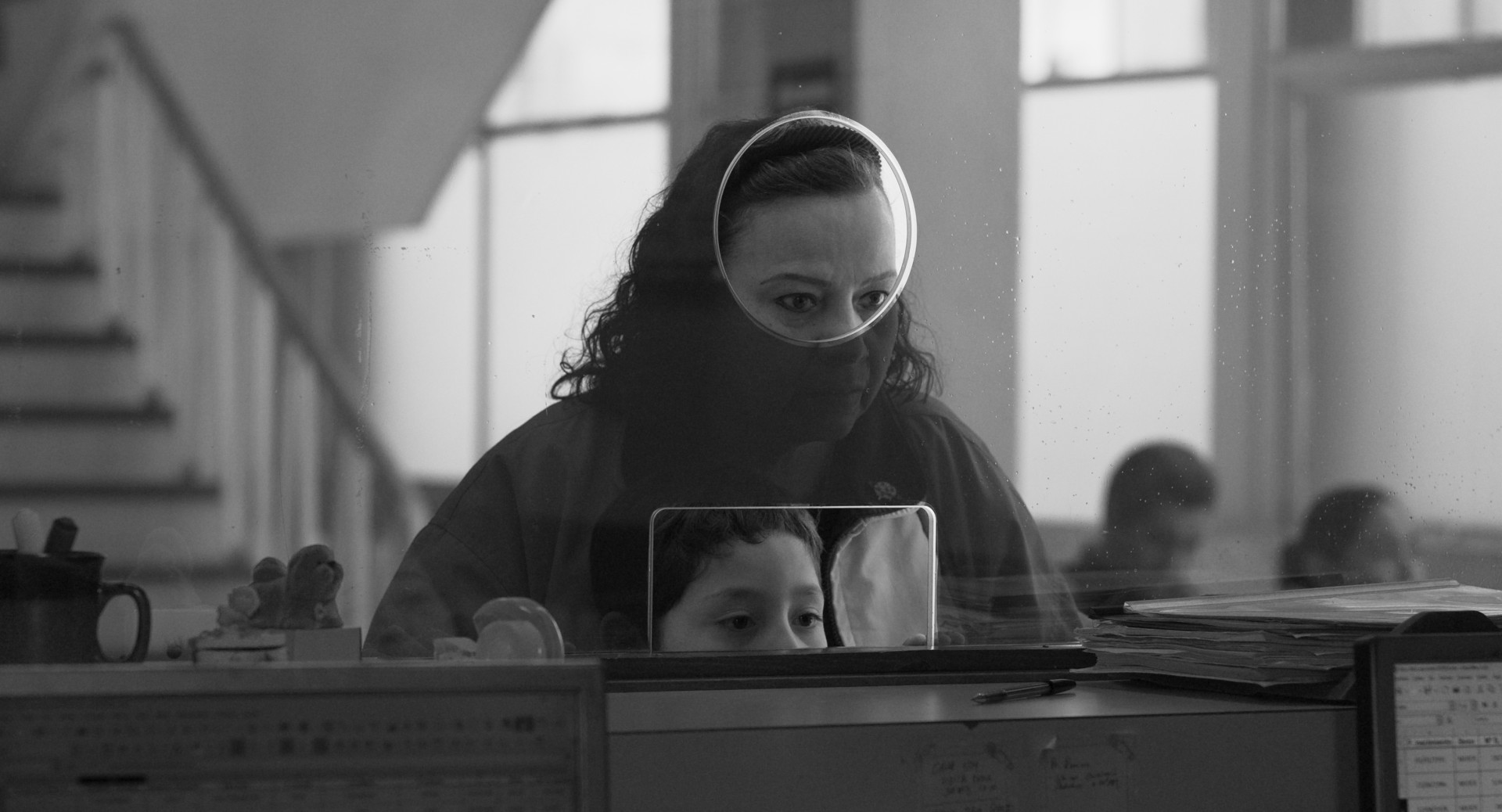
VERDICT: Against a background of endemic poverty and hardship, award-winning Mexican director Fernando Eimbcke weaves a charming, often comic tale of love, loss and loneliness around a solitary woman and her two temporary lodgers in 'Flies'.
Flies and their irritating buzzing are the bane of a summer day, and they provide the first scene of perfectly timed silent comedy that opens Flies (Moscas), the story of how a man and his 9-year-old son precariously lodge with a reluctant, cold-eyed landlady while the boy’s mother is in the hospital. With a story this simple and gentle, it is a film that will appeal to children as well as adults, who will enjoy the same humor but may catch more nuances.
Directed in sharp-edged black-and-white with seemingly effortless precision by Fernando Eimbcke, it marks the writer-director’s welcome return to a Mexican setting after his 2025 Olmo, a teen comedy set in the United States, made few waves. Flies harks back to his first three extraordinary films — Temporada de patos shown at Cannes, Lake Tahoe which bowed in Berlin competition where it won the Alfred Bauer Prize and the FIPRESCI award, and Club Sandwich which won the Golden Shell at San Sebastián. Pushed by the director’s reputation, the new film looks ready to embark on a lively flight to global festivals after another premiere in Berlin competition.
Olga (Teresita Sanchez from Dos Estaciones) is a stone-cold woman living alone who is entirely focused on her tidy apartment and her middle-aged aches and pains. To make ends meet, she rents out a room to Tulio (Hugo Ramirez), whose wife is in a nearby hospital, but he omits to mention he is traveling with his son Cristian (Bastian Escobar). The father and son have a disarmingly close relationship; since children are not allowed in the hospital, they spend much of the day roaming the streets of the city, eating in cheap diners, and even sharing sandwiches sitting on the curb between parked cars. Dad has a childlike energy while he’s with the boy. But he draws the line at wasting money, which is barely enough to buy his wife’s medicine, when Cristian discovers an arcade game he loves from the 1990’s, Cosmic Defenders Pro. It is to become his obsession.
It doesn’t take long for Olga to discover the boy’s presence in her house and she gives Tulio an ultimatum. One of her house rules is that she will not listen to stories of patients’ illnesses, and she cuts them no slack even when Tulio is forced to leave town to earn more money. The dignity Ramirez brings to this role is astounding, but it doesn’t move Olga a bit. In her heartless self-protectiveness one feels the echo of Dora, the cynical letter-writer for the illiterate in Walter Salles’ Central Station (1998), a seminal work of Latin American cinema. But just as Dora got involved in spite of herself in a young boy’s search for his father, Olga finds herself drawn into Cristian’s all-consuming desire to see his mother. Where once she threatened Tulio with calling in the police if he didn’t vacate his room by the weekend, now she casually breaks the law, brandishing a false document to get Cristian into the hospital.
Though Olga’s turn-around with the boy is easily foreseeable as part of the film’s structure, her own inner transformation is beautifully and surprisingly rendered. Sanchez’s body language tells all when she puts on a record and dances the cha cha with Cristian, her face opening up for the first time in a wide-open smile that dazzles.
The film is full of battles, small and big, and there will be winners and losers. As we know from the beginning, Olga’s fight against pesky flying insects is unequal; she will never defeat them. Repeated, obsessive returns to the Cosmic Defenders machine is the literal equivalent of this endless struggle, involving all three characters before the story is through. In a scene that is deeply moving because it is so underplayed, Tulio uses the self-multiplying space invaders from the game to explain to his son how cancer cells proliferate in the human body.
It is also a film of few words and many resonating images. Maria Secco’s black-and-white cinematography illuminates the apartment complex with its aging windows and stairs, turning it into familiar territory while leaving the feeling of a world out of the past. In place of music, Eimbcke gives space to Javier Umpierrez’s astute sound design, creating a noisy urban universe of sirens, alarms and neighbors’ noise. It is a choice that underlines the feeling of background uneasiness that never stops.
Director: Fernando Eimbcke
Screenwriters: Fernando Eimbcke, Vanessa Garnica
Producers: Erendira Nunez, Michel Franco, Fernando Eimbcke
Cast: Teresita Sanchez, Bastian Escobar, Hugo Ramirez
Cinematography: Maria Secco
Production design: Alfredo Wigueras
Costume design: Gabriela Fernandez
Editing: Salvador Reyes Zuniga, Fernando Eimbcke
Sound design: Javier Umpierrez
Production companies: Teorema (Mexico), Kinotitian (Mexico)
World sales: Alpha Violet (France)
Venue: Berlin Film Festival (Competition)
In Spanish
99 minutes