
Hope
Hope
VERDICT: Korean director Na Hong-jin's gonzo sci-fi action comedy is a wild rollercoaster ride loaded with just enough famous names, lowbrow jokes and blood-splattered thrills to excuse its thin plot and cartoon characters.
South Korean director Na Hong-jin reaches for big, brash, blockbuster territory with his gonzo sci-fi action comedy Hope, probably the most incongruous film to compete for the prestigious Palme d’Or in Cannes this year, and arguably any other year. Headlined by a core cast of Korean box-office heavyweights, including former model and Squid Game co-star Jung Ho-yeon, this high-energy monster movie also features a handful of bizarre CGI supporting roles by Michael Fassbender, Alicia Vikander, Taylor Thompson and others, which strongly suggest the film-makers have sequel ambitions.
Na has a solid commercial track record in Korea, plus prize-winning form in Cannes. Following The Chaser (2008), The Yellow Sea (2011) and The Wailing (2016), his latest feature marks his fourth visit to the French festival, and his first time in the main competition. Reportedly the most expensive film in South Korean history, Hope is also Na’s most full-throated crowd-pleaser to date, packed with breathless extended action sequences, high-calibre stunt work, world-class production design and rowdy slapstick humour.
That said, Hope is also disappointingly light on plot or character psychology, lacking the deeper socio-political bite that international audiences have come to expect from festival-friendly genre films in the wake of Get Out (2017), Parasite (2019), The Substance (2024) and others. Never mind subtext, there is barely even text here. Some of the CGI monster effects also look oddly cheap and clunky, while the relentless wham-bang action become a little exhausting over the film’s unwieldy 160-minute span. Hope is not pitched at art-house connoisseurs but, judging by its generally warm reception in Cannes so far, it has premiered just in time to give jaded critics some much-needed escapist thrills after a week of mostly po-faced misery dramas. Box office prospects should be healthy, with Neon and MUBI already signed up to cover most European, North American and English-speaking markets.
Hope takes place in a small South Korean harbour town of the same name, close to the Demilitarized Zone and the border with North Korea. Cynical, foul-mouthed police chief Bum-seok (Hwang Jung-min) and his trusted cousin Sung-ki (Zo In-Sung) are summoned to a grisly rural crime scene, the bloody carcass of a cow that has been slashed to death. A team of hunters blame a tiger rumoured to haunt the nearby mountains, but it soon becomes clear the town is under assault from something bigger, weirder and far more dangerous.
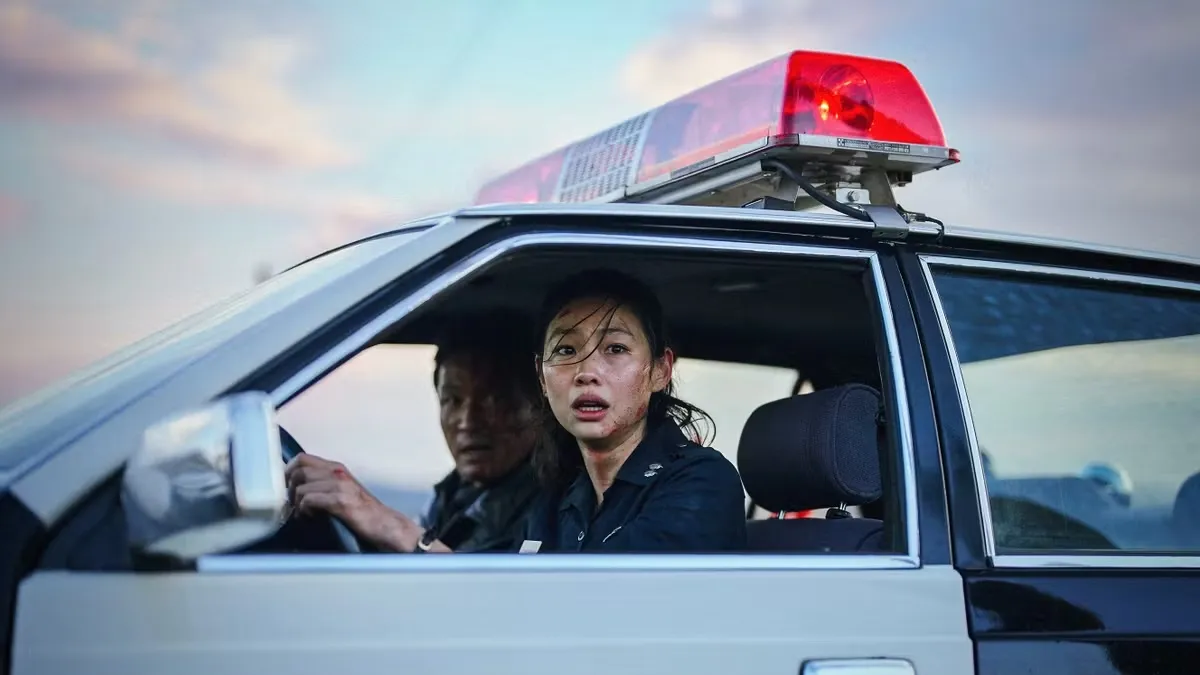
When Bum-soek investigates the town of Hope itself, he finds an apocalyptic war zone of smashed buildings, wrecked vehicles and mangled human corpses. Na teasingly keeps the cause of all this carnage off screen for almost 45 minutes, but eventually reveals it to be a kind of humanoid alien hybrid beast in the middle of a rage-crazed, hugely destructive, Godzilla-sized rampage. The film’s opening hour then becomes virtually one long hyperkinetic battle sequence, with sassy young female officer Sung-ae (Jung) joining Bum-seok for a breakneck monster showdown involving shotguns, bazookas and rubber-burning car chases.
An hour into Hope, with the beast seemingly vanquished and the surviving townsfolk tending their wounds, Sung-ae hubristically declares “this is where it ends.” But of course, in grand action thriller tradition, this is only the beginning. As Sung-ki and his motley team of hunters discover while sweeping the nearby mountains, the killer creature has arrived on Earth aboard a giant silver spaceship, which is teeming with many other fellow flesh-chomping monsters, diverse in look and size, with variable roles and ranks. After a brief breathing space, Na revs up for an even bigger extended set-piece battle featuring forest gunfights, high-speed vehicle stunts and blood-splattered twists. Once again, these action scenes are expertly choreographed, but soon become repetitive.
Hope concludes with a jarring shift of focus, hinting at some vast extra-terrestrial conflict unfolding in the skies above Korea. In this final act, Vikander and Fassbender make their extended digital cameos as CGI aliens with Avatar overtones. This poorly explained, belated piece of fantasy world-building is obviously intended as a sequel teaser, but it belongs in an entirely different cinematic universe to the two-hours-plus orgy of gleefully gory cartoon carnage that has gone before.
In its favour, Hope is never less than entertaining, boasting high-gloss production values and virtuoso slapstick stunts worthy of Buster Keaton in his prime. Cinematographer Hong Kyung-pyo, a Na regular who also shot Parasite, gives the action a lush widescreen look, subtly blending majestic landscape shots filmed in both Korea and Romania. Brimming with salty language and cheerfully crude toilet jokes, the screenplay also contains some pleasingly meta, self-aware commentary on its own plot conventions. A chest-thumping score by frequent Jordan Peele collaborator Michael Abels invokes some of the old-school orchestral swagger of classic Hollywood.
Director, screenwriter: Na Hong-jin
Cast: wang Jung-min, Zo In-sung, Jung Ho-yeon, Taylor Russell, Cameron Britton, Alicia Vikander, Michael Fassbender
Cinematographer: Hong Kyung-pyo
Editing: Kim Sunmin
Music: Michael Abels
Producers: Na Hong-jin, Saemin Kim, Saerom Kim
Production company: Forged Films (South Korea)
World sales: Plus M, Seoul
Venue: Cannes Film Festival (Competition)
In Korean
160 minutes