
Matabeleland
.
VERDICT: Matabeleland may be her first feature documentary but Nyasha Kadandara juggles romance and politics across Zimbabwe and Botswana like a pro.
Godard or Griffith famously claimed a girl and a gun are what makes cinema. Maybe that’s for fiction. For documentaries, half of the job is putting an engaging personality in front of the camera. Nyasha Kadandara gets two such figures for her debut feature documentary, Matabeleland. Sweetening the set-up, the pair, Chris and Dumi, are lovers.
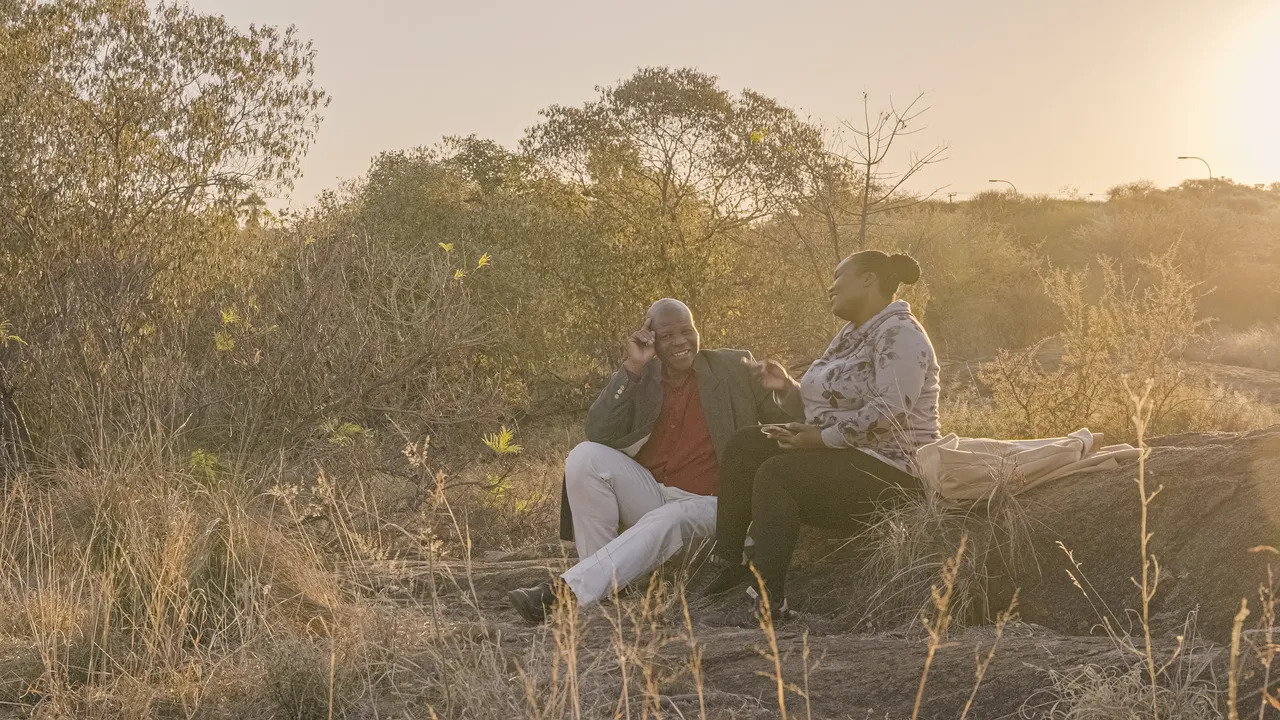
Chris, an energetic Zimbabwean 65-year-old, is dealing with an unfavourable economic situation in Botswana that has led him to become a casual worker. We see him as he goes about his business, his hustling intended to raise enough money for the burial of his father’s remains, his dad having died young, a victim of Robert Mugabe’s need to crush his enemies. In scenes where he speaks to the camera (and Kadandara) about the need to get his finances right, you can see the strain in his body language. Every single thing appears to be put on hold for the burial.
One of those things put on hold is marriage, which is how Dumi, his lover for several years, comes into the picture. Much of their relationship appears to be typically traditional, even as Chris says that he was treated a lot more royally back when he was quite liquid. Dumi, though, is a joy on camera, and perhaps in life. Her eyes light up when she smiles, and she looks like the type of person who doesn’t hold a grudge. It’s easy to understand why the rather brusque Chris is with her. Though charming Chris long enough to get him into bed doesn’t seem too hard, given the endless number of children he has fathered with several women over the years, as one comical scene shows. Unfortunately, Dumi’s agreeable nature may also be why she hasn’t left a man who, frankly, doesn’t want to put marrying her on top of his list of priorities.
This will-they-won’t-they set-up should be enough for a compelling documentary but this is an African documentary funded by western institutions. This means romance isn’t enough; the subject must be politics. So, right from the start of the film, we are introduced to the bloody political precursor to Chris’s need to bury his father. Back in the 1980’s, Mugabe had waged a mass killing, referred to as the Gukurahundi, to force a transformation of Zimbabwe into a one-party state. Chris’s father was one of the casualties.
But while this is a helpful background to understanding what lies behind Chris’s quest, one gets the sense that the man himself is more concerned about the implications of a man being unable to bury his own father and not necessarily the larger interplay of high-level politicking that led to his current situation. Luckily for Chris, there is an organisation created to give families an opportunity to say goodbye to family members lost during that particular civil war. The film’s most touching scene involves such a goodbye.
It is to Kadandara’s credit that the politics of Matabeleland blend in quite nicely with the life of her main character. The film, therefore, has two wonderful things going on: its compelling leads and the supple freshness of its tone. There is death and burial involved but this is not one of those harrowing documentaries about the dark continent. And when the film closes with a note informing us of the possibility of matrimony, you may feel your heart leap for joy. Matabeleland may be a first feature but Kadandara handles business like a pro. Audiences at festivals, schools, and at home everywhere would agree.
Director: Nyasha Kadandara
Cinematography: Nyasha Kadandara
Editing: Jordan Inaan
Producer: Sam Soko for LBx Africa
Co-producer: Bob Moore for EyeSteelFilm
Sound: Nyasha Kadandara
Sound Design: Benoît Dame
Music: Eduardo Aram