
No Good Men
No Good Men
VERDICT: The ever-surprising Shahrbanoo Sadat opens up the world of Afghan life for women before and during the American pullout in 2021 in a riotous feminist romance that opened the Berlin Film Festival with a bang – even without stars.
To watch No Good Men — boldly selected as the opening film at the 76th Berlinale – is to plunge into a captivating world saturated with color and music and irrepressible women, but tainted with the tragedy of Afghanistan’s recent history and a smarmily oppressive patriarchal society. The third of five planned films written and directed by Shahrbanoo Sadat, who here also plays the lead character Naru, it is an offbeat five-country coproduction set in Kabul, whose dusty beauty has been largely recreated in Germany, given that Kabul is now in the hands of the Taliban.
Sadat’s films have one strong common denominator: they all bring vividly to life the diaries and life story of author and actor Anwar Hashimi, who memorably appears here on screen as a morally courageous if work-obsessed news reporter for Kabul TV. The previous films showed him as a young village shepherd (Wolf and Sheep, 2016) and a homeless youth in Soviet-run Afghanistan (The Orphanage, 2019).
And yet the spotlight in No Good Men has shifted from the autobiographical protagonist to a ballsy female voice unafraid to express her views. The only thing that makes her shy away is her love life, and since the film begins on Valentine’s Day, romantic feelings are bound to be part of the tale. Naru (played with disarming sincerity by Sadat) is the single mom of 4-year-old Liam, now that she has finally kicked her abusive, economically dependent husband out of the house. But she has to play nice and avoid a divorce if she wants to keep her son with her: as we are repeatedly told, Afghan law gives the father the right to take children away whenever he wants.
Yet this is Kabul during the American military occupation and there are many astonishing things happening. Women work at a TV station as newscasters, although the fey pastel green backgrounds and tons of drag queen makeup they are made to wear considerably dilute their authority. Always confrontational and uncompromising, Naru bawls out a policeman for not checking her bag for a bomb – and nothing happens. A glamorous girl friend back from America (Torkan Omari in a laugh-out-loud cameo) brings a huge vibrator as a gift to the newly-single Naru. They have a good laugh and no man bursts in to castigate them. Refreshingly, at every turn, Sadat undercuts the trite expectation that female transgression will be followed by swift retribution.
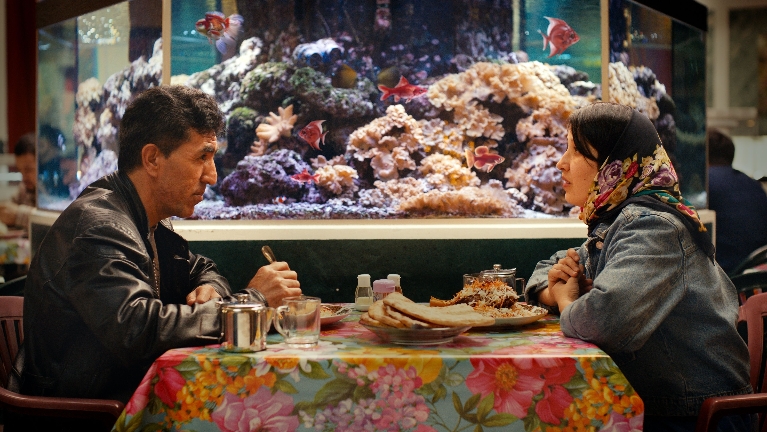
One expects to see women on the street wearing the ubiquitous blue head-to-toe burqas that hide their faces: they don’t. Instead Naru, a heavy-lifting camera operator who aspires to move from women’s shows to in-the-field news reporting, wears rugged blue jean jackets and light scarves. One day she twists the arm of her boss to do camerawork for the station’s star reporter, Qodrat Qadiri. Hashimi’s undertaker’s face turns even more lugubrious as he instantly dismisses her as incompetent. And when he takes her in with him to tape a long-sought interview with a Taliban chieftain, her presence becomes an excuse to halt the proceedings.
But later, Qodrat invites her to a crowded restaurant where they buck prejudice to sit in an outer room filled with men. He bursts into a dazzling, seductive smile of white teeth. His initial skepticism gradually turns into grudging respect as Naru reveals a gift for interviewing women on the street – the “vox popoli” who previously refused to speak to her male colleagues. In the end the two work together so often they give rise to gossip – which is not entirely baseless.
The film shifts tone as the story turns a corner with Pres. Biden’s historic announcement on April 14, 2021 that American troops would pull out of Afghanistan. Although the ending isn’t A Year of Living Dangerously (or meant to be), Sadat’s version has a satisfying quotient of chaos and danger whose tension finds its release in a classic but emotional sacrifice.
While the sassy, Bollywood-style music reinforces the volatile atmosphere, much credit goes to an excellent technical team led by D.P. Virginie Surdej (The Blue Caftan) and production designer Pegah Ghalambar. In a breathless second they switch the mood from the gauche exotica of a sequined wedding party, to the shock of billowing gray smoke a second later when a suicide bomber blows herself up, killing seven guests. The most violent events in the film are based on real attacks, lending a somber air of realism to the entire story. And yet they are such frequent occurrences, they barely register in a Kabul helplessly descending into chaos.
Director, screenwriter: Shahrbanoo Sadat
Producers: Katja Adomeit, Shahrbanoo Sadat, Jeppe Wowk, Marina Perales Marhuenda, Xavier Rocher, Ingvil Saether Berger, Balthasar Busmann, Maxi Haslberger
Cast: Shahrbanoo Sadat, Anwar Hashimi, Liam Hussaini, Yasin Negah, Torkan Omari, Fatma Hassani
Cinematography: Virginie Surdej
Production design: Pegah Ghalambar
Costume design: Pola Kardum
Editing: Alexandra Strauss
Music: Harpreet Bansal, Therese Aune, Kristian Eidnes
Sound design: Anne Gry Friis Kristensen, Sigrid DPA Jensen
Production companies: Adomeit Film (Germany), Adomeit Film (Denmark), Motlys (Norway), Wolf Pictures (Afghanistan), La Fabrica Nocturna Cinema (France), Amerikafilm (Germany)
World sales: Lucky Number (France)
Venue: Berlin Film Festival (Opening film)
In Dari
103 minutes