Teenage Sex and Death at Camp Miasma
Teenage Sex and Death at Camp Miasma
VERDICT: Gillian Anderson stars as a veteran horror movie scream queen in Jane Schoenbrun's third feature, an uneven but boldly ambitious love letter to vintage slasher films and their psycho-sexual undercurrents.
Gender dysphoria meets erotic euphoria in the splendidly named Teenage Sex and Death at Camp Miasma, a boldly original celebration of vintage slasher movies and their hidden psycho-sexual undercurrents from writer-director Jane Schoenbrun. A queer fantasia packed with homages to classic genre cinema, this candy-coloured fever dream is a hot mess at times, overstuffed with fetishistic totems, post-modern twists and cryptic plot swerves. That said, Schoenbrun’s third feature is an admirably ambitious, visually opulent passion project with strong cult credentials.
Much like Schoenbrun’s previous feature, the widely praised queer-awakening fable I Saw the TV Glow (2024), this highbrow love letter to lowbrow movies puts a deeply personal spin on pop culture fandom. The director, who is trans and uses “they/them” pronouns, has pitched both films as allegories for the trans experience, moving through dark periods of dissociation, alienation and imposter syndrome before emerging as a more confident, gender-affirmed self.
Teenage Sex and Death at Camp Miasma boasts a larger budget and grander canvas than its predecessor, but retains a strong indie auteur voice. The presence of Gillian Anderson as co-star and Brad Pitt as executive producer should help it find a wider audience, buoyed by buzzy reviews from its Cannes world premiere this week, where it opened the Un Certain Regard section. MUBI has already lined up a streaming launch for August.
Schoenbrun’s semi-autobiographical protagonist is Kris (Hacks star Hannah Einbinder), a non-binary, Sundance prize-winning indie film-maker who is being courted by a major studio to reboot a moribund slasher movie franchise launched in the 1980s. The bravura opening credits sequence serves up a fast-cut musical montage which condenses four decades of this fictional horror series into four zippy minutes, from gory underground classic to inferior straight-to-video sequels, gimmicky spin-off toys, crappy fan merchandise and more. All of this alluringly trashy ephemera is framed by increasingly negative reviews and related news stories, plus more elevated critical reassessments of the films as seen through a feminist, queer and gender theory lens. It’s a witty, dense, fun exercise in audio-visual scene-setting.
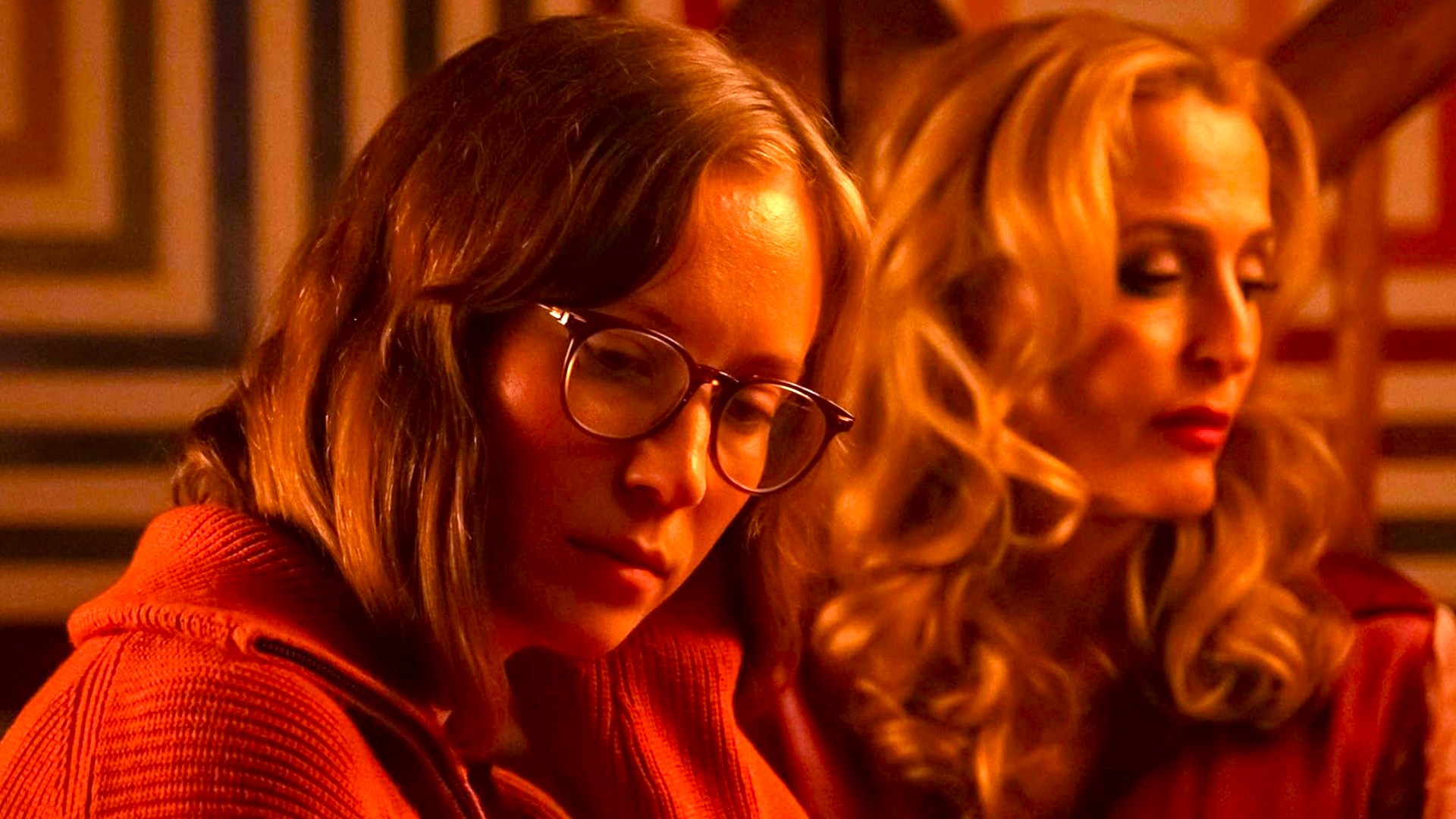
Teenage Sex and Death... opens with Kris in the remote wilds of the Pacific northwest, en route to a meeting with the reclusive star of the original Camp Miasma film, Billy Presley (Anderson), now a semi-mythical Norma Desmond figure long absent from the screen. While clueless studio bosses might accept Presley for a self-referential fan-service cameo, Kris wants something much far more personal from her: a way to unlock the spellbinding, mysterious, tantalising promise of sexual self-realisation triggered by the first film, which starred the young Billy (Amanda Fix) as the archetypal “Final Girl” in a teen-murder rampage conducted by “Little Death”, a ghostly monster with a cubic metal ventilation shaft for a head. Yes, that does sound weird, and it only gets weirder.
Billy is now living alone in the abandoned summer camp where the original Camp Miasma film was shot, which Schoenbrun frames as a liminal Lynchian neverland of painted backdrops and sound-stage artifice. The mysterious retired star greets Kris in full unhinged gothic diva mode, but she is is playing games with her young visitor, testing her limits. The flirtatious sizzle between them soon becomes physical, and increasingly surreal, with lavishly staged sex scenes accompanied by mountains of chocolate that would make Willy Wonky jealous. The pair’s hot pillow talk mostly involves Film Theory discussion about the male gaze, coded queerness, the kinky cosplay element of horror movies, and studios making cynical “woke” reboots of problematic “zombie IP” franchises. Which is niche, but admittedly quite arousing.
Meanwhile, the line between fact and fiction becomes fuzzy, with Kris and Billy slipping into the Camp Miasma cinematic universe. Little Death is again on a bloodthirsty rampage, skewering innocent teens with his priapic Freudian spear. As one of the secondary characters observes during the film’s funniest scene, a chaotic online pitch meeting between Kris and baffled studio bosses, there is a lot to unpack here. There certainly is, and not all of it makes much narrative sense. But the sheer audacity of Teenage Sex and Death... is ultimately its saving grace, even if some of Schoenbrun’s ideas feel undercooked or thinly explained.
The core of Schoenbrun’s thesis seems to be the latent libidinal power of horror films, which can trigger heightened erotic excitement in queer superfans like Kris, who find themselves identifying with both the male killers and female victims as they fight to the death in ritualised, sexualised murder scenes. This non-binary, dual-gender element clearly has special resonance for trans viewers. The fact that the supernatural serial killer who stalks Camp Miasma is named Little Death, a common term in French literature to describe post-orgasmic delirium, is another not-so-subtle clue.
With its ungainly mash-up of academic theory, occult private folklore and kitschy horror tropes, Teenage Sex and Death… is not quite the delirious feast of transgressive psycho-sexual giallo excess it aims to be. But it is still loaded with delicious ingredients, from Anderson’s high-camp histrionics to superb film-within-film sequences which lovingly recreate the scratchy VHS look and blood-spurting excess of vintage slasher movies.
It is also densely layered with explicit homages to cult cinema classics, from Sunset Boulevard (1950) to The Shining (1980), Psycho (1960) to Videodrome (1983), the Halloween and Friday 13th franchises, and many more. Pulpy oddity Sleepaway Camp (1983) is also a key inspiration with its contentious gender-switch twist, which has since attracted much critical debate over its alleged transphobia. Spotting these quotes and echoes is a fun game for genre fans, marking Schoenbrun out as a kind of Queer Tarantino.
Director, screenwriter: Jane Schoenbrun
Cast: Hannah Einbinder, Gillian Anderson, Amanda Fix, Arthur Conti, Eva Victor, Zach Cherry, Sarah Sherman, Patrick Fischler, Jasmin Savoy Brown
Cinematography Eric K. Yue
Editing: Graham Mason
Music: Alex G
Producers: Dede Gardner, Jeremy Kleiner
Executive producers: Efe Cakarel, Jason Ropell, Zane Meyer, Daniel Bekerman, Caddy Vanasirikul, Brad Pitt
Production company: Plan B (US)
World sales: The Match Factory
Venue: Cannes Film Festival (Un Certain Regard)
In English
112 minutes