
TFV International Picks from 2025
.
VERDICT: Films that mattered in 2025.
As The Film Verdict rips through its fifth year of publishing reviews that illuminate the films that matter, we want to take a moment to look back over 2025 and highlight some of the many excellent features, documentaries and shorts we’ve come across in our festival journeys around the world. While our L.A. reviewer Alonso Duralde has a long history of Top Ten list-compiling, this is the first time the international critics at TFV have sorted through more than 400 reviews to present our global recommendations for the most memorable titles of the year.
We are living through a momentous time of worldwide social and political change fired by wars of aggression, so it is not surprising that many of the top films reflect an anguishing malaise. But other notable titles take off in different directions, surprising in their exotic narratives and stylistic whimsy. In this special issue, TFV’s global network of film critics gives their unique, wide-angle perspective on new international cinema that we hope you will enjoy. Our recommendations follow.
Deborah Young, editor
THE VOICE OF HIND RAJAB (Kaouther Ben Hania)
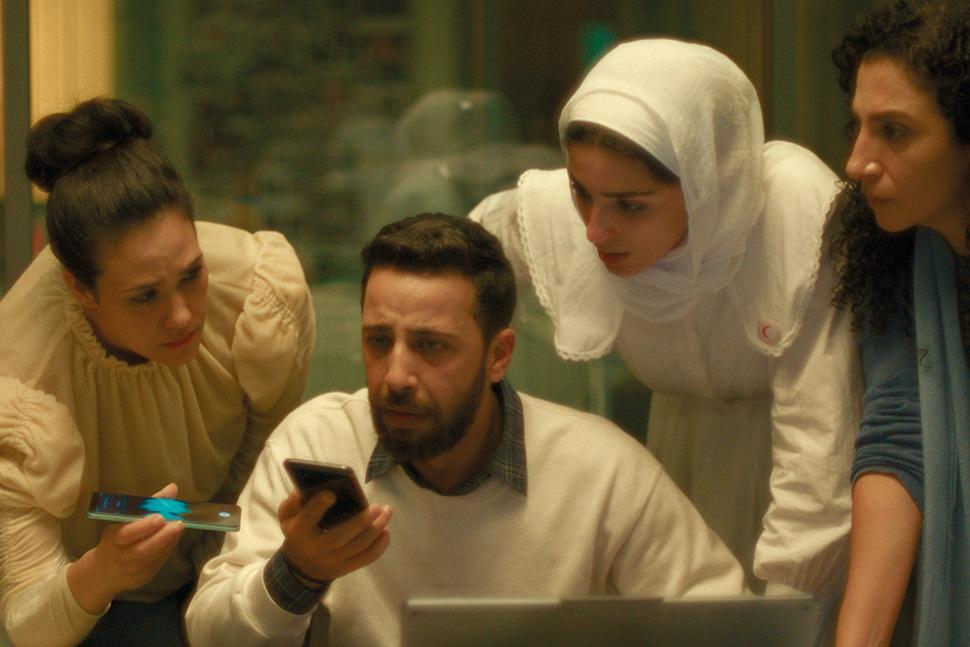
Ben Hania established herself as Tunisia’s politically attuned, stylistically forward voice of modernity with Four Daughters (2023), the true story of a family split asunder when the two eldest daughters become radicalized and join an extremist Islamic group. The film’s canny mixing of actors and the real protagonists is a dress rehearsal for the daring conceit in The Voice of Hind Rajab, which pairs the real-life audio of heart-breaking telephone calls of a small Palestinian girl trapped in a car with her dead family, and a re-creation by actors of her attempted rescue by the Red Crescent. This tremendously moving reenactment bowed at Venice and has shaken audiences to the core wherever it has played, revealing the simple truth about Israel’s war with Gaza with an emotional power and directness that cannot be denied. –Deborah Young
THE TESTAMENT OF ANN LEE (Mona Fastvold)
Writer-director Mona Fastvold’s gloriously bizarre avant-garde musical biopic stars Amanda Seyfried as 18th century female religious leader Ann Lee, messianic founder of the “shaker” sect. Filmed with the same freewheeling stylistic flair as her collaboration with husband Brady Corbet on The Brutalist (2024), but thankfully without the same undertow of grandstanding pomposity, Fastvold’s unorthodox passion play celebrates Lee’s legacy as a trailblazing proto-feminist who was ultimately sunk by her own obsessive, puritanical zeal. Seyfried’s explosively energetic, all-singing, all-dancing star performance is a pure joy. –Stephen Dalton
MY FATHER’S SHADOW (Akinola Davies Jnr.)
At Cannes last year Alice Rohrwacher, as head of the Camera d’Or jury, referred to My Father’s Shadow, the debut feature of Nigerian-British director Akinola Davies Jnr, as a “ghost story”. In the film, a busy father goes to the city with his two kids against the backdrop of Nigeria’s 1993 presidential elections. Those familiar with Nigerian politics know the outcome of those elections, a matter that adds a tragic poignancy to the father’s declared hopes for the country his children will inhabit. The film’s delicate surrealism suggests Rohrwacher was right—the film is indeed a ghost story—but My Father’s Shadow is also a love letter to a country, and a dream, that never emerged.
Honourable Mention: Matabeleland —Oris Aigbokhaevbolo
SENTIMENTAL VALUE (Joachim Trier)
Art and life can often intertwine in painful ways, as is the case in Joachim Trier’s father-daughter story about a filmmaker (Stellan Skarsgård) who struggles to reconnect with his estranged firstborn (Renate Reinsve) after having been an absent parent for years. As he tries to set up a new project, with the main role intended for her, the layers of artifice and sincerity overlap to create an increasingly affecting exploration of the relationship between creativity and familial affection, as well as a witty metaphor for Nordic co-productions (the director is Swedish and his main producer Danish). Bonus points for Skarsgård’s “Where else?” in response to a question about his film – a Netflix production – playing in theaters, a line that has become more relevant in light of the streamer’s recent interest in purchasing Warner Bros. –Max Borg
SIRAT (Oliver Laxe)
Sirat (the very narrow bridge between hell and heaven) has been called the most controversial film of the last Cannes festival. Director Oliver Laxe works with producers (the legendary Esther García, among others) who give him the freedom to be daring, imperfect, to use naturalistic actors and make a film with a very tenuous storyline and no ending. As Homer teaches us, it’s the journey and not the destination that matters.The first, very powerful scenes depict a rave in the Moroccan desert, where Luis (Sergi López) and his son Esteban (Bruno Nuñez) arrive like aliens from another civilization. They are looking for Luis’ daughter. In the middle of the rave, some soldiers appear to take the Europeans to a safe place. It seems the feared total war is near. When tragedy strikes it’s a punch in the gut. The consequences and following punches are so quick that they leave us numb. Sirat is not a masterpiece but a much-needed cinematographic experience, and for me, that’s better. –Lucy Virgen
PUT YOUR SOUL ON YOUR HAND AND WALK (Sepideh Farsi)
A devastating yet profoundly human portrait of life under siege in Gaza is shaped through intimate, pixelated WhatsApp calls with photojournalist Fatma Hassona. What defines the film is not only horror, but the stubborn persistence of everyday life in its shadow: laughter over oversized sunglasses, carefully chosen hijabs, children playing hopscotch beside ruins. The imperfections — frozen frames, garbled audio when bombs fall — pull us closer rather than distancing us. Fatma’s journalism is rooted in home, where the front line is family and friends. There is no dramatic score, no commentary, only her matter-of-fact voice describing airstrikes and loss with the tone of everyday conversation. The tragedy of her death hangs over every frame, yet what lingers is vitality. Not a symbol or statistic, but a full, complex person — funny, talented, flawed, and vibrantly alive — whose presence turns cinema into an act of responsibility and remembrance. –Adham Youssef
BELEN (Dolores Fonzi)
Belén is based on the true story of a woman accused of having an abortion after suffering a miscarriage in Tucuman, Argentina, in 2014. Attorney Soledad Deza defended Belén in what became a cause célèbre that energized the women’s movement and ultimately led to the legalization of abortion in Argentina. Writer-director Dolores Fonzi plays the lawyer defending Belén, and Camila Pláate, who plays the accused, won Best Supporting Performance at San Sebastian. The film conveys the tensions and difficulties of the struggle, as well as the determination of the many women who rallied behind the victim of an abusive system. Belén also defies the current challenges of filmmaking in Argentina, after President Javier Milei cut all public funding to the national film institute INCAA. – Patricia Boero