
Voices of Gaza and Beyond: Palestinian Stories at CIFF
.
VERDICT: At the 46th Cairo International Film Festival, Palestine is not only present as a topic; it's foundational to the emotional and artistic narrative.
Actress Hiam Abbass is fresh from presenting her latest film, Palestine 36 (2025), directed by Annemarie Jacir, as Palestine’s entry for the 2026 Oscars. Now she walks onstage at the Cairo Opera House to receive the Achievement Award presented by the 46th Cairo International Film Festival—an honor that celebrate her not just as an actress, but as a figure of Palestinian culture. The festival has also carefully curated films in various programs, projects that reflect what it means to be Palestinian.
Her filmography shows Abbass’s achievement is not that of a single individual, but a collective effort to champion Palestinian voices and talent, and to embody the endurance of her people in the West Bank, the Gaza Strip, and the worldwide diaspora.
The Cairo festival postponed its 2023 edition in solidarity with the Palestinian people and dedicated a whole spotlight on Palestine in 2024. This year it features eight projects that echo the resilience of Palestinians around the world and give Palestinian artists a voice to tell their own stories.
After touring world festivals and winning the directing prize in Un Certain Regard at Cannes, Tarzan and Arab Nasser screened their film Once Upon a Time in Gaza in Cairo. There is power in giving Gaza a visual profile that transcends the unfortunate image of a war-torn city. The film takes place in 2007, weeks before the Gaza Strip came under the control of Hamas, and investigates, through a thriller story, how the city’s social fabric began collapsing under siege.
Attention to atmosphere, rather than narrative urgency, gives the film an edge that is rare among Palestinian feature films. It is firmly in the tradition that the brothers have maintained since their 2015 film Dégradé and their 2020 romance Gaza Mon Amour, all of which celebrate Palestinian everyday life, with all its hardships, laughs, absurdities, and violence. In Once Upon a Time in Gaza, the working-class coastal city of Gaza—its slang, architecture, routines, humor, hardships, resilience, and corruption—is the main protagonist. As the camera lingers on normal street interactions, the Nasser brothers are able to capture the texture of the everyday that the wars (2008–2009, 2012, 2014, and 2021) later erased.
Tarzan and Arab Nasser are examples of how non-Western filmmakers can not only combat stereotypical images of where they come from, but also challenge the expectations international festivals and funders have of filmmakers from the MENA region.
A strong addition to Horizons of Arab Cinema this year, and competing for the Best Documentary Award, is Palestinian on the Road, an essay-documentary and pilgrimage film that begins from the private journey of the director and opens a collective cartography of Palestinian dispossession. Ismail Al-Habbash, a veteran in presenting Palestinian cinema worldwide, starts this journey by remembering how he could not accompany his wife Salam when she was battling cancer, up until her death in a Jerusalem hospital. He had applied for a permit to cross into Jerusalem, but permission came after she died.
This road film, which follows the path of Jesus Christ from Nazareth to Jerusalem, becomes a political reflection, as each station of grief and site on the map has been contested for decades, if not centuries. However, in this soft-hearted documentary, Al-Habbash does not seek a miracle, but investigates the very idea of miracle under occupied Palestine.
In his journey, Al-Habbash stops in Jenin, and so does Alex Bakri in his new documentary Habibi Hussein. The film follows Hussein Darby, the final projectionist of Cinema Jenin, as he tries to repair a 50-year-old projector, a gesture that feels like retrieving a world that is already gone.
Although the film is not nostalgic, Habibi Hussein attempts to cast a critical eye at the film infrastructure that has collapsed in places like Jenin. Shot in 2008, the film is not just a metaphor for the many aspects of Palestinian culture that have been demolished over the years. It also sheds light on the work of foreign NGOs in the West Bank. In the film, the cinema becomes the property of a German NGO, which enables Darby to return to his old job, which he did for 43 years. As soon as the project starts, (it was featured in Marcus Vetter’s film Cinema Jenin), Darby is marginalized and eventually silenced. Habibi Hussein enters an unspoken territory of criticizing foreign NGOs operating in Palestine and, more importantly, documentaries made by foreigners about Palestine.
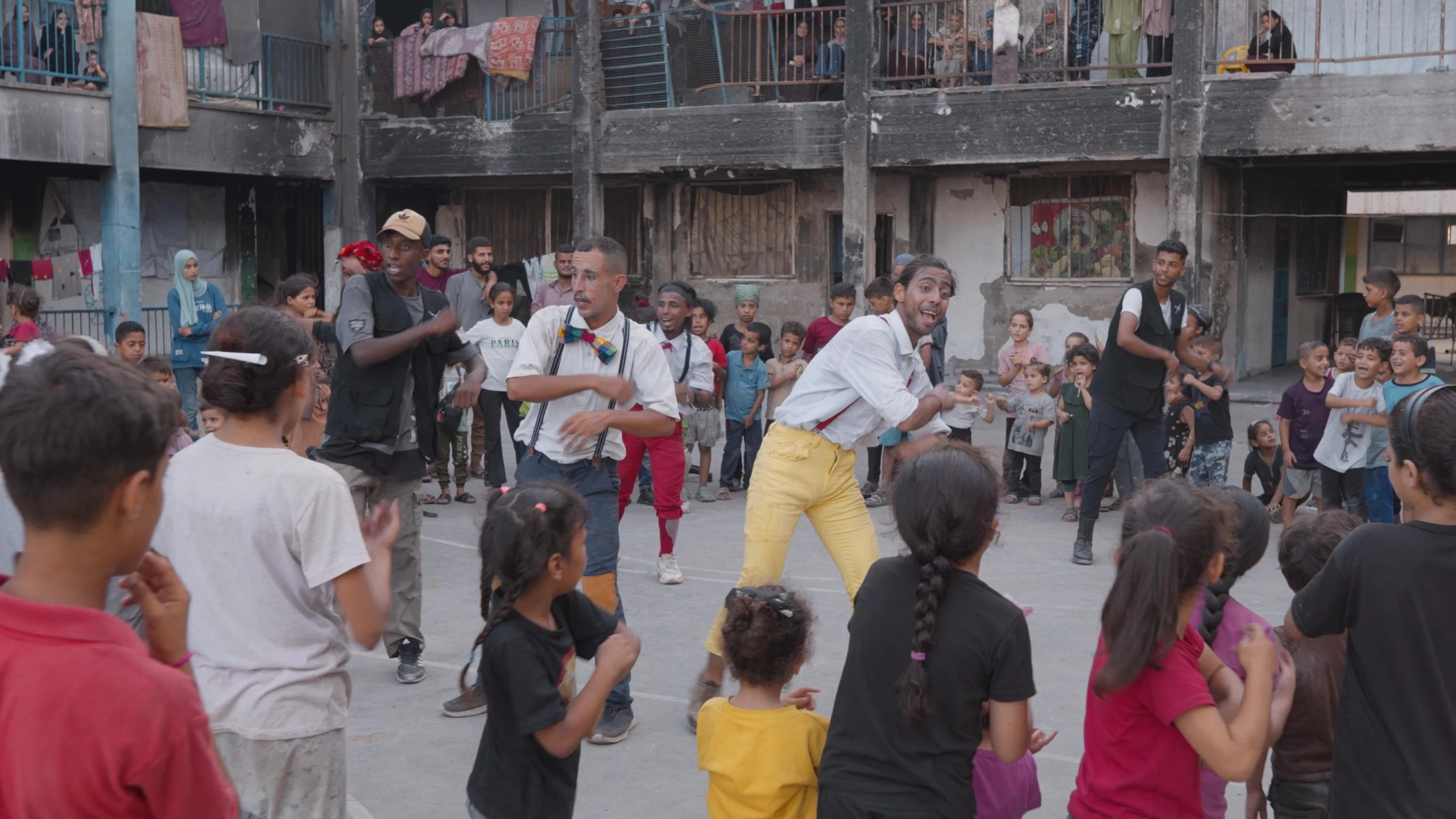
Mai Saad & Ahmed Eldanf’s One More Show follows a circus collective that continues performing and touring the destroyed streets in Gaza. Saad (an Egyptian filmmaker) and Eldanf (a Palestinian) place their storytelling in the fragile backstage space where performance is uncertain, and the audience is made up of children whose childhoods have been stolen. Their approach leans toward observational ethnography and minimal narration. The film quietly rejects the usual NGO narrative of art as resistance, and suggests that culture is not a response to violence, but something that exists irrespective of it; a form of time that runs parallel to war, not in reaction to it.
One cannot watch the children enjoying the performance of the Free Gaza circus troupe without thinking of Hind Rajab, a five-year-old Palestinian girl in the Gaza Strip who was killed by Israeli forces during the Gaza war, along with six of her family members and two paramedics attempting to rescue her. Kaouther Ben Hania’s The Voice of Hind Rajab, which premiered in Venice and received critical acclaim, reconstructs the hours during which Hind remained trapped inside a car surrounded by Israeli tank fire, speaking to paramedics who were unable to reach her. Through audio testimony, eyewitness accounts, and visual material drawn from news documentation and social media, the film uses Hind’s voice to convey the terror and helplessness of the situation.
Ben Hania preserves the child’s voice as evidence, memory, and indictment, and positions the audience as witnesses to systematic death. Another approach appears in Who Is Still Alive, a feature-length documentary by Nicolas Wadimoff, which features nine Gazans speaking about their lives before the war, what they lost, and how they resist being erased. Wadimoff, who has been documenting Gaza since the early 1990s and has supported Palestinian filmmakers for decades, emphasizes, through the film and its title, not who survived, but who remains living.
The film was originally intended to be shot in Switzerland, but its location was moved to South Africa because Palestinians from Gaza can enter without a visa, underlining global restrictions on Palestinian mobility. This relocation becomes part of the film’s meaning: Gaza is present even in its displacement. With a refusal to aestheticize atrocity, the film focuses on testimony and presence, and avoids archival and war footage, relying solely on voice, memory, description, and embodiment.
Among the countries that have remained supportive of the Palestinian cause for liberation and self-determination is Chile, where Andrés and Francisca Khamis Giacoman’s short documentary Baisanos takes place. By following the passionate world of Club Deportivo Palestino fans, the filmmakers, both Chilean and descendants of Palestinians, trace how travel, exile, homesickness, and solidarity are not site-specific cultural practices, but tools of survival in a diaspora—sometimes loudly, sometimes playfully, sometimes through football.
As part of the new Cairo XR Films program, Karim Moussa’s experimental project Rebuilding Gaza imagines post-war reconstruction as an architectural possibility, empowering the very concept of the future with architectural imagination.
Five weeks after the ceasefire, which took place on October 10 between Hamas and the Israeli government, the tragedy of the last war—and the ones before it—continues to bring in waves of solidarity and political resistance from individuals and institutions around the world. Cairo is only one place. And cinema is only one tool.