IDFA 2025: The Verdict
,
VERDICT: Under new Artistic Director Isabel Arrate Fernandez, the world's largest documentary festival screened a strong program of political films, intensely personal stories and dazzling visual artistry.
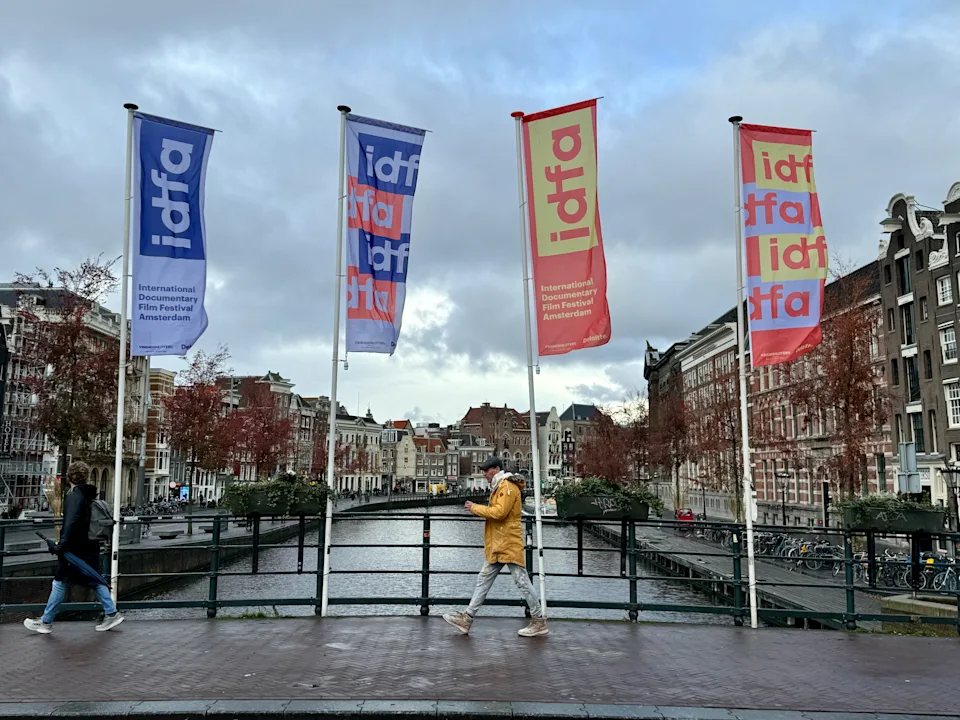
Warm greetings from the chilly port of Amsterdam, where the 38th edition of IDFA has entered its final gallop towards the finishing line, just as the mild autumn weather turns wet and wintry. Prizes are yet to be awarded across the main sections of the International Documentary Film Festival Amsterdam, but the key world premieres have already screened, and this week already feels like a very strong debut for newly appointed Artistic Director Isabel Arrate Fernandez. The world may be a raging bonfire of conflict and crisis, with truth itself in the firing line, but non-fiction film-making appears to be in very rude health. These facts may well be related, of course.
War zones and trauma stories have certainly been well represented across the IDFA program, from Gaza to Ukraine to Georgia. But this has also been a good festival for formally inventive documentaries that blend factual reportage with intensely personal stories and strong visual flair. Some of the most impressive include Maria Sylvia Esteve’s Mailin, which elevates a true story of child sexual abuse into a hypnotically beautiful high-art horror film, and A Fox Under a Pink Moon by Mehrdad Oskouei and Soraya Akhalaghi, which blends raw phone-cam footage of people-smuggling with inventive animated sequences.
European film-makers exploring postcolonial themes has been another IDFA motif this year. One of the most intriguing world premieres is Dutch-Moroccan director Nordin Lasfar’s quietly angry documentary Mohammed & Paul – Once Upon a Time in Tangier, which casts a caustic eye on the legendary Sheltering Sky author Paul Bowles, dissecting his problematic relationship with his Moroccan housemate, literary collaborator and alleged lover Mohammed Mrabet. Expect to see that at future festivals.
Documentary cinema shares a wide overlap with investigative journalism, of course, so it makes sense that some of the most buzzy sold-out screenings at IDFA have been films that champion press freedom, media activism and whistleblowers. Cover Up by Laura Poitras (Citizenfour, All The Beauty and the Bloodshed) and Mark Obenhaus is a laudatory portrait of veteran reporter Seymour Hersh, who made his name exposing US military war crimes in Vietnam, while Steal This Story, Please! by Carl Deal and Tia Lessin does something similar for Amy Goodman, long-time figurehead of independent US news channel Democracy Now!
Meanwhile, Eugene Jarecki’s The Six Billion Dollar Man makes a persuasively positive case for controversial WikiLeaks founder Julian Assange, and Julia Lotkev’s marathon epic My Undesirable Friends Part I – Last Air in Moscow chronicles Vladimir Putin’s brutal crackdown on Russian media critics following his illegal invasion of Ukraine. Not all these films were IDFA premieres, but they packed extra political punch in the Netherlands, home of the international criminal court, which is keeping a cosy cell warm for Putin and his fellow war criminals.
The only major disappointment of the festival so far has been Trillion by Russian-born director Victor Kossakovsky (Gunda, Architecton), a sweeping audiovisual symphony about an anonymous German artist spreading millions of dry fish scales across a rocky Norwegian peninsula. Shot in ravishing monochrome, with Joaquin phoenix credited as executive produer, this monumental love letter to landscape and marine life looks amazing, but it very soon becomes ponderous and repetitive. It would have made much more sense as a short film or gallery installation.
Speaking of galleries, IDFA’s most spectacular screening venue for the last decade has been the Eye Filmmusuem, a mighty modernist spaceship perched on the harbourside across the water from Amsterdam’s main railway station. Not officially part of the festival, but overlapping with it, the museum’s current exhibition Tilda Swinton: Ongoing is a multimedia assemblage which chronicles the Scottish-born indie film queen’s long career through personal family artefacts, photos, costumes and collaborative works with numerous feted film-makers, from Jarman to Jarmusch, Joanna Hogg to Pedro Almodovar.
The exhibition runs until February and offers some stunning visual images, especially Tim Walker’s newly commissioned contemporary photo section. Swinton’s latest docu-drama project, the posthumous Marianne Faithfull homage Broken English by Jane Pollard and Iain Forsyth, offers a bridge between the museum and the IDFA program.