
Talking to a Stranger
Hablando con extraños
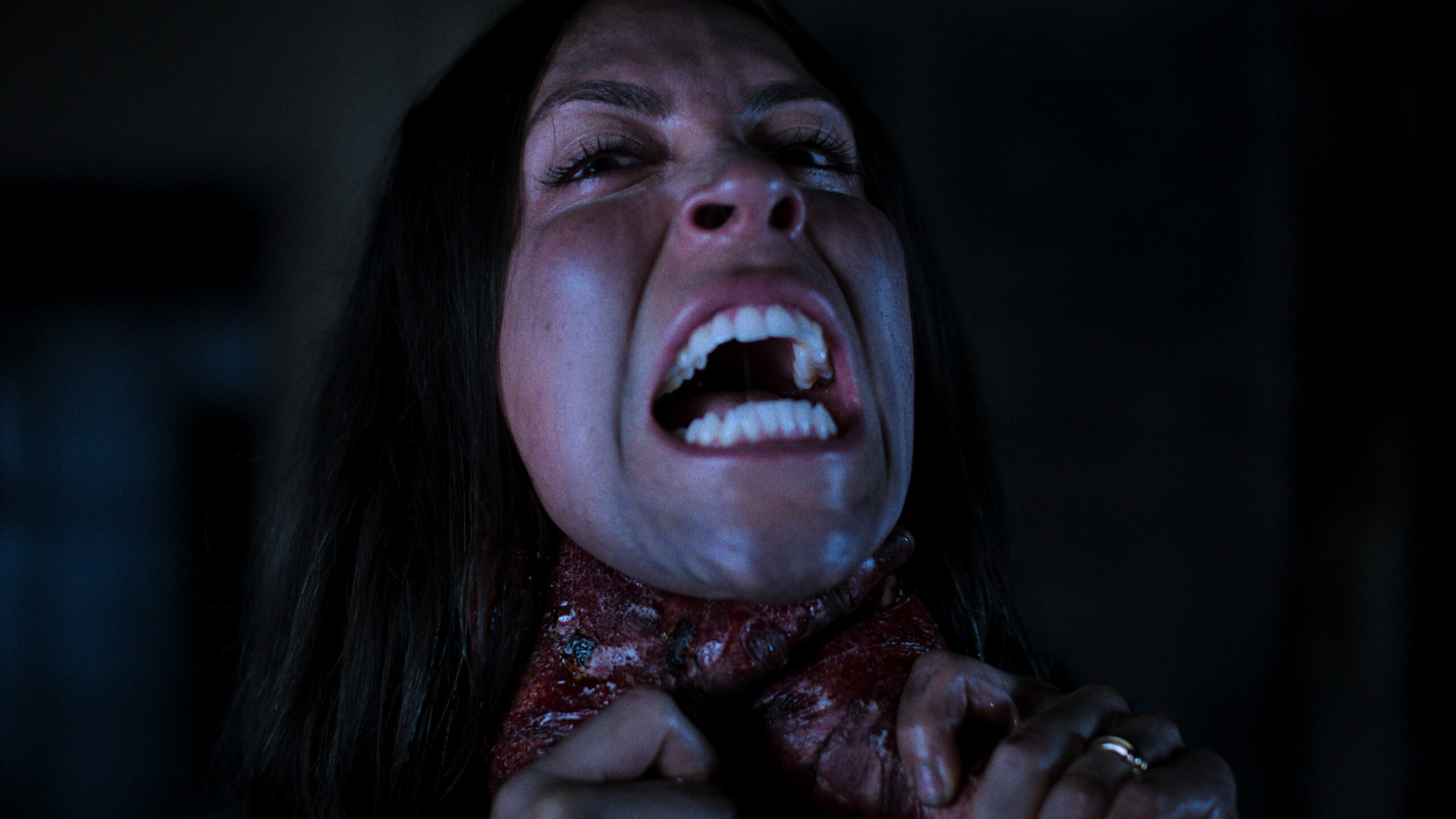
VERDICT: A demon feeds on a mother’s grief in ‘Talking to a Stranger’, a powerful and unsettling piece of Mexican horror.
In the realm of contemporary Latin American horror, few names elicit as many thrills – on screen and in the theater – as that of Adrián García Bogliano, the Spanish-born Mexican auteur who has made a splash on the international festival circuit with genre fare such as Here Comes the Devil and Scherzo Diabólico. He’s on typical unsettling form with Talking to a Stranger, already poised to have many more legs on its global journey after debuting in Rotterdam’s Big Screen Competition.
Performing the titular action (which loses the somewhat creepy implication of the original title about there being more than one eerie presence at play) is Patricia (Gigi Saul Guerrero), a woman whose psyche is permanently fragile following the tragic death of her son Chris, who perished in a housefire a few years back. Struggling to make sense of what is real and what is in her head, which also affects her sleep, Patricia starts having conversations with what appears to be her little boy, somehow back from the dead, or at least partially so. But as her grip on reality starts to negatively affect her surroundings, the rest of the family begins to wonder if there might actually be something in the house, possibly with malevolent intentions…
While the film is relatively short at 104 minutes, it still commendably takes its time setting the mood and tone: despite the pyrotechnics in the opening sequence, Talking to a Stranger is more of a slow burner, as Bogliano allows the dread to build up before the more conventional – but still chilling – third act developments. While this may frustrate those expecting jump scares (which are in very short supply), it’s also the best way to create a connection between the viewers and the entire family, as the drama grows in power even outside of the supernatural context.
Of course, the otherworldly is still involved, although the director (who also serves as the editor) and his cinematographer Damián Aguilar have made sure to avoid visually signposting the difference between the real world and Patricia’s hallucinations – in fact, the color palette gives every scene a slightly heightened sheen, matching the protagonist’s worldview in between the trauma and the medication that’s supposed to help her sleep. Throughout the viewing, we are effectively made to walk in her shoes, feeling her pain when she realizes something is wrong but still wants to cling on to the idea of one day reuniting with her deceased child.
Sound is the other key component, or rather, its absence: Patricia’s husband – who has set up a surveillance system to monitor her nocturnal activities – specializes in tinkering with audio tracks and, in one of the more successful blends of the scientific and the demonic on screen, discovers the unseen entity does emit discernible noises, only they’re on a frequency that most human adults cannot perceive. It’s a subtly chilling undertaking by the team at LSD Studio, arguably the most apt name for a post-production contractor on a project that at times feels very trippy.
But most important of all is the human factor, specifically the lead performance, which Bogliano has entrusted to Mexican-Canadian actress and filmmaker Gigi Saul Guerrero, perhaps best known outside of Latin America for her work behind the camera (in 2021, she directed Bingo Hell, one of the installments of Prime Video’s Welcome to the Blumhouse series of horror films). In her hands (and eyes, and lungs) Patricia becomes a force of nature, an avatar of pure, raw pain even as she’s somewhat sedated for a large chunk of the running time. The sense of loss emanating from every inch of her deceptively lethargic movements and expressions is nothing short of a revelation, providing the movie with an emotional core that keeps things compelling regardless of the familiarity of the genre trappings.
Director, Screenwriter: Adrián García Bogliano
Cast: Gigi Saul Guerrero, Eugenio Rubio, Yago Andreu Sandoval, Tatiana Del Real, Vania García, Nora Huescas
Producers: Javier Colinas, Eckehardt Von Damm, Pablo Guisa Koestinger, Andrea Quiroz Hernández, Carlos Solís, Luis Solís
Cinematography: Damián Aguilar
Production design: Catalina Oliva
Music: Fernando Escalante, Ricardo López Coa
Sound: LSD Studio
Production companies: Corazón Films, Salto de Fe Films, Mórbido Films, Prismaticoos Films
World sales: Corazón Films
Venue: International Film Festival Rotterdam (Big Screen Competition)
In Spanish
104 minutes