
Frank & Louis
Frank & Louis
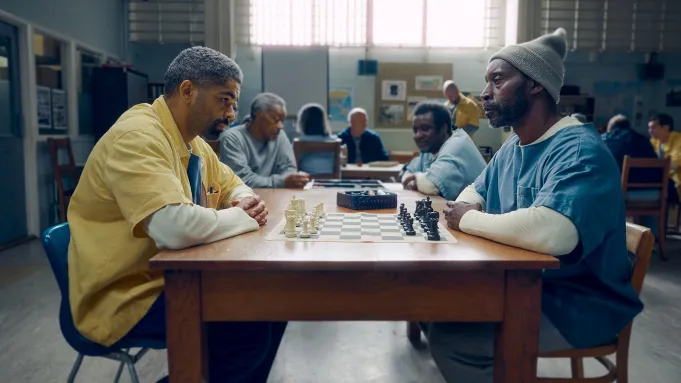
VERDICT: Crime and punishment, guilt and healing are the big themes treated by writer-director Petra Volpe in the thought-provoking ‘Frank & Louis’, a measured, stylistically impeccable study of two Black prison inmates, one losing his memory through dementia.
Petra Volpe became one of the most talked-about Swiss directors when her hospital-set drama Late Shift hit Berlin audiences last year with its stunning pace. unstoppable drama and harried heroine. Her new film Frank & Louis is a calmer, more reflective take on caregivers pushed to their outer psychological limits in institutions. In this case the austere setting is an American correctional facility where an unusual mental health program is underway. Though less adrenaline-pumping, it is in other ways the stronger film, deepening its look at how human beings interact under extreme circumstances.
Ultimately, it is also a heart-wrenching study of how a serious crime scars the soul of the perpetrator as well as the victim, and how healing, such as it is, can take place through selfless service to another person. Though the setting may seem overly familiar at first, that impression is quickly swept aside as personalities take over in the riveting lead performances by Kingsley Ben-Adir and Rob Morgan. Both actors are superbly measured and self-aware, fiercely casting out any hint of sentimentality in the story.
A night scene introduces Frank Baker (Ben-Adir) as he is marched shackled into a new prison with a dozen other men in orange jumpsuits. The dominant colors will soon shift to the blue of standard-issue prison wear and yellow in the distinctive jackets of the “Gold Coats”. These are veteran inmates who (based on a real program in a California prison in San Luis Obispo) have been trained as caregivers for fellow prisoners with cognitive issues like Alzheimer’s and dementia. This hierarchical color symbolism draws the first, seemingly definitive line between Frank, young and athletic but with grizzled hair attesting to 17 years already served behind bars, and the fragile and failing 60-year-old Louis Nelson (Morgan) who is put in his care.
Louis has been a tough, violent customer all his life, feared by the other inmates. Now he is fragile and failing, with bouts of lucidity alternating with total puzzlement over where he is and what brought him there. There is something of the mortally wounded animal in his hostility and rage towards Frank that gives Louis a human side despite the fact he (like Frank) is serving time for murder.
As his memory fades, the paradox becomes increasingly clear: he no longer has the capacity to understand why he is being punished. The viewer shares Frank’s perplexity: first, and most banally, how to dress and feed a man who refuses his help. The group of inmate-caregivers, coached by an enlightened psychiatrist, rally around Frank when he is so discouraged he is ready to quit. They have all learned to roll with the fearful rages, outbursts and insults from the men they care for, and have grown protective and attached to them as their minds deteriorate and they move ever closer to hospice care. All this is touchingly suggested in Volpe and Esther Bernstorff’s screenplay without becoming maudlin. As a kind-hearted Hispanic Gold Coat (René Pérez Joglar in a warm supporting role) reminds Frank, one day their minds will be empty of everything, “even hate”.
Frank’s own struggle is multifaceted. He is approaching an important hearing with the parole board which fills him with hope and trepidation and, after many years, he has reestablished contact with his sister. But we sense that he is not being completely honest when he claims to have conquered his anger issues and gotten his violent impulses in check. In contrast, Louis seems to mellow as his dementia progresses, but he receives no help from his daughter who refuses all contact with him.
The slow pacing, especially in the first half of the film, requires some patience on the part of the viewer, but there are rich rewards later as scenes flow organically to their inevitable conclusion. Compared to the frenzied rhythm of Late Shift, Frank & Louis is a model of stylistic moderation, where all the narrative and technical elements work together in a persuasive whole. Oliver Coates’ sophisticated score quietly but insistently penetrates almost every scene, depicted by cinematographer Judith Kaufmann with simultaneous lights and shadows that are the visual equivalent of the moral dilemma under the surface of the story. How can we reconcile punishment – even just punishment – with a criminal who doesn’t remember his crime? It is Kafka seen from another angle.
Director: Petra Volpe
Screenwriters: Petra Volpe, Esther Bernstorff
Producers: Reto Schaerli, Lukas Hobi
Cast: Kingsley Ben-Adir, Rob Morgan, René Pérez Joglar, Rosalind Eleazar, Indira Varma
Cinematography: Judith Kaufman
Production design: Su Erdt, Iain Andrews
Costume design: Pascale Suter
Editing: Hansjorg Weissbrich
Music: Oliver Coates
Sound design: Gina Keller
Production companies: Zodiac Pictures
World sales: TrustNordisk
Venue: Sundance Film Festival
In English
94 minutes