The Echo of the Herd
La voix du troupeau
VERDICT: An isolated rural life is at the center of the quietly compelling Swiss-French documentary ‘The Echo of the Herd’, screened at Visions du Réel.
In 2022, Matthias Joulaud and Lucien Roux wowed the Visions du Réel audience with their graduation short Ramboy, produced jointly by the two major film schools in French-speaking Switzerland (ECAL in Lausanne and HEAD in Geneva) in association with Akka Films (founded by Who Is Still Alive director Nicolas Wadimoff). The latter has reteamed with the duo for their first feature-length project, The Echo of the Herd (La voix du troupeau). Its festival journey should prove fruitful on the documentary circuit and at events that promote inclusive screenings; the premiere at the 2026 edition of Visions du Réel had audiodescription available for the visually impaired, as well as French subtitles for the hard of hearing.
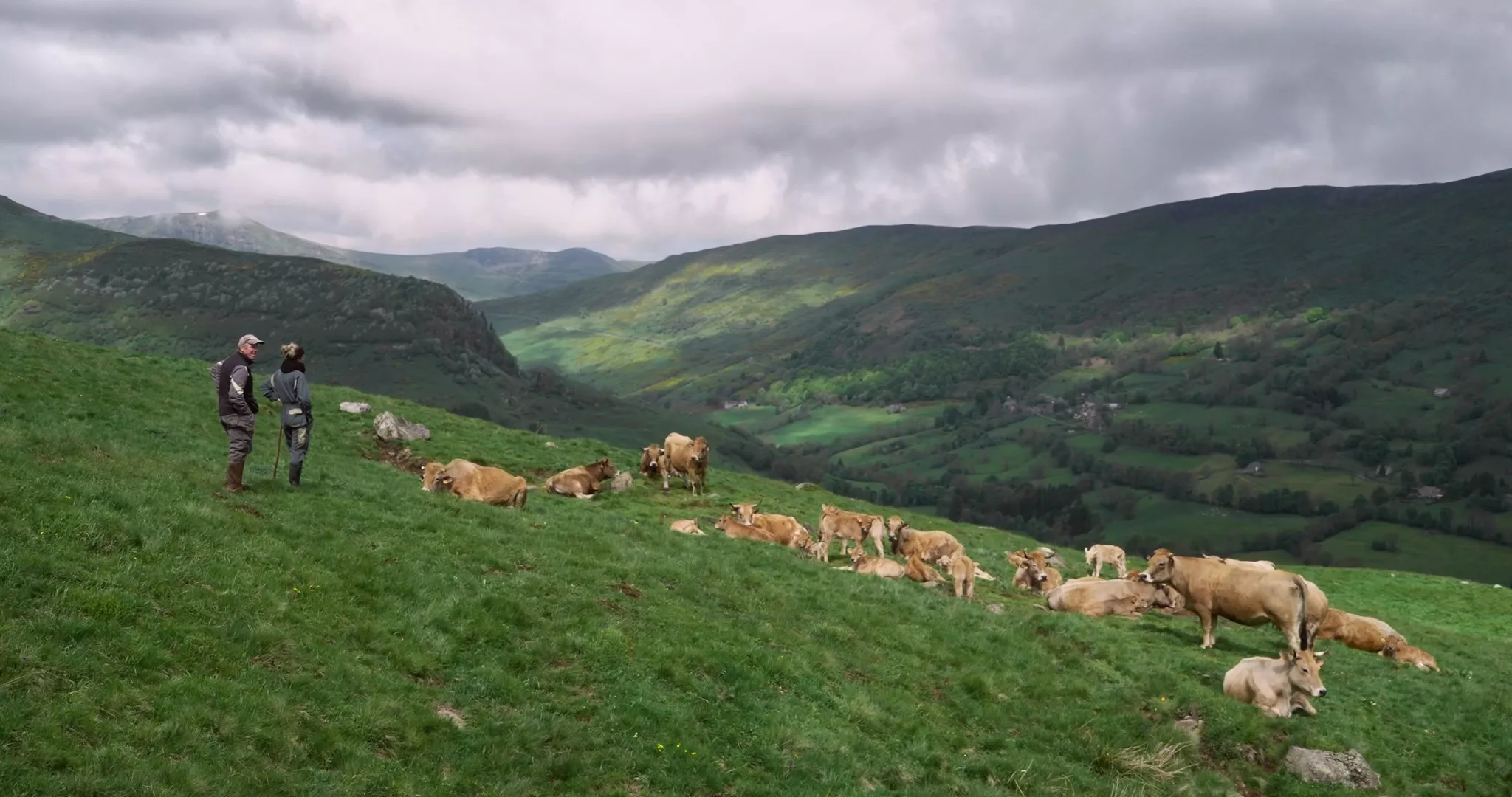
The film was shot in Cantal, a rural department in France’s Auvergne-Rhône-Alpes region which is not too far from Lucien Roux’s hometown of La Tronche, in the Isère department. This is where the farmer Didier leads a fairly isolated existence, especially after the passing of his brother Claude. Prone to loneliness, Didier throws himself into his work, looking out for the cows that have always defined his existence. The daily routine is not without difficulties, and not just because of the physical aspects of the job: Didier was born deaf and, without Claude by his side, he has to reinvent himself linguistically, finding new ways to get around his aural impairment and make himself understood, all while the national farming business is grappling with hardships periodically recounted through news broadcasts.
In addition to writing and directing, Joulaud and Roux also served as cinematographers, capturing the not-always-ordinary quotidian habits of Didier’s existence. Given the premise, they place an expected but nonetheless welcome focus on the visual component, highlighting how the farmer goes on about his life almost wordlessly, save for when he has to communicate with other people. From the very beginning, the opening shots make clear this is a milieu that, while rooted in the realities of the region, exists as its own little world, particularly as far as Didier and his personal perception of his surroundings are concerned.
In that sense, the international title sort of smudges the nuance contained in the original French: the voice of the herd, rather than the echo. It’s a voice expressed without dialogue, one that Didier has grown accustomed to over the many years spent with the cows. Through that relationship between farmer and cattle, the film plays as an ideal companion piece, and spiritual successor, to Ramboy. There, it was a question of learning, as a young boy got initiated into family traditions in Ireland; here, we deal with a man who has already learned, and honed his skills to such a degree he can, hopefully, carry out his duties and coexist with a community that, for all intents and purposes, will never be able to fully understand him.
The same goes for the two filmmakers: if the 2022 short was a calling card, this feature-length expansion on similar themes is a confident work of artistic and humanistic maturity, one that finds the universal hook of solidarity and man’s profound bond with nature in a very specific rural microcosm that, much like its deaf inhabitant, finds a way to exist on its own terms.
Directors, Screenwriters: Matthias Joulaud, Lucien Roux
Producers: Juliana Fanjul, Annick Bouissou, Alexandre Cornu
Cinematography: Matthias Joulaud, Lucien Roux
Music: Sylvie Klijn, Yatoni Roy Cantu
Sound: Yatoni Roy Cantu
Production companies: Akka Films, Les films du tambour de soie, RTS Radio Télévision Suisse
World sales: Akka Films
Venue: Visions du Réel (Burning Lights Competition)
In French
80 minutes