Fjord
.
VERDICT: Cristian Mungiu goes international with his sharp, layered family drama ‘Fjord’, which deals with culture clashes and prejudice on Norwegian soil.
Having dissected the past and present of Romania across five films since 2002, Cristian Mungiu goes international with his sixth feature Fjord, shot in Norway. The director’s pedigree (complete with world premiere in Competition at the Cannes Film Festival) would be sufficient to ensure continued exposure beyond the fest circuit, and in this case the potential for mainstream crossover is increased via the casting of two internationally recognizable leads like Sebastian Stan and Renate Reinsve (although the former, with a completely shaved head and a sizable pair of glasses, looks nothing like his usual self).
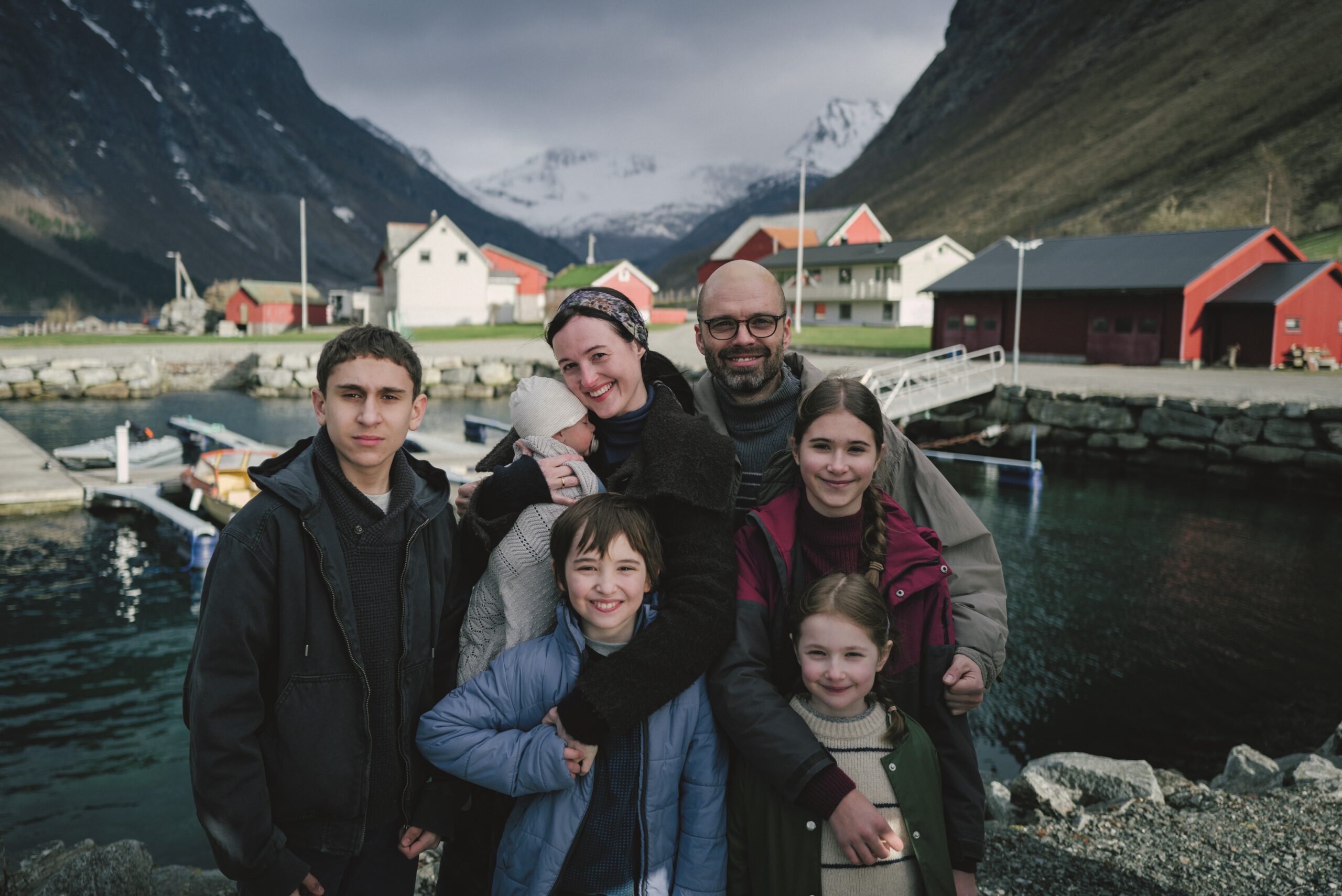
The two actors play Mihai and Lisbet Gheorghiu, who have spent years living in his native Romania, in Bucharest. After the death of his parents, they decide to settle in the Norwegian village where she grew up, as Mihai’s in-laws can help them take care of their five children (the youngest of whom is still a little baby). The language barrier causes a little awkwardness (Mihai understands Norwegian but doesn’t speak it well, and the children are still learning), but English is widely accepted within the community, and everything seems to be going well, although some eyebrows are raised over the fact the children aren’t allowed cell phones or access to the Internet.
Then, one day, one of the teachers overhears an exchange between the two oldest kids that suggests the parents’ conservative, faith-based education methods might include physical violence. As others had previously noticed bruises on the children’s bodies, this causes the school to reach out to the relevant authorities, and soon a conflict arises: as they have to fight for the chance to keep seeing their children (kept separate not just from the parents, but also from each other), Mihai and Lisbet are confronted with the uncomfortable truth that, despite the progressive aura enveloping the country they live in, a culture clash will almost always be inevitable.
Per the press notes, the story – rooted in extensive research on similar cases, although the plot isn’t based on one specific incident – takes place in Norway (the shoot happened primarily in Ålesund, on the Western coast), but it could be any of the Nordic countries, all seen as a bastion of progressive values. This point is hammered home by the fact Denmark, Sweden and Finland all contributed to the production (with different crewmembers coming from all the concerned territories), and while xenophobia is not overtly mentioned, there is a subtle allusion to it via the presence of Mia (Lisa Carlehed), a Swede who relocated to the neighboring country and indirectly embodies the notion of someone who assimilated “correctly”.
Of course, the fact Fjord – a title indicative of the metaphorical waves and current that threaten to drag the parents into an abyss – was shot in Norway means Mungiu got to cast Reinsve as Lisbet, giving her another meaty role to chew on as a woman walking a tightrope between her country of origin and the culture she married into, trying to figure out exactly where things went wrong. It’s a role she could play in her sleep at this point, but the nuances in the screenplay, paired with her understated performance, make this mother of five a compellingly complex figure who periodically earns and then loses audience sympathy (viewers expecting a clean cut take on the subject will probably not be happy with what transpires in the third act).
Arguably even more impressive in Stan, who reconnects with his Romanian roots (he was raised in Bucharest and Vienna by his mother, and made his film debut in Michael Haneke’s 71 Fragments of a Chronology of Chance at the age of 11). Having previously wowed audiences with his turns in A Different Man and The Apprentice, playing men who felt confident – sometimes to a fault – with their verbal skills, here he scales it back as someone who has to express himself in a second or even third language, letting his incredulous and frustrated facial movements convey all the layers of simmering rage once he realizes the progressive society he was invited into draws certain lines when it comes to tolerance.
It’s all perfectly measured, much like the film itself, which Mungiu constructs with a clinical eye for observation without passing judgement; much like the people looking into Mihai and Lisbet’s conduct, his empathy lies primarily with the children, while still refusing to explicitly state which side he agrees with. The shades of gray, which at times blend with the white of the snow-covered mountains, remain constant as the director examines a new microcosm, through the prism of globalization, to deliver his most internationally conscious viewpoint to date on something he has always emphasized: we all contain multitudes. Whether they’re compatible, within the same person of between different people, is left entirely up to the viewer.
Director, Screenwriter: Cristian Mungiu
Cast: Sebastian Stan, Renate Reinsve, Lisa Carlehed, Ellen Dorrit Petersen, Lisa Loven Kongsli, Henrikke Lund-Olsen, Vanessa Ceban, Christian Rubeck, Markus Scarth Tønseth
Producers: Cristian Mungiu, Dyveke Bjørkly Graver, Andrea Berentsen Ottmar, Katrin Pors, Mikkel Jersin, Jussi Rantamäki, Emilia Haukka, Sean Wheelan, Kristina Börjeson, Mimmi Spång, Pascal Caucheteux, Vincent Maraval, Grégoire Sorlat, Marco Perego, Adela Vrânceanu Celibidache
Cinematography: Tudor Vladimir Panduru
Production design: Marius Winje Brustad, Simona P?dure?u
Costume design: Kirsi Gum
Music: Kaspar Kaae
Sound: Constantin Fleancu, Pietu Korhonen, Kristian Eidnes Andersen
Production companies: Mobra Film, Why Not Productions, Eye Eye Pictures, Film i Väst,
Garagefilm International, Snowglobe, Aamu Film Company, France 3 Cinéma, Goodfellas
World sales: Goodfellas
Venue: Cannes Film Festival (Competition)
In Norwegian, English, Swedish, Romanian
146 minutes