
My Father’s Shadow
.
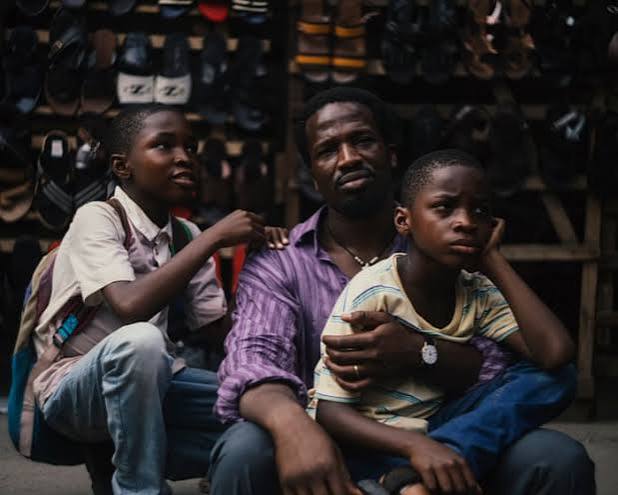
VERDICT: In a boldly impressionistic sketch teetering between dream and reality, Akinola Davies, Jr. makes a dazzling feature debut with ‘My Father’s Shadow’, a gripping exploration of the bonds between a father and his young sons and the societal forces tearing them apart.
It is rare that a story set far away in 1993 Nigeria, about characters whose lives don’t obviously intersect those of most viewers, strikes the heart with as powerful a punch as My Father’s Shadow.
Directed by British-Nigerian filmmaker Akinola Davies, Jr. from a screenplay he wrote with his brother Wale Davies, this impressive first feature recounts how an absentee dad impulsively takes his 11-year-old Akin and his 8-year-old Rémi on a daytrip to the big city of Lagos. It is a day that will change their family forever.
After bowing at Cannes in Un Certain Regard last year as the first-ever Nigerian film in the official selection (and, no small feat, where it won the Caméra d’Or — Special Mention), the film was the U.K.’s Oscar submission for best international feature and a big BAFTA winner. Its latest appearance is in Amman’s Non-Arab Feature Competition.
On a lazy day in June, while their mother has gone to the village leaving Akin in charge of his little brother, the boys are frightened to see a man appear in the bedroom – their father. He works in a factory in Lagos and they see him so seldomly that he has become a distant figure. But moved by their pleading, he suddenly decides to take them with him to Lagos, where he has to collect overdue wages from his boss. A walk through the forest takes them to a crowded bus, which soon runs out of gas. They are left to hitchhike their way to the city, where more adventures await.
Perhaps it is the autobiographical elements, reimagined in the fictional story, that set the film apart and give it a profound feeling of psychological truth and authenticity. Each member of the main cast – the father Fola (Sope Dirisu), elder son Godwin Egbo and younger boy Chibuike Marvellous Egbo – brings strength and complexity to his role, while the fundamentally unstructured narrative does away with familiar character arcs. There are no pat conflicts or satisfying resolutions in this story of an imperfect man seen through the mythologizing but critical eyes of his children.
But more is going on than a family reunion. As Fola takes his kids around the city, the sense of overwhelming poverty becomes pervasive, like friends living on small loans and the generosity of others – all lessons in sharing that he imparts to the boys. Their hope for a better future depends on reelecting a democratic government, a political movement Fola seems involved in and that creates an atmosphere of danger around him.
This underlying tension is signaled in different ways: the soft, exceedingly ominous background score by Duval Timothy and CJ Mirra accompanies the little family on their trip; carrion birds continually circle overhead, while street preachers proclaim doom; the camera picks up details of rotting cars, fruit and animals. The most open threat comes from truckloads of scowling soldiers armed to the teeth who seem to pop up everywhere. So do newspaper headlines that scream about a “Bonny Camp Massacre.”
General elections have just been held after a decade of military rule. The camera captures the excited faces of normal people on the street and in a caffè, who have overwhelmingly voted for the social democrat businessman M.K.O. Abiola. When the military government annuls the election results on television, people take to the streets in a spontaneous uprising. The terrified Akin and Rémi are swept up in the chaos and violence along with their father.
There are echoes here of Raoul Peck’s 1993 classic The Man by the Shore, in which the domestic terror of Haitian dictator Papa Doc is seen through the eyes of a young girl. And Davies captures some of Peck’s lyricism, too, in his free-wheeling editing offering subliminal glimpses of ambience and atmosphere, shot in 16 mm with visceral sensuality by D.P. Jermaine Edwards.
As the streets explode with violence in a thrilling scene of sustained terror, the significance of the Bonny Camp massacre is finally revealed and its connection to Fola becomes sickeningly clear – at least it becomes clear by inference, which may pass over the heads of some audiences. Similarly, the screenwriters choose the risky emotional rollercoaster of a dubious double ending which is first happy, then sad. This feels like taking complex story-telling too far, especially when either ending would have provided definitive closure. But these instances of narrative over-reach can’t sink an otherwise marvelously inventive screenplay.
The three central performances, underlined by warm closeups, go deep. As the father, Sope Dirisu uses his imposing physicality to connect with his estranged boys, like in an elemental scene on the beach when he swings both of them over the water, one on each arm. An aura of mystery veils him from boys and viewers alike: his feelings for his wife and his lover, his political convictions, his interpretation of a father’s role as the breadwinner of the family rather than its emotional support. As his sons, the Egbo brothers are perfectly cast, the angry and stubborn (and very funny) little Rémi demanding love, while the hugely expressive Akin is better able to assimilate the disappointments and unfairness of the adult world. Overall, they make the film a powerful introduction to Nigerian cinema.
Director: Akinola Davies, Jr.
Screenwriter: Wale Davies, Akinola Davies, Jr.
Producers: Rachel Dargavel, Funmbi Ogunbanwo
Cast: Sope Dirisu, Godwin Egbo, Chibuike Marvellous Egbo
Cinematography: Jermaine Edwards
Production design: Jennifer Anti, Pablo Anti
Editing: Omar Guzman Castro
Music: Duval Timothy, CJ Mirra
Sound: CJ Mirra
Production companies: BBC Film, BFI, Element Pictures, Crybaby in association with Fatherland (Nigeria)
World sales: The Match Factory
Venue: Amman Film Festival (Non-Arab Feature Competition)
In English
94 minutes