Ink
Ink
VERDICT: Danny Boyle directs this stylish, punchy, occasionally heavy-handed adaptation of James Graham's hit stage play about Rupert Murdoch's early adventures in tabloid news.
Despite his long track record as a film festival fixture, British director Danny Boyle belatedly makes his Venice debut this week with Ink, a splashy choice of opener for the Biennale competition. Adapted by dramatist James Graham from his own 2017 stage play, which enjoyed prize-winning runs in both London and New York, this punchy period piece revisits Australian media tycoon Rupert Murdoch’s controversial arrival on the London tabloid newspaper scene, an epochal cultural shift that still resonates today.
Shot with Boyle’s customary visual brio, Ink is consistently entertaining, with plenty to say about the contemporary media landscape, even if its conclusions feel a little glib and bombastic at times. Boyle’s reliable track record plus a meaty cast headlined by Guy Pearce, Jack O’Connell and Claire Foy should guarantee solid audience appeal. Following joint festival premieres in Venice this week and Toronto on September 15, Studiocanal are lining up European release for January, while Netflix plan a limited US theatrical run in December ahead of a January streaming debut.
Much of Ink follows that familiar, crowd-pleasing narrative trope of plucky, rule-breaking outsiders beating snobby establishment elites at their own game. In 1969, Rupert Murdoch (Guy Pearce) buys the ailing, money-losing British tabloid The Sun and hires a brash young editor, Albert “Larry” Lamb (Jack O’Connell), to turn its fortunes around. Lamb takes the paper in an irreverent, populist direction, increasing its coverage of sports, celebrities and scandal. Big-prize competitions, TV adverts and topless “glamour model” shoots also boost readership. Initially dismissed as salacious trash by its Fleet Street competitors, The Sun is soon outselling all of them, with circulation in the millions. Like Lamb, Graham has working-class roots in the north of England, so his caustic portrait of London’s stuffy media gatekeepers may have extra personal resonance.
Interestingly, while Murdoch is routinely painted as a Machiavellian monster by the left-leaning creative arts community, Ink depicts him with even-handed nuance and even compassion. There is scant trace of Logan Roy from Succession in Pearce’s measured, layered portrait. Indeed, Murdoch comes across as restrained and prudish in the face of Lamb’s boorish, attention-grabbing stunts. His key arguments – readers like stories, news should be entertainment, deference towards the British upper classes is over – are certainly hard to refute. Graham and Boyle appear less concerned with character assassination than with the unforeseen moral consequences of letting this genie out of the bottle, the damage that undiluted tabloid excess has done to our collective souls.
In its dramatic middle act, Ink becomes a true-crime thriller when Muriel McKay (Lucy Russell), wife of Murdoch’s office deputy, is abducted from the family home by masked raiders. After mistaking McKay for Murdoch’s first wife Anna, the kidnappers demand a million-pound ransom. When the police fail to make any headway, Lamb uses The Sun in a contentious public campaign to track them down. His legally and ethically dubious tactics end in tragedy, but Graham leaves it open to question how much blame can be levelled at Lamb. With echoes of Boyle’s TV kidnap drama Trust (2018), this is the film’s most gripping chapter, combining high stakes and kinetic action.
Graham was not even born when the events in Ink took place, and he is arguably a little too misty-eyed about a lost Fleet Street subculture ruled by boozy machismo, sleazy sexism and casual racism. In fairness, Boyle and Graham try to temper all this testosterone with a handful of secondary women players, notably the fictionalised amalgam character Jules Davis (Foy), a sassy reporter who is also Lamb’s open-secret mistress.
Stefanie Khan, who became the first model in the paper’s long-running “Page Three” topless photo section, also features in a brief subplot. British viewers are more likely to pick up on some of the minor background details here, including early hints of Murdoch’s game-changing 1980s battles with the newspaper print unions, and of his plans to promote The Sun’s hugely controversial future editor, Kelvin MacKenzie.
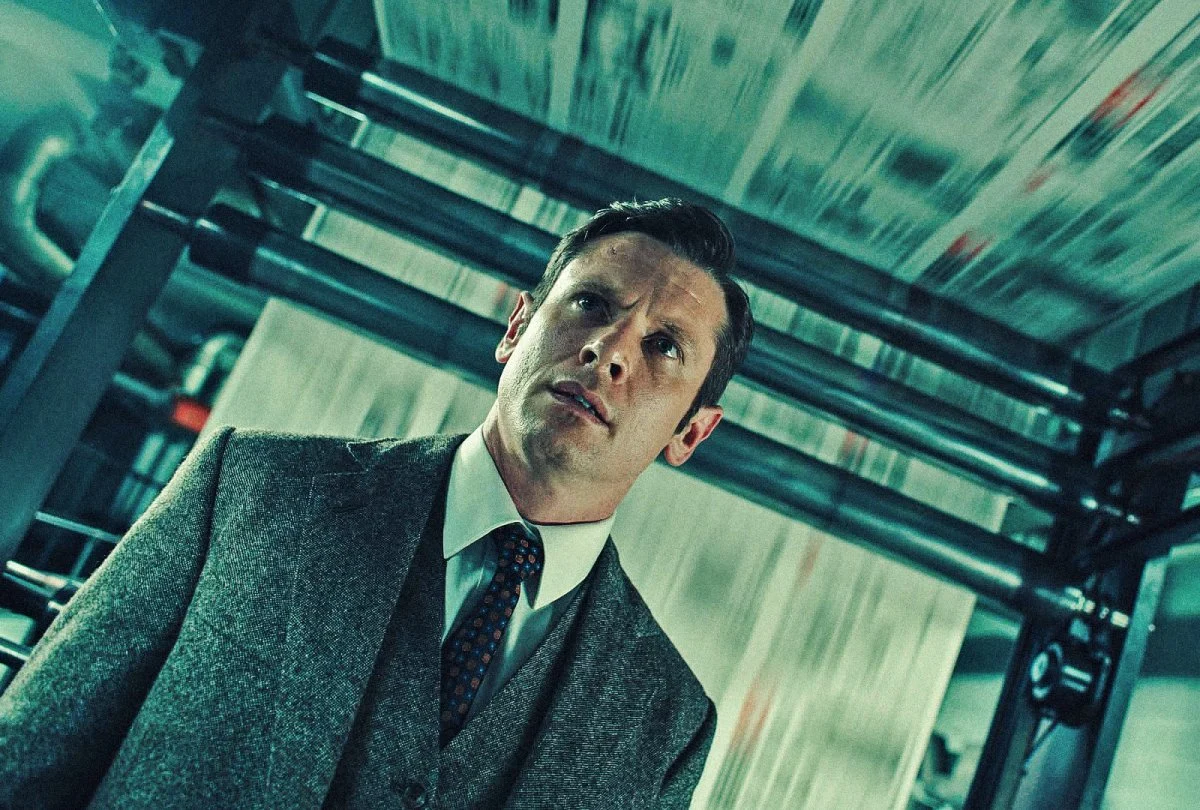
Boyle has always been a strong visual stylist, opening up Ink beyond its stage-play origins with his signature jump-cutting collagist energy and lively, vintage pop-heavy soundtrack. Sprinkled with snippets of archive newsreel footage, Alwin Küchler’s cinematography is purposely grainy, its muddy colours and slanted camera angles invoking the tobacco-stained, smog-choked, soot-caked look of London at the dawn of the 1970s. A rowdy office party sequence featuring an ariel panorama of revellers having sex, taking drugs and throwing up in toilets plays like a self-conscious homage to the director’s greatest hits, notably Trainspotting (1996). Boyle remains the poet laureate of filthy bathroom hedonism.
Graham’s screenplay for Ink lightly tweaks the original stage text, which foreshadowed Murdoch steering The Sun to the political right under Margaret Thatcher’s Conservative government, as well as his future purchase of Fox News in the US. The film ends on a more universal and timely montage, appearing to blame this embryonic skirmish in the culture wars for a wide array of 21st century evils including fake news, the dark side of social media, the Andrew Tate manosphere and more.
Wherever you stand on the malign power of Murdoch’s media empire, this conclusion feels slightly strained and simplistic. Boyle is clearly not immune to tabloid tactics himself. All the same, Ink is a compelling overall package, a timely treatise on journalistic ethics, and a gripping cautionary fable about the dangers of giving people what they want.
Director: Danny Boyle
Screenwriter: James Graham
Cast: Jack O’Connell, Guy Pearce, Claire Foy, Blake Harrison, Patrick Kennedy, Lucy Russell
Cinematographer: Alwin H. Küchler
Editing: Fin Oates
Production and costume designers: Carson McColl, Gareth Pugh
Music: Daniel Pemberton
Producers: Danny Boyle, Tracey Seaward, Tessa Ross, Michael Ellenberg, Anna Marsh, Ron Halpern, Joe Naftalin, Sudie Smyth, Tonia Davis, Zoe Edwards, James Graham
Production companies: House Productions (UK), Media Res (US), Studiocanal (France)
Venue: Venice Film Festival (Competition)
In English
116 minutes