Bucking Fastard
Bucking Fastard
VERDICT: Legendary German director Werner Herzog returns to fictional drama with an audacious, critically divisive, based-on-reality fairy tale starring Rooney and Kate Mara as sisters who share a spookily close bond.
Making a rare return to fictional storytelling after a late-career phase dominated by documentaries, Werner Herzog opens Bucking Fastard with a dedication to David Lynch. This is an early clue that we are not heading for conventional dramatic terrain with this dreamlike, surreal, darkly comic fable, which stars real-life siblings Rooney and Kate Mara in their first-ever screen pairing as eccentric sisters who share an uncannily close bond and an obsessive fixation on finding true love. A long-gestating passion project for the 83-year-old Bavarian director, this gonzo fairy tale world premieres in competition this week at the Venice Film Festival, where it has already divided critical opinion.
Herzog chose to debut Bucking Fastard in Venice, where he is also picking up an honorary Golden Lion award for Lifetime Achievement, after declining a non-competitive slot in Cannes. He is pitching this as the last part of a “operatic triptych” about obsessive outsiders following Fitzcarraldo (1982) and Grizzy Man (2005), which is a neat marketing hook, and this art-house curio is going to need any promotional help it can get. It plays like a half-cooked experiment at times, but it is also sweetly charming, hauntingly strange, sporadically hilarious and elevated by strong performances.
The inspirational spark for Bucking Fastard is the true story of Freda and Greta Chaplin, twin sisters from Yorkshire in northern England, who earned media notoriety in the early 1980s after they were briefly jailed for harassing a local truck driver with whom they had become obsessed. Indeed, the film’s title comes from one of the pair’s verbal slips during their trial. Reclusive misfits with a troubled family life, the sisters became highly dependent on each other from childhood, wearing the same clothes, speaking in overlapping echoes, completing each other’s sentences. They escaped York for London in the late 1980s thanks to a kindly benefactor, Jack Davenport, who acted as their landlord and protector. The pair were never diagnosed with any mental health conditions, but they certainly appear fragile and traumatised in archive documentary footage.
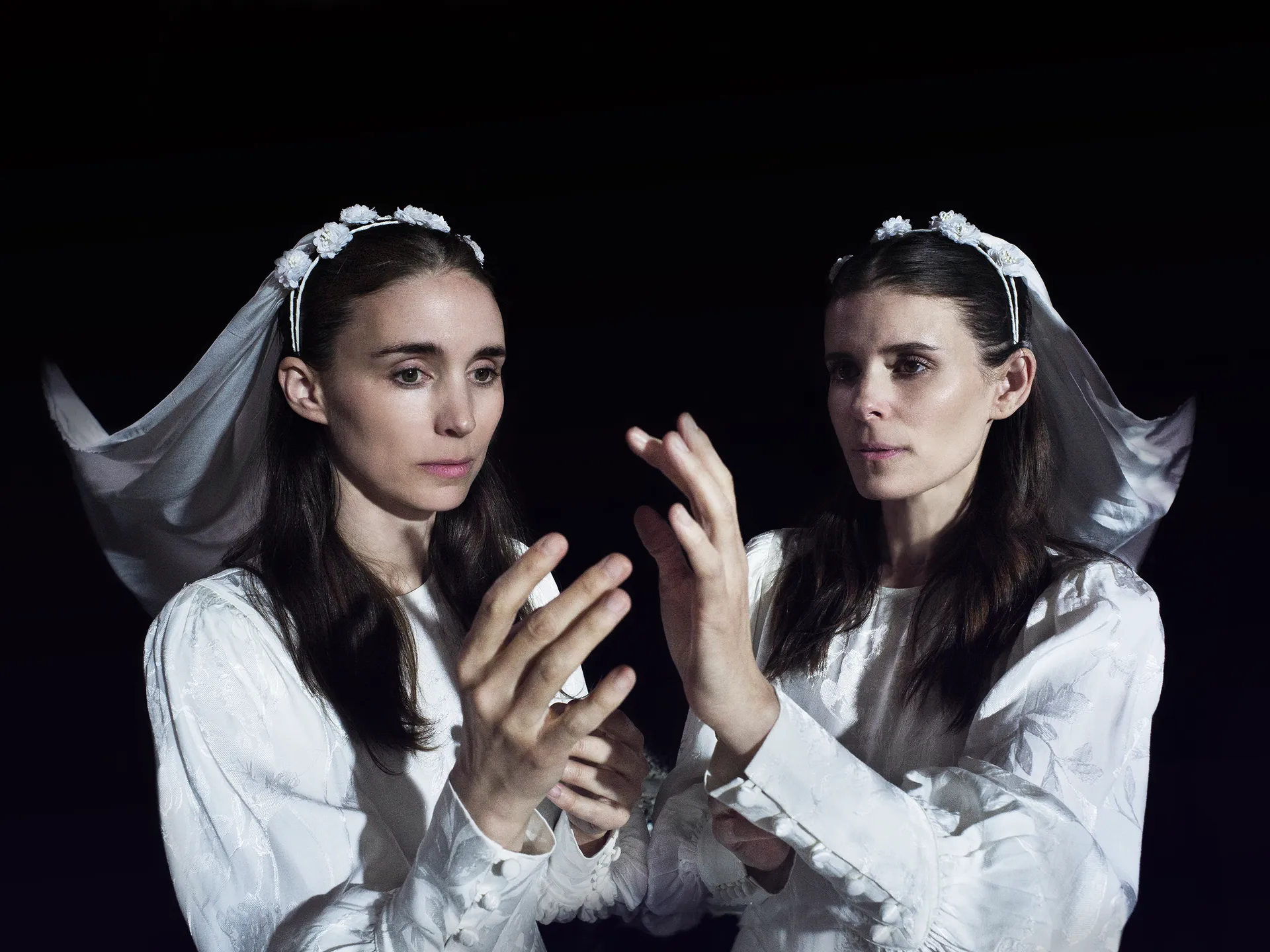
Herzog has been mulling a Chaplins-inspired project for more than 30 years, mentioning them in his 1991 Filmstunde interview series and later memoirs. His re-imagination of their case contains some key biographical parallels, but strikes a much more sunny and comic tone. In his version, the sisters become Joan and Jean Holbrooke (Rooney and Kate Mara), who wear matching outfits and do everything in unison, speaking not in overlapping echolalia but in synchronised lockstep most of the time. This uncanny doubling effect is highly effective on screen, playing like an extended performance art piece. Think the eerie supernatural twins in The Shining (1980) but much more cheeky fun, and dressed by Wes Anderson’s production team.
The pair live in a highly stylised, hall-of-mirrors version of contemporary Ireland, where they become embroiled in a lusty three-way affair with their hunky neighbour, Gareth Malone (Orlando Bloom on grand form, essentially channelling Colin Farrell in charming rogue mode). But when Malone calls off their tryst in order to marry someone else, Jean and Joan respond with scalding fury, stalking and arson attacks. After a bruising court case, they escape to a new life in the city, where social worker Timothy (Domnhall Gleeson) watches over their welfare. But they are fragile innocents in an urban jungle, and creepy attention from male neighbours soon becomes a daily problem. Once again, Herzog gives us a wonky, Fellini-esque fever-dream of Dublin here, populated by mentally challenged oddballs and predatory clowns.
The sisters are then rescued once more when their big-hearted aunt Louise (Marion O’Dwyer) invites them to live at her idyllic farmstead in the rural far west of Ireland, in the shadow of a dramatic mountain landscape streaked with limestone caves. Herzog purposely keeps time-and-place details vague but this striking location is Keshcorran Hill in County Sligo. Here they live a simply rustic existence, rescue a stray fox from a government cull, and befriend twinkly-eyed locals who enchant them with romantic folklore about the caves. Taking these ancient superstitions as literal truth, Jean and Joan then spend years digging through the mountain searching for the “gateway to Orkney”, a mythical lost kingdom of love and happiness.
This epic tunnelling project becomes a deranged, Fitzcarraldo-sized task which is surely doomed to tragic failure. And yet, here in Herzog’s cave of half-forgotten dreams, even the most outlandish fantasy ending is permitted. It would be hard to spoiler such a relentlessly illogical plot, but the film’s final act makes great use of the Postojna cave complex in Slovenia, a subterranean wonderland full of cathedral-sized chambers, magnificently sculptural stalactites and “baby dragon” lizards. This is the kind of awe-inspiring location the director explores in his nature documentaries, this time with its magical otherness tilted towards fictional narrative.
Judged as conventional cinematic drama, there is plenty to critique in Bucking Fastard. The tonal shifts are bumpy, the humour uneven, and secondary characters feel like cartoonish caricatures. Herzog is a fluent English speaker, but his English-language dialogue often feels cumbersome and stilted. Whether this goofy excursion into a fairy-tale underworld ultimately adds up to anything deeper than self-indulgent whimsy is open to question.
But viewed from a more generous angle, as an audaciously playful late-career statement from an uncompromising director, this is an enjoyably bold trip through the looking glass into Lynch-lite weirdness. The Mara sisters give compelling, attention-grabbing mirror performances while Herzog’s long-time cinematographer Peter Zeitlinger does great work with restlessly kinetic camerawork, whirling and sweeping from sparkly mountain vistas to intimate close-ups. Bucking Fastard is maybe not a future cult classic, but it is certainly a commendably ambitious work for such a seasoned screen heavyweight, and pleasing proof that Herzog still has a few surprises in him.
Director, screenwriter: Werner Herzog
Cast: Kate Mara, Rooney Mara, Orlando Bloom, Domhnall Gleeson, Hugh O’Connor, Marion O’Dwyer
Cinematographer: Peter Zeitlinger
Editing: Marco Capalbo
Production designer: Derek Wallace
Costume designer: Maeve Paterson
Music: Ernst Reijseger
Production company: Providence Road Entertainment (US), Gateway to Orkney (Ireland)
Producers: Werner Herzog, Ariel Leon Isacovitch, Clara Wu Tsai, Agnes Chu
World sales: Hanway Films, London
Venue: Venice Film Festival (Competition)
In English
109 minutes