
From Inside Out: The Architecture of Peter Zumthor
From Inside Out: The Architecture of Peter Zumthor
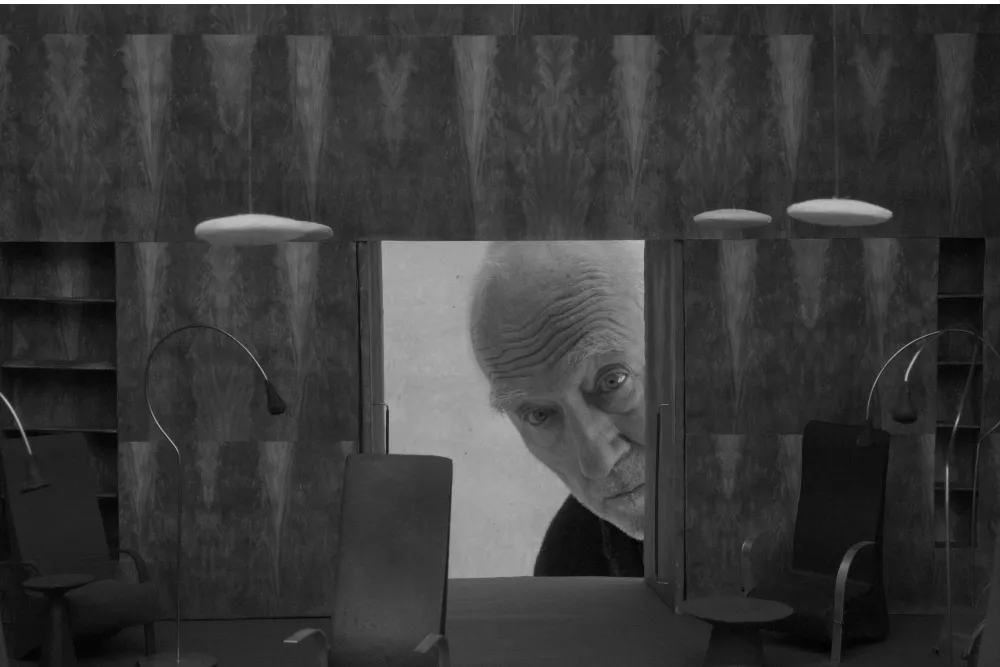
VERDICT: Wim Wenders explores the work of prize-winning Swiss architect Peter Zumthor in this finely crafted 3D documentary, a beautiful if slightly opaque love letter from one maestro of deluxe minimalism to another,
Exploring Goethe’s maxim that “architecture is frozen music”, Wim Wenders delivers a musically rich, visually exquisite, formally eccentric portrait of Swiss architect Peter Zumthor in his latest feature-length documentary. The 81-year-old German auteur shoots From Inside Out: The Architecture of Peter Zumthor in lustrous high-resolution 3D, a format he has used multiple times before, most effectively in his superb cinematic memorial to legendary avant-garde choreographer Pina Bausch, Pina (2011). This stereoscopic dimension may sound like a gimmick, but the immersive effect is very pleasing, plunging us into the temple-like chambers and monumental spaces at the heart of his subject’s work.
Wenders has enjoyed something of a late-career resurgence in recent years, earning rapturous reviews, multiple prizes and an Oscar nomination for his most recent Tokyo-set drama Perfect Days (2023). But away from his erratic fiction filmography, he has also built up a long-running sideline in high-gloss documentaries celebrating the work of other artists, from Yasujiro Ozu to The Buena Vista Social Club, photographer Sebastião Salgado to visual artist Anselm Kiefer.
From Inside Out feels like a relatively minor addition to this canon, partly because the Pritzger Prize-winning Zumthor is a low-profile figure who typically works on modestly scaled projects, but also because Wenders frames his story with an unusually diffuse, opaque, sideways gaze. Following the film’s Venice world premiere this week, audience interest is likely to be specialist, but connoisseurs of concrete porn, luxury minimalism and tactile brutalism will find much to enjoy in this low-voltage love letter from one meticulous craftsman to another. An executive producer credit for Brad Pitt, architecture fan and long-time champion of Zumthor’s work, could prove an extra selling point.
This project began as a short film commissioned for the Venice architecture biennale in 2012. Eager to make something more substantial, Wenders returned to interview Zumthor multiple times in his Swiss studio over the next 14 years. He also made pilgrimages to his best-known works, including his huge but elegant shelter for Roman ruins in Chur, the fortress-like concrete edifice of Vals thermal baths in the Swiss alps, and the handsome cuboid glass tower of Bregenz Art Museum in Austria. Lending the film a timely crescendo, Wenders spends much of his final act swooning over the sensuous curvilinear contours of Zumthor’s largest commission to date, the David Geffen Galleries at the Los Angeles County Museum of Art, which only opened in April this year.
Wenders takes an elliptical approach to Zumthor’s biography, sharing only spare factual details, making the buildings centre stage instead of the man who designed them. We learn less about the architect’s life than his guiding philosophy, which is to root his constructions very deeply in their local context and history, using maximum local artisan input and timeless materials like wood, brass and Jurassic limestone. A building, he says, should feel like “the final piece of a landscape that was not yet complete.”
Rather than using a genre-typical array of experts and talking heads, Wenders enlists a starry background chorus of artists, writers, dancers, musicians and fellow film-makers to move through Zumthor’s buildings, responding to them in personal ways. In some scenes, he even adds ghostly figures to represent past inhabitants of these spaces. Some of these cameos feel frustratingly scrappy, such as the scenes at the David Geffen Galleries, where film-maker Werner Herzog and his visual artist wife Lena share a fleeting conversational exchange while director Ava DuVernay and others float around in the background. Conventional or not, a few more focussed insights from these creative heavyweights would have been welcome.
But other interactions feel more fully realised and intellectually grounded. One of the strongest chapters takes place at the Steilneset Memorial to the 91 people tried and executed as witches in the 17th century by the remote Norwegian island community of Vardø. A collaboration between Zumthor and artist Louise Bourgeois, this visually stunning arctic monument opened in 2011. Wenders follows Norwegian-born writer Siri Hustvedt, who has written about the witch trials but never before visited the site, as she shares her impressionistic musings on camera.
Wenders also takes care to warm up these cool concrete spaces with human touches, particularity music. Early in the film, double bass player Anna Trauffer performs inside one of Zumthor’s earliest works, the exquisitely crafted St. Benedict’s chapel in the Swiss mountain village of Sumvitg. Later, singer-songwriter Sophie Hunger brings her guitar to one of his newest, the extension to the Beyeler Foundation art gallery in Basel, which she explores while strumming and singing her jaunty theme song commissioned for this film. The underlying score also features the lightly experimental jazz-folk duo Kappeler/Zumthor, which consists of Zumthor’s son Peter Conradin Zumthor and his pianist partner Vera Kappeler.
Shot with customary painterly precision by Wenders and his regular cinematographer Franz Lustig, From Inside Out is never less than ravishing visually, full of slow-gliding mobile shots and impeccably composed stereoscopic tableaux. Overall this is a beautifully tailored, enjoyably pretentious, occasionally self-indulgent but frequently sublime documentary which ultimately celebrates the deluxe minimalist aesthetic of both subject and director.
Director, screenwriter: Wim Wenders
Cast: Cast: Peter Zumthor, Anna Trauffer, Carin Caduff, Tarek Atoui, Aoi Yamada, Siri Hustvedt, Pedro Reyes, Reiko Sudo, Mark Bradford, Ava DuVernay, Mark Oliver Everett, Ever Anderson, Lena Herzog, Werner Herzog, Sophie Hunger
Cinematography: Franz Lustig, Sebastian Cramer
Editor: Maxine Goedicke
Music: Vera Kappeler, Peter Conradin Zumthor, Laurent Petitgand, Sophie Hunger
Producers: Karsten Brünig, Wim Wenders, Marc Schmidheiny, Christoph Daniel, Dario Suter, Joel Brandeis
Production companies: Road Movies (Germany), DCM (Germany)
World sales: Hanway Films, London
Venue: Venice Film Festival (out of competition)
Language: German, Swiss German, English
114 minutes