
Growth of the Soil
Markens Grode
VERDICT: Asta Kamma August is a star on the rise in Hans Petter Moland's epic.
“The long, long road over the moors and up into the forest—who trod it into being first of all? Man, a human being, the first that came here. There was no path before he came,” begins Knut Hamsen’s 1920 Nobel Prize-winning novel Growth of the Soil. So too does Hans Petter Moland’s elemental adaptation, which zeroes in on the first half of the book capturing the dirt under the fingernails reality of life on the edge of civilization.
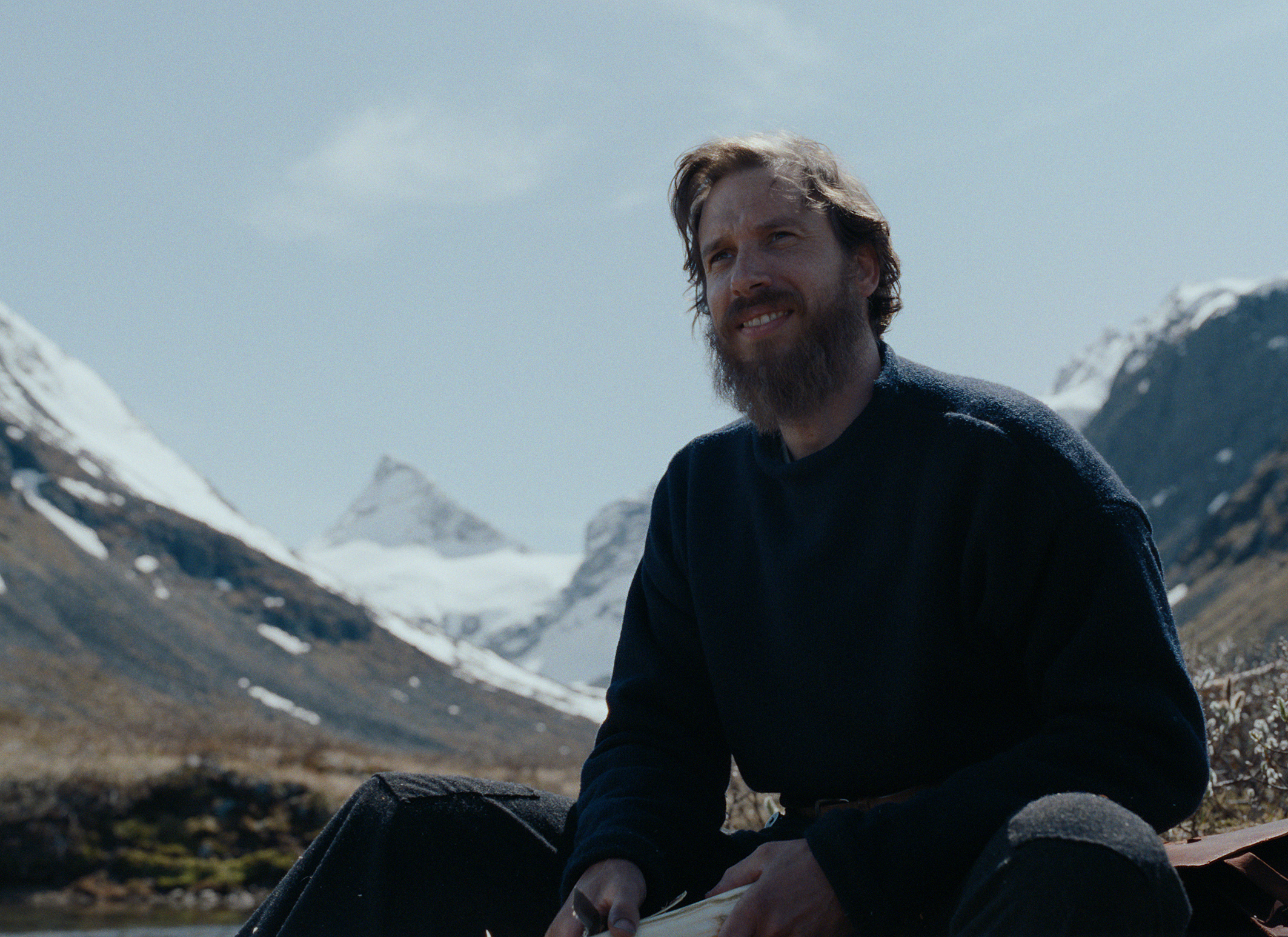
Isak (Herbert Nordrum) is man literally carving out his place in the world. In a remote, mountainous region of northern mid-19th century Norway, he finds a patch of land wild with timber and decides to make it his home. A crevice in a rock face is the first place he finds shelter, as it protects him from the wind and snow. Soon he is joined by Inger (Asta Kamma August), a woman with a harelip, traversing the land with a cow in tow. They make an unspoken agreement to be together and consummate their relationship. They build a home out of timber and rock. And then a barn for livestock. Soon she is pregnant with child. They are in love, living in an enjoyable solitude. They aren’t lonely and their days are filled with farming and raising their child Eleseus. This idyll won’t last.
The modern world encroaches on their life. First comes the arrival of the Sheriff, who informs the illiterate Isak that he must formally register a deed for his property with the state and pay taxes. Another child is born, Sivert. Isak and Inger are happy, and their joy grows. However, when Inger is sent to prison following a violent incident, Isak must raise his sons on his own. And when she returns, their life simply cannot return to what it once was.
Thoughtfully constructed, Moland approaches material as if it were a biblical text. The early portions of the two-and-a-half-hour movie are nearly wordless. Chaptered, the first section is called Before Time and indeed, it feels primordial. Isak and Inger — perhaps like Adam and Eve — are both in wonder and awe at the untamed world. The wind howls around them and the cold gnaws at their bones. A fire is barely enough to keep them warm. Moland makes us feel every tree chopped down, and every boulder leveraged, as the pair wrestle the land around them into something habitable. When Isak is pinned under a tree, with Inger nowhere in sight, the filmmaker unfurls an agonizingly felt sequence as the man figures out how to get a nearby axe into his hands so he can free himself.
If the first half of the film is more primeval, the second stirs melodrama into the mix. Isak’s masculine stoicism starts to fray as Inger, with the changing times, stakes her independence and begins to see the possibilities for herself and children in the wider, quickly modernizing world. Nordrum, perhaps best known for his supporting turn in The Worst Person In The World, operates in a different register here. Under an unkempt beard, his Isak is a man who understands only what’s in front of him, driven by the simple notion that the home and farm he has built will establish his legacy. But nothing is so simple, and the actor finds the tenderness inside Isak’s otherwise largely animalistic nature. As he did for Renate Reisve, Nordrum sets the stage for a breakout turn by August (who also stars this year in the TIFF selection What Lies Between Us). Inger is given the film’s biggest arc, from an almost timid woman who feels undeserving of care given her affliction, to someone who finds the confidence and self-determination in a world she begins to see will no offer no gifts to those who don’t claim opportunities when they arise. And the actress owns it, giving Inger an unforgettably formidable presence, anchored by a head that refuses to be bowed, and an intelligence whose depths are yet to be reach.
Beautifully photographed and painstakingly modulated, The Growth of the Soil falls just shy of achieving the cumulative power of its grand scope. Too often, the film unfolds as a series of events whose emotions are muted. Isak eventually matures and seemingly finds everything he could’ve wanted with a home and wife and children, assuming in his simple way, it would pass on to the next generation. The devastation is that nothing is so easy. Philosophically, Moland communicates that message, but just misses the heart.
Director: Hans Petter Moland
Screenplay: Hans Petter Moland, Gard B. Eidsvold
Cast: Herbert Nordrum, Asta Kamma August, Gard B Eidsvold, Anders Baasmo
Producers: Hakon Overas
Cinematography: Oskar Dahlsbakken
Production design: Thomas Oyjordsbakken Odland
Costume design: Anne Pedersen
Editing: Linda Man
Music: Kaspar Kaae
Sound: Gisle Tveito
Production companies: 4 1/2 FICTION AS 4 ½ Fiction (Norway), Scanbox Entertainment (Norway)
World sales: Beta Cinema
Venue: Toronto International Film Festival (Special Presentations)
In Norwegian
155 minutes