
Coward
Coward
VERDICT: Love is an emotional battlefield in Lukas Dhont's sentimental war movie.
All isn’t quiet on the western front in Lukas Dhont’s Coward. For his third feature, the director endeavors to find queer love and joy deep in the trenches of WWI. But the blunt melodrama in this Cannes-prize winning film is as violent as anything in the battlefield, leaving a cannonball-sized shape in the story’s emotional tenor.
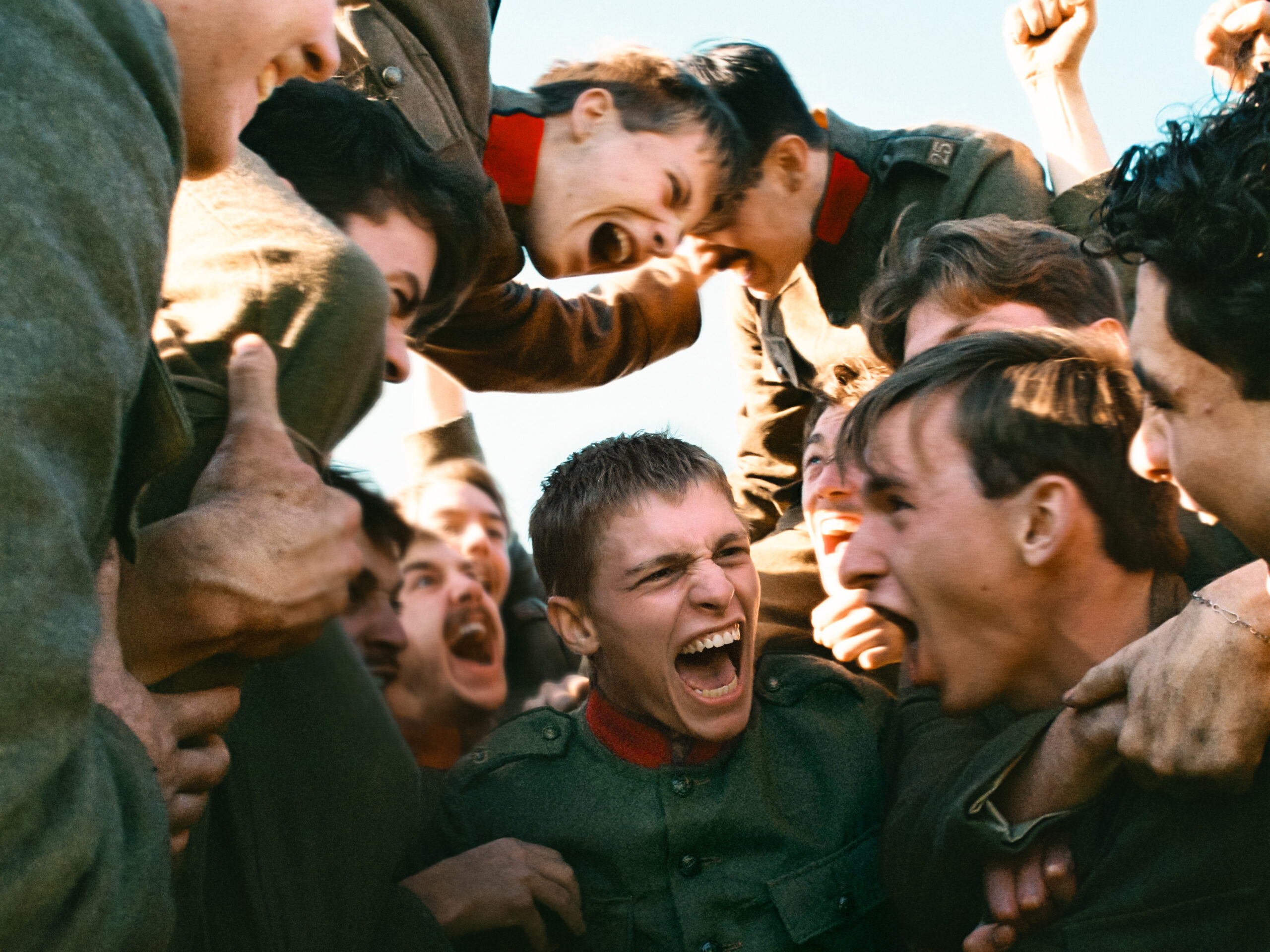
It’s 1916, and a trainload of fresh faced young Belgian men head to the front, psyching themselves up as they sing “Pack Up Your Troubles in Your Old Kit-Bag, and Smile, Smile, Smile” in unison. Pierre (Emmanuel Macchia) is among them, and when he arrives at camp, he does his best to live up to the model of the ideal soldier. Little does he know that there are other ways to serve until he sees “the band of rejects.” Led by the flamboyant Francis (Valentin Campagne), the group of soldiers — unable or forbidden from taking part in combat — are tasked with raising morale among the men. Through song, dance, and plays, Francis (adept at costumes thanks to his trade as a tailor before the war) leads his charges in staging elaborate entertainments for the troops. Soon, Pierre starts helping with their productions and something deeper unfolds with between himself and Francis.
While some of their comrades mutter about about the “rejects” playing arts and crafts while everyone else is “killing the Huns,” its undeniable that the soldiers welcome the distraction from the horrors of the battlefield. If Francis doesn’t fully understand the reality of what goes on in no man’s land, Pierre does. More than once he’s dragged maimed, disfigured, and horrifically injured bodies back to their side until one day he’s had enough, and intentionally drives a knife through his hand. Unable to fight while the wound heals, he joins Pierre and the “rejects” full time. Their love blooms, as intense as it is temporary.
Coward draws it’s strongest power from the bitter irony that Pierre and Francis can enjoy some measure of an unfettered sexual and emotional relationship that, either before or after war, would be untenable. Indeed, Francis half-seriously wishes the war wouldn’t end; he realizes what they have is special and singular. But Pierre has bigger dreams, pushing for promises from Francis of a future together that wavers between unrealistic and delusional. It’s a shame then that so much of this tenderness is rendered with syrupy sentimentality, as Dhont punches in Valentin Hadjadj’s barn door-sized score to ensure not one feeling goes unnoticed. The effect is a movie that unfavorably echoes the worst excesses of 1940s Hollywood dramas, unable to trust viewers to let their own hearts move them. This follows to the two leads — who shared an acting prize on the Croisette — who either by design or from the script settle their performances on a single register. Pierre is mostly interior turmoil, Francis all extravagance, with neither being by led by Dhont toward the sensitivities the story calls for.
Away from Francis’ rehearsals and shows, the wartime sequences are routine. From the muddy trenches to the muddy fields of barbed wire, Dhont feels somewhat uninspired here. The volume is loud, the camera close and shaky; it’s almost as if the scenes were completed with only the most perfunctory interest in order to return to the material the filmmaker felt more compelled by. Similarly, a sequence through a hospital recovery room full of men attempting to heal from life-altering injuries feels muted in the casual and almost cavalier nature in which its displayed.
Coward does earn commendation for interrogating modes of masculinity, and how war blurs the lines of manliness that are more rigidly formalized in peacetime. Otherwise, Dhont’s picture draws a chintzy conclusion that war and love are similar kinds of hell. But as the picture comes to a close, the filmmaker attempts to wrap the film in a happy bow. But its a disservice to the men ruined both physically and psychologically, and an injustice to Pierre and Francis — they are so idealized as to not be changed at all.
Director: Lukas Dhont
Screenplay: Lukas Dhont
Cast: Emmanuel Macchia, Valentin Campagne
Producers: Michiel Dhont
Cinematography: Frank van den Eeden
Production design: Eve Martin
Costume design: Isabel Van Renterghem
Editing: Alain Dessauvage
Music: Valentin Hadjadj
Sound: Valerie Deloof, Flavia Cordey
Production companies: The Reunion (Belgium), Lumen (France), Topkapi Films (Netherlands), Versus Productions (Opus) (Belgium), France 2 Cinema (France), RTBF (Belgium), Proximus (Belgium), BeTV (Belgium)
Venue: Toronto International Film Festival (Special Presentations)
In French, Dutch
125 minutes