
Ghost Song
Geister
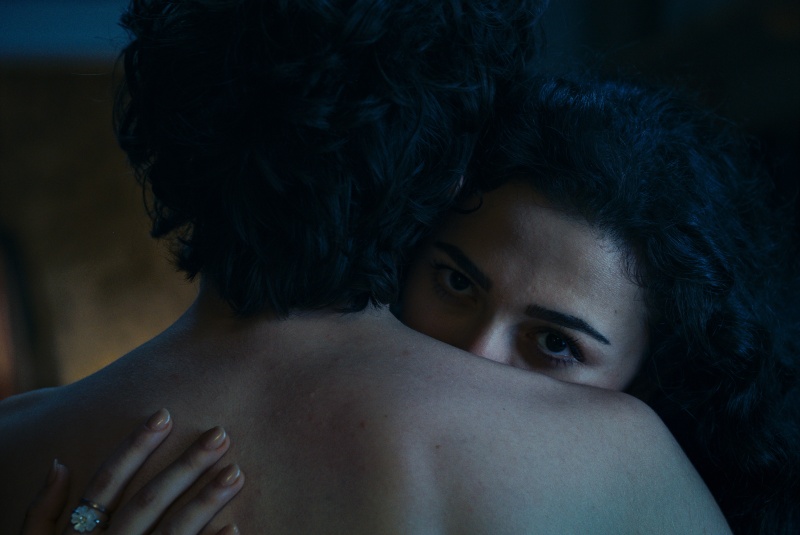
VERDICT: Fatih Akin’s ‘Ghost Song’ (‘Geister’) takes supernatural screen romance to its breaking point, but even those who don’t shed a tear over teenagers’ death wishes will admire the high-class scenery and pacing.
Grabbing the opening spotlight at the San Sebastian festival is Ghost Song (Geister), a romance between 20-year-olds in which one of them dies in the first scene. Although their first date has to be canceled, their love beyond the grave burns brighter in adversity. If this sounds like the plot of a manga, it is pertinent that the film has just been adapted as a graphic novel illustrated by Bea Davies, which is scheduled for release alongside the movie release by Warner Bros. Germany this November. This gives an idea of the younger audiences the film is aimed at.
The version screened in competition at San Sebastian is shot by cinematographer Frank Griebe in gorgeously unexpected black and white, up-fronting the film’s existential themes and turning each shot into a richly layered composition. There is also a graded color version and Akin has said it may be an alternate screening option
Though the story is set in Berlin, the characters are plausibly diversified in their ethnic backgrounds, which span Turkey, Africa and Syria. Versatile German filmmaker and producer Fatih Akin, who cowrote the screenplay with Ruth Toma, has a gift for effortlessly integrating cultures in such a natural, modern way. At the same time, the characters’ various traditions and religious convictions play an important role in their attitudes toward life and death that the story is getting at.
Akin is perhaps best known for his 2017 revenge thriller In the Fade, which won best actress kudos for Diane Kruger in Cannes and the Golden Globe for best foreign language film. Ghost Song, too, unfolds its simple storyline around the untimely death of a person close to the hero.
It all begins in the top-of-the-world restaurant of a soaring TV tower, where students are celebrating their graduation. Faris (Eren M. Guvercin) and Farasha (Mariam Dawoud) meet at the open bar, where they discover they both don’t drink alcohol and both have aced their physics exams. They are also comic-book good-looking and charismatic: Faris has the tousled hair and classic features of a Turkish Chalamet, while Farasha (Mariam Dawoud) has the strong features (and character) of a young Syrian whose choice to wear a traditional headdress sets off her beauty. Their mutual attraction is evident, especially to Farasha’s bestie Una (a vivid Carlotta von Falkenhayn), who is painfully plastered, and to Faris’s best friend. Finally the four set off in Faris’s car to drive home late at night. Between sinisterly interrupted highways and funereal cello chords, the tension starts to rise, then soar.
The accident is not shown immediately but cleverly parsed out by editor Andrew Bird over the course of the film: Faris and Farasha touching hands in the front seat, the car swerving across construction work and finally plunging off the bank into a river. Everyone miraculously escapes – except Farasha. But she is far from being written out of the story. She reappears at her burial service and is frustrated to find that no one can see or hear her except her dead father. He tells her she can communicate with the living for the next 40 days in their dreams, but to go beyond that would drive them mad.
Farasha, however, turns out to be a very selfish ghost, with no intention of letting go of Faris, ever. And he is too deeply in love to break up with her, even while she pushes him to suicide so they can be together.
If at first there are some strong echoes of the Patrick Swaze-Demi Moore relationship in the classic Ghost, by its end Ghost Song leans much more into the dark wizardry of Japanese anime and manga, drawing on their influence to explore the theme of teenage suicide for a younger demographic. It’s the kind of film that speaks directly to younger audiences and that should auger the film well.
Director: Fatih Akin
Screenplay: Ruth Toma, Fatih Akin
Cast: Mariam Dawoud, Eren M. Güvercin, Carlotta von Falkenhayn, Gabriel-Winner Amorim
Producers: Fatih Akin, Herman Weigel, Steffen Schier, Julia Hayungs, Margret Mackuth, Felix Wendlandt
Cinematography: Frank Griebe
Editing: Andrew Bird
Production design: Seth Turner
Music: Malakoff Kowalski
Sound: Joern Martens, Richard Borowski, Corinna Fleig, Tobias Fleig
Production companies: Bombero International (Germany), Warner Bros. Film Productions (Germany) with Rialto Film (Germany)
World Sales: Beta Cinema
Venue: San Sebastian Intl. Film Festival (Official Selection)
In Arabic, German,Turkish
106 minutes