
La Bola Negra
La Bola Negra
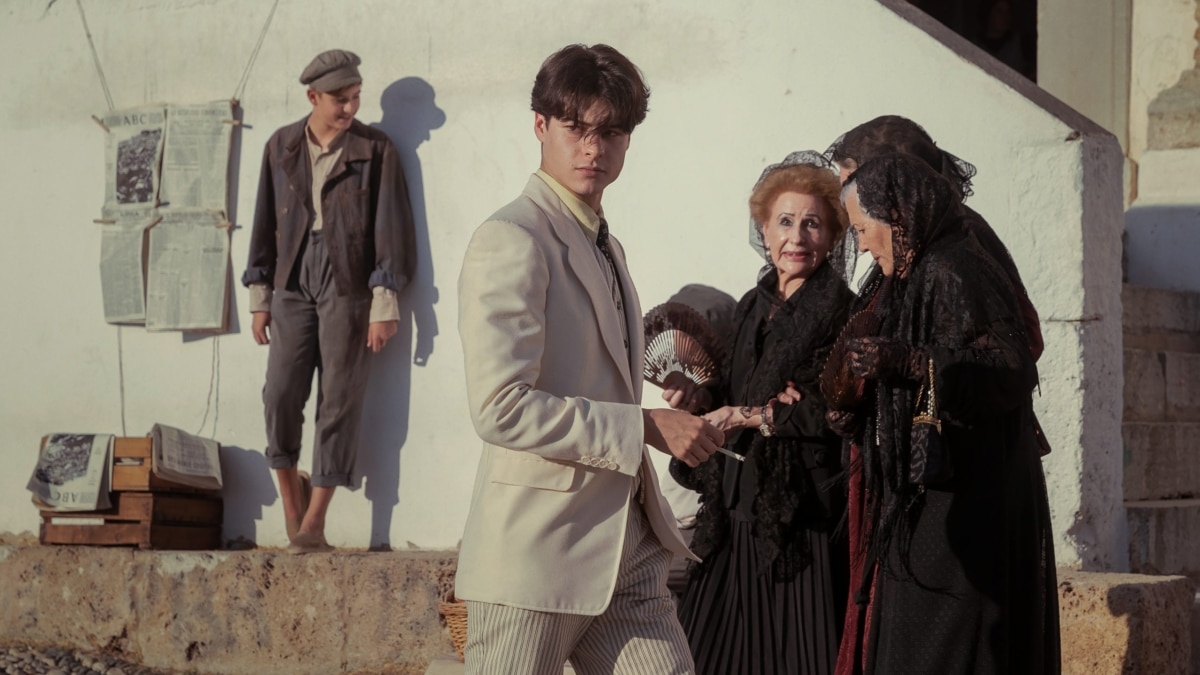
VERDICT: Spanish writer-director duo Javier Calvo and Javier Ambrossi revisit the life and legacy of queer literary icon Federico García Lorca in this ravishing if slightly ungainly epic, a prize-winning Oscar hopeful backed by Penélope Cruz and Pedro Almodóvar.
An operatic blend of fact and fiction, literary adaptation and speculative biography, La Bola Negra weaves a maximalist melodrama around the life, legacy and legend of Federico García Lorca, one of Spain’s most enduring cultural icons and gay martyrs.
Co-directed by Javier Calvo and Javier Ambrossi, a former long-term couple known in Spain by their joint nickname “Los Javis”, this sprawling epic is lavishly mounted and richly layered, sometimes to its own detriment. But it is also a visually ravishing, boldly ambitious, unapologetically high-camp celebration of queerness, artistic creation and sexual liberation. It comes as no surprise to see Pedro and Agustín Almodóvar listed in the credits alongside their production company El Deseo.
Momentum has been building around La Bola Negra since its Cannes world premiere in May, where it earned mostly positive reviews and a shared Best Director award for Los Javis. Since then, it has won further festival prizes in Toronto and Sydney, been bought by Netflix, and selected as Spain’s official submission to the Academy Awards. The film’s homecoming debut in San Sebastián this week, ahead of domestic theatrical release next weekend, has been accompanied by suitably grandiose promotional fanfare, including the carving of a giant Lorca portrait into the town’s main beach. This is not a film about subtle understatement.
La Bola Negra features a time-jumping triptych of plots spanning more than 80 years. In the earliest, set in 1932, a beautiful young man named Carlos (Milo Quifes) applies for membership of an exclusive casino in Granada, only to be voted down by the board using a secret ballot of black and white balls – hence the bola negra of the title, and the origin of the term “blackballed”.
The casino bosses reject Carlos due to scandalous rumours about his closeted homosexuality, which is no secret to his family and friends, but still they insist he must deny his true self to be accepted into polite bourgeois society. This chapter, it transpires, is adapted from fragments of a semi-autobiographical novel which Lorca left unfinished when he was murdered by fascist militia men in 1936 in circumstances which remain unexplained today, but his open sexuality and socialist sympathies made him an obvious target.
Set in 1937, the film’s main narrative arc stars singer-songwriter Guitarricadelafuente, aka Álvaro Lafuente Calvo, in his debut cinematic role as Sebastián, a sensitive young musician who is pressured into fighting for Franco’s Nationalist army during the Spanish Civil War. While on military service on Spain’s rugged northern coast, he befriends a wounded prisoner from the left-wing Republican side, Rafael Rodríguez Rapún (Miguel Bernardeau). Ostensibly mortal enemies, the pair develop an illicit, sensual, erotically charged bond that would mean certain death if discovered. A real person in a fictional setting, Rapún was an actor, football player and Lorca’s sometime lover. He was also a strikingly handsome man, and the film-makers shoot Bernardeau very much as a radiant, magnetic, delicious sex object.
Punctuating these historical chapters, La Bola Negra also features a broadly contemporary storyline set in 2017. Madrid-based writer and historian Alberto (Carlos González) is struggling with various issues, notably a spiky relationship with his boozy, druggy mother Teresa (Lola Dueña). In the midst of their clashes, Alberto uncovers a family secret that links back to the intertwined fates of Sebastián and Rafael, casting new light on Lorca’s unfinished novel. Adding an extra meta-fictional layer, Los Javis share screenplay credits with dramatist Alberto Conejero, whose 2013 stage play La Piedra Oscuro provides this film’s core plot.
Bloated and disjointed at times, La Bola Negra works best as a series of gorgeous tableaux and superbly staged set-pieces: a fascist air raid on a village full of innocents, a naked beach party that makes the homoerotic volleyball scene in Top Gun look positively prudish, a brilliantly choreographed flamenco dance number that unfolds like a fever dream, and more. One excellent stand-alone subplot features Penélope Cruz in a high-voltage supporting role as a sassy, vampish nightclub singer who entertains the Francoist troops despite secretly loathing them. Less successful is Glenn Close’s superfluous cameo as an American Lorca scholar, which is marred by leaden, on-the-nose dialogue.
Consumed in one almost-three-hour sitting, La Bola Negra risks collapsing under the weight of its own operatic pretensions. Particularly in its closing act, which is awash with false endings, unnecessary codas and heavy-handed messaging. Calvo and Ambrossi undoubtedly possess plenty of stylistic flair, but during this final dramatic crescendo they often cross the line between hot-blooded emotionalism and syrupy kitsch. A tighter edit could easily have trimmed half an hour of extraneous padding and still left a rich, ravishing, rousing epic.
All the same, 90 years after Lorca’s murder at the hands of anti-gay fascists, there is something irresistible about a film that celebrates his memory with such lusty defiance, sexy swagger and positive queerness. These battles are still being fought around the globe, of course, but history has largely proven Lorca right and Franco wrong. Sometimes, revenge is a dish best served flaming hot.
Directors: Javier Calvo, Javier Ambrossi
Screenwriters: Javier Calvo, Javier Ambrossi, Alberto Conejero
Cast: Guitarricadelafuente, Miguel Bernardeau, Carlos González, Milo Quifes, Lola Dueñas, Penélope Cruz, Glenn Close
Cinematography: Gris Jordana
Editing: Alberto Gutiérrez
Music: Raül Refree
Producers: Javier Calvo, Javier Ambrossi, Jean Labadie, Alice Labadie, Pedro Almodóvar, Agustín Almodóvar
Production companies: Suma Content (Spain), Los Esquiadores AIE (Spain), Movistar Plus+ (Spain), Le Pacte (France), El Deseo (Spain)
World sales: Goodfellas, France
Venue: San Sebastián International Film Festival (Perlak)
In Spanish, Catalan, Italian, English
159 minutes