
Earbug
Earbug
VERDICT: 'Earbug' turns a young woman novelist’s creative block into a disturbing exploration of childhood trauma, supported by superb voice performances but weakened by thematic excess and uneven characterisation.
by Nemo Kim
Love gets under the skin in Earbug—and into the brain. In Kim Hyo-mi’s animated debut, physical intimacy allows an insect-turned-alien to enter the brain through the ear and reveal hidden feelings—a tempting shortcut for a novelist struggling to write about love. Yet access to the mind does not unlock the heart, sex does not necessarily amount to love, and others’ revelations offer little protection against her own terrible memories.
Combining everyday life with grotesque fantasy, KAFA (Korean Academy of Film Arts, which produced) graduate Kim centers his tale on twenty-something would-be author Jeong-yeon (voiced by Ji-in Jeong), whose creative paralysis is rooted in her unresolved family history. The film is most affecting when confronting the damage inflicted on a child caught in her parents’ marital collapse. Elsewhere, proliferating symbols and unconvincing relationships weaken a drama whose emotional clarity does not always match its visual ambition.
Working at a convenience store to support herself, Jeong-yeon shares a run-down home with school friend Na-jung (Do-ha Beom), a painter. While Na-jung seemingly pursues her ambitions with ease, Jeong-yeon wonders how she can write convincingly about love, something she has never experienced.
She begins dating Kyung-hoon as research, her search for material reducing him to a means of completing her novel. At the same time, the earbug promises access to others’ innermost feelings, yet Jeong-yeon repeatedly fails to translate its revelations into fiction, perhaps because she mistakes sexual intimacy for love.
The roots of this confusion lie in childhood. After seeing her mother enter a hotel with another man, Jeong-yeon summoned her father, whose subsequent, repeated threats of suicide place a terrible burden on her. The discovery shattered her parents’ marriage, leaving a trauma that haunts both intimacy and her writing. Love, ironically, remains the subject she longs to explore.
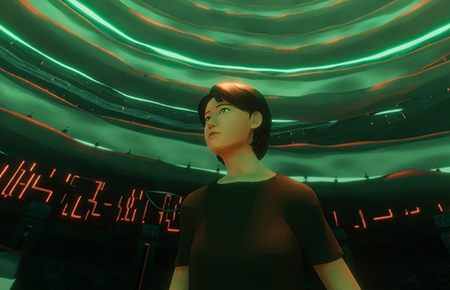
Using motion capture of human movement, Kim renders emotion and gesture with precision and expressive freedom, avoiding the stiffness often associated with 3D animation. Kim’s greater achievement, however, lies in the directness with which she confronts Jeong-yeon’s trauma. When Jeong-yeon accompanies Kyung-hoon to a motel for their first physical encounter, the claustrophobic blood-red corridors evoke a horror film, turning romantic anticipation into dread. Intimacy draws her back into a space poisoned by memory. The room number, 2006, invites speculation about links between her past and her self-imposed deadline of writing a great novel about love by age 26. Here, artistic ambition, sex and traumatic memory become painfully entangled.
Other images give her anxiety a menacing physical form. Protective-suited figures patrol the streets to contain an infection, spraying people who turn into insects and are promptly crushed. Churches briefly allow young people to kiss and express themselves through music, until parents or men in hazmat suits intrude to pursue them or to police their sexuality. In the chaos, the ear becomes a testament to resolve artistic yearning and the struggle to preserve identity. Such passages take the animation beyond literal experience, but their accumulation can demand the viewer pay more attention to decoding symbols than to following Jeong-yeon’s emotional trajectory.
Generational conflict is more readily legible. Older male judges scrutinise Jeong-yeon patronisingly, while parents urge their twenty-something offspring to abandon creative aspirations for “real jobs”. Housemate Na-jung’s apparent affair with a married gallery director further entangles ambition, sex and power. Whether this relationship belongs to the film’s reality or is coloured by Jeong-yeon’s suspicions remains uncertain, as her parents’ history makes the possibility of projection difficult to dismiss.
Na-jung’s characterisation is also weak. Jeong-yeon shows such strong dislike for her that it makes their longstanding friendship hard to believe in, with little affection or shared history to explain their bond. The revelation that wealthy Na-jung chose shabby accommodation because her luxurious home offered little artistic inspiration further strains credibility, introducing an unconvincing conceit about creativity’s need for hardship. Additionally, Jeong-yeon’s insistence that Na-jeong stop smoking weed and seeing a married man echoes the parental policing the film critiques. Her attitude towards cannabis may also reflect Korea’s strict legal and social prohibitions, though viewers outside that context may find her moralising less sympathetic. Nevertheless, Ji-in Jeong and Do-ha Beom’s excellent voice performances bring a natural conversational rhythm to scenes that might otherwise feel overwhelmed by imagery.
The film’s naturalistic details are keenly observed. Jeong-yeon’s hunched back captures a writer’s desk-bound posture and subtle shifts in facial expression lend nuance to Jeong-yeon’s portrayal, particularly when jealousy colours her feelings towards Na-jung. Less effective are the large white highlights in her eyes, recalling Japanese shoujo manga heroines and adding a decorative quality at odds with her naturalistic voice and behaviour. A late suggestion of hollowness offers psychological significance, but comes too late to dispel the distraction.
Ravel’s Boléro is an inspired musical choice. Its insistent repetition and accumulating layers heighten tension, while the melody becomes an earbug itself, lingering beyond the auditorium.
For English-language viewers, the subtitles pose a more immediate obstacle. Often stretching to three or four lines, they cover much of the frame and vanish before even fast readers can finish. Needless verbosity—“first of all” instead of “first”—compounds the problem. This is especially damaging in a film whose visual compositions deserve sustained attention.
Despite its shortcomings, Kim’s debut is most compelling when revealing how creativity becomes entangled with an experience its creator has never fully confronted. The fantasy may be uneven, but the raw wound at its core is vividly felt, making Kim’s next feature an eagerly awaited prospect.
Director, screenplay, cinematography, editing: Hyomi Kim
Cast: Ji-in Jeong, Do-ha Beom, Dha-sol Kim, Kyoung-do Lee
Producers: Yeon Chan-heum, Hyomi Kim
Animation: Hwang Tae-seok, Yeon Chan-heum
Music: Dong-wook Kim, Geon-ho Lee
Sound: Ju-suk Lee
Production company: Korean Academy of Film Arts (KAFA)
World Sales: M-Line Distribution
Venue: Busan Intl. Film Festival (Vision Korea)
84 minutes