
Free Zone
Free Zone
VERDICT: Jasmine Alakari's engaging documentary follows an Iranian anarchist in Athens, caught in the tension between revolutionary politics, exile and the possibility of an ordinary life.
Abtin Parsa, a Iranian young anarchist activist, is angry that people are dancing in an Athens square while his friends are in prison in Iran. An older activist disagrees. Protesting in Europe, he tells Parsa, is usually about being heard and to warn the authorities that the people are not asleep, not starting a revolution. Parsa, who recounts imprisonment and torture in Iran, is not persuaded. Parsa’s experience as a revolutionary in dilemma about this activism in the country that he is seeking refuge in is the topic of Jasmine Alakari.
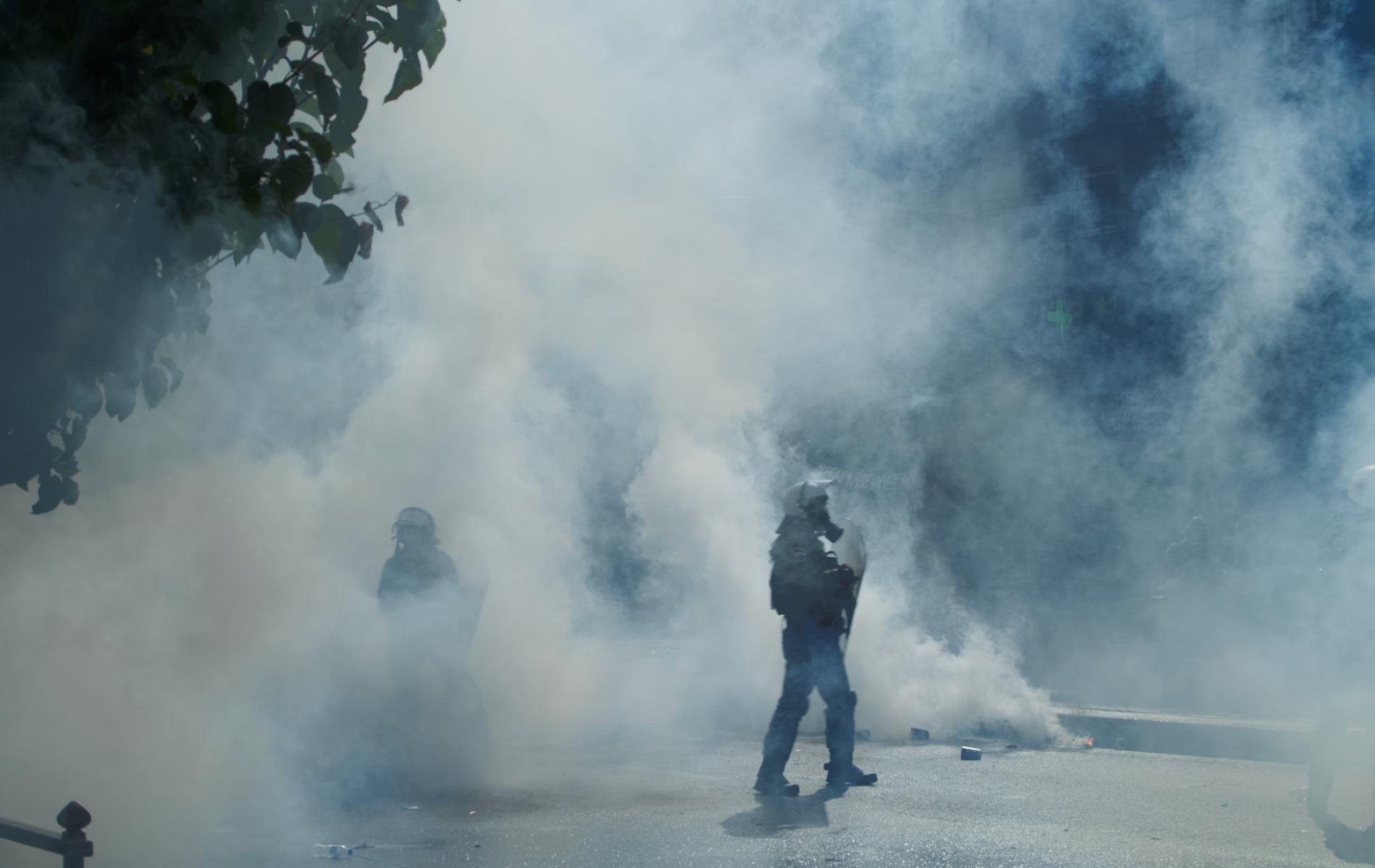
World-premiering in the German Competition at DOK Leipzig, the 90-minute documentary follows Parsa among anarchist activists in Exarcheia, the Athens neighbourhood where occupied buildings have provided shelter for refugees. Exarcheia has stood as a symbol for resistance in Greece since the 1970s, has become a refuge city for refugees who lived in occupied buildings. In 2019, Greece’s conservative government begins clearing those squats. For Parsa, an Iranian exile with precarious status, arrest carries the threat of losing the place where he has found refuge. He is fighting the authorities in a country whose permission he needs to stay.
Jasmine Alakari films their argument in a room, cutting between the older man and Parsa beside his girlfriend, Myrto. She lets the exchange go on long enough for both men to expose their assumptions. It is one of the best scenes in Free Zone. The older activist’s distinction between European protest and revolutionary struggle seems questionable when applied to political exiles. Leaving a country does not necessarily mean leaving its conflicts behind, especially when European governments make decisions that affect those left behind. Parsa’s circumstances give this disagreement a personal urgency, though Alakari is more interested in what his convictions cost him than in resolving it.
The film opens with the sea and Parsa addressing Jasmine directly. Her camera is often closest to him indoors. In cramped rooms he argues with friends, laughs, celebrates a birthday and tries to remember when he last had a cake. In one shot, his shadow falls over portraits of revolutionary figures. Cinematographers Agnesh Pakozdi and Ben Bernhard also take us into Exarcheia’s raw streets, where riot police, demonstrations and eviction operations tell a harsher story. The contrast is clear without being flagged: the man who confronts the police outside is also trying to build a life inside. Even shots from a high vantage point showing the Mediterranean echos voiceover of immigrant boats being raided.
Alakari makes good use of events she cannot film directly. Parsa talks about torture while the image holds on a darkening sky. Later, the news of his arrest arrives in a worried telephone call over a shot of nearly empty blue seats. Both choices are more affecting than a reconstruction would have been. The film is less sure-footed when news reports and political commentary are laid over the street footage. Some context is necessary, but the images and residents’ testimony already tell us plenty about the police operation and its consequences.
Myrto brings humour and tenderness into a story otherwise full of anxiety. She remembers meeting Parsa while dancing and, on a call with his mother, tells her that she loves him. Parsa talks about how affection has softened his anger. There is an irony here: a man furious at strangers for dancing met his girlfriend on a dance floor. Myrto is engaging, but we learn more about what she means to Parsa than about how she experiences his politics herself.
As Parsa tries to secure papers that might allow him to visit his sick mother, the consequences of his precarious status become ordinary and immediate. A joke about a dog having a passport lands because the people in the room know how much easier its travel may be. Alakari’s film comes at an important time, where thousands of immigrants are actively participating in political life in Europe, whether in electoral politics or in activism in a political ecosystem fuelled by right-wing anti-immigrant rhetoric. It raises an important questions about immigrants’ position in the local politics of their host countries, especially when European countries have a big say in the politices that affects countries in the global south.
Free Zone works best when she lets Parsa challenge, and be challenged by, the people around him. The topic-sensitive question that Alakari that raises is: what does it mean to document another person’s suffering when you can leave? Alakari does not fully investigate her own position, but the question has force.
Director, screenplay: Jasmine Alakari
Producers: Jasmine Alakari, Ben Bernhard
Cinematography: Agnesh Pakozdi, Ben Bernhard
Editing: Jasmine Alakari, Katarina Stankovich, Lina Marquez
Music: Felix Römer
Sound: Nikos Triantafyllou
Sound design: Richard Meyer, Max Knepper
Sound mixing: Alexandre Leser
Production company: Deutsche Film- und Fernsehakademie Berlin (DFFB)
Co-production: Rundfunk Berlin-Brandenburg (RBB)
Venue: DOK Leipzig (German Competition Documentary Film) – World Premiere
In English, Farsi, Greek
90 minutes