
BerleeN
BerleeN
VERDICT: Ahmad Abdalla's inventive and politically charged portrait of three Arab migrants finds anxiety, humor, and magical realism in a city where escaping the past does not necessarily mean escaping fear.
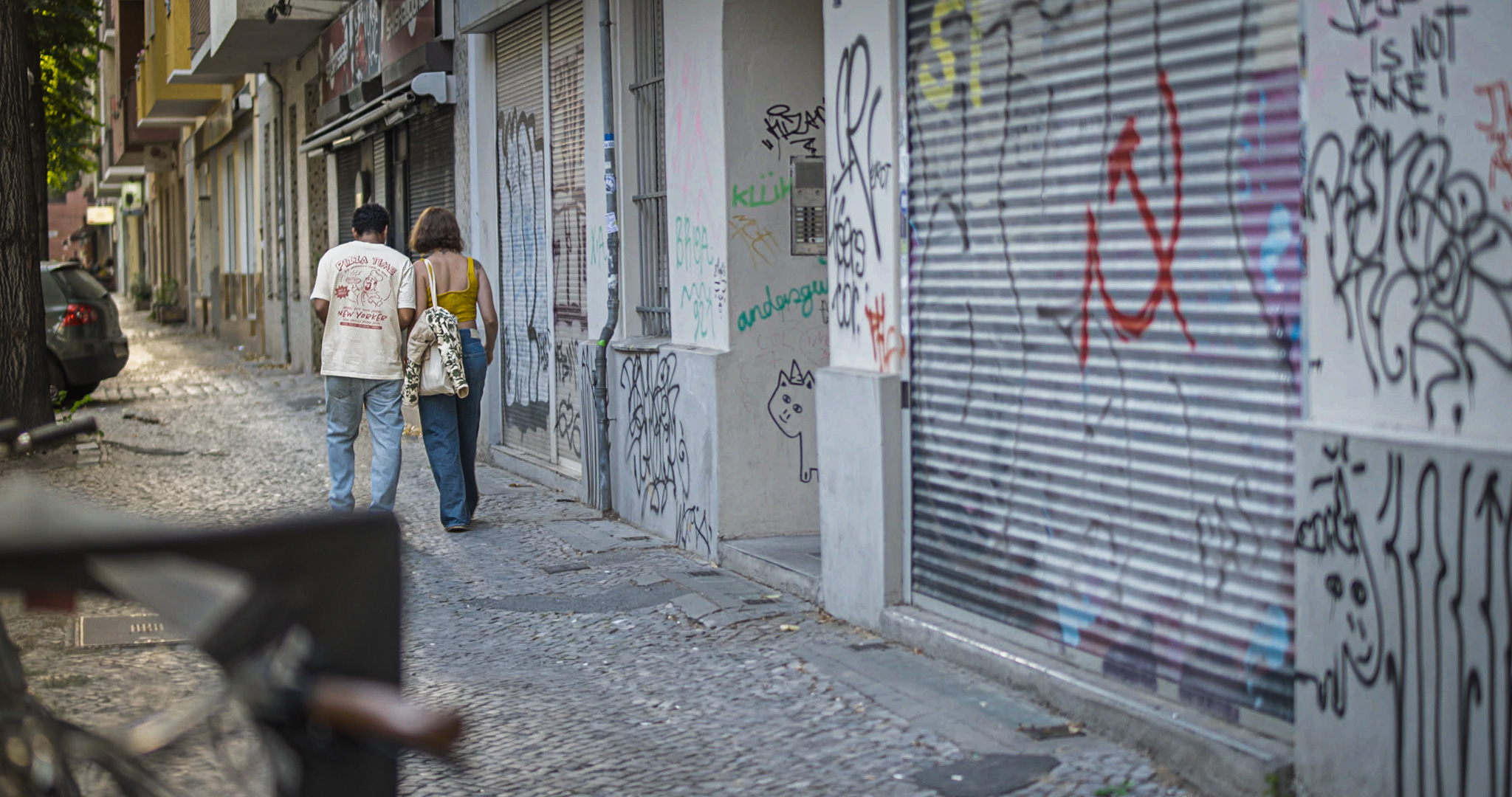
“Sorry your grandparents were Nazis, ya cucks,” reads graffiti beside a sprayed Palestinian flag on a wall in Berlin. The camera catches it as an Iraqi man walks past. It is one of several moments in Ahmad Abdalla’s BerleeN when the German capital seems to speak directly to its Arab inhabitants. Elsewhere, painted eyes appear to follow pedestrians. A Palestinian sticker keeps reappearing after being removed, and even recycling bins produce mysterious melodies. There’s something funny in Abdalla’s BerleeN, but also something unsettling.
Premiering in Cairo’s International Competition, this 94-minute film follows three Arabs whose lives eventually intersect over a single day. Abdalla is not new to this tradition: the overlapping narratives of Heliopolis, Microphone, and Exterior Night showed his interest in cities and their people, and BerleeN takes it into new territory. If Exterior Night was a love-hate letter to Cairo, BerleeN is a frequently funny, visually inventive, and sometimes uneven tale about starting a new life in a city only to discover that the fears you thought you had escaped still follow you.
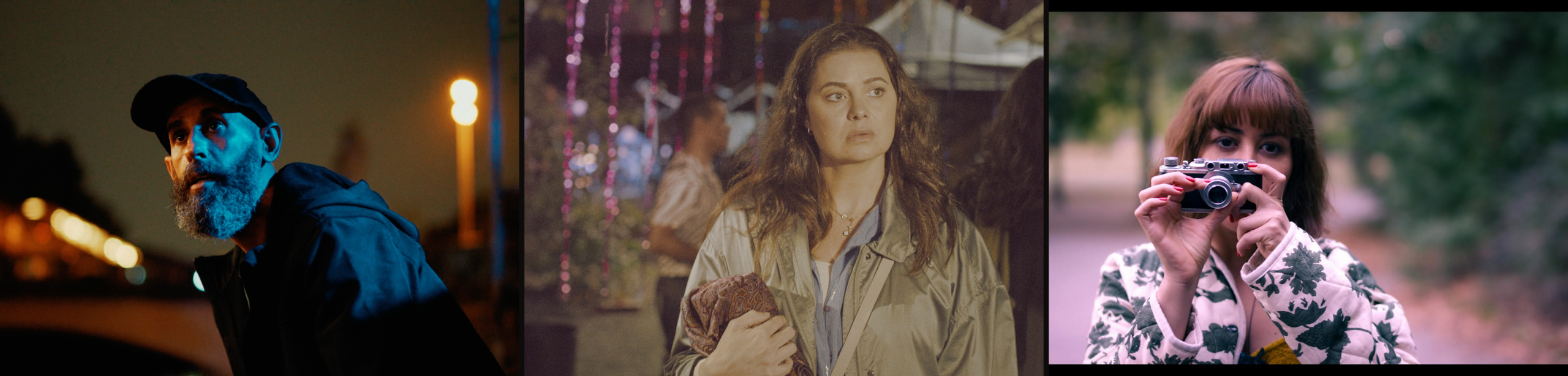
Bargaining for a second-hand camera, Hannah jokes that at least she is lucky at something. When asked why she considers herself unlucky, she announces that her ex-husband is getting married that day. Later, while boarding the U-Bahn, she struggles to explain her despair to Mo, an Egyptian cameraman and would-be partner, played with warmth by Muhammad Hatem. She cannot see the point of a relationship when everything seems so unachievable and bleak, and knowing that her problems are small beside what is happening elsewhere in the world makes her feel even worse. Minna Shalabi captures this exhausting mixture of helplessness, guilt, and unhappiness with precision.
Yusra Lozi offers an equally convincing, quieter performance as Maha, a Syrian woman who has built a social media presence by preparing traditional Arab food. Her cheerful online persona hides a more complicated and troubled existence, which becomes increasingly unsettling when an old stranger starts calling her Razan, the name of the stranger’s daughter, who was killed in the Hama bombing campaign against civilians in 2018. What initially seems an absurd misunderstanding gradually reveals a story of grief and trauma that Maha can neither fully understand nor simply walk away from. Lozi’s restrained reactions give these interactions an emotional credibility that the more elaborate and visible aspects of Abdalla’s screenplay occasionally struggle to achieve.
Haider Helo, who played an Iraqi citizen in Tamer El Said’s magnificent eulogy and love letter to Cairo, In the Last Days of the City, brings a different energy to his character Hassan, an Iraqi immigrant determined to avenge his brother’s death. Encounters with criminals and intimidation gradually turn his story into a thriller. Helo is most convincing in his silences and moments of obvious resignation, which suggest a man who has survived the most terrible of things but cannot imagine a better future on the horizon. The way he recalls people being locked in a container for ten days on their way to Europe is chilling. He has escaped violence only to find himself moving towards it again.
Together, the three characters recall an Egyptian saying about someone dancing on the stairs, seen by neither those above nor those below. They no longer belong completely to the places they left, but neither have they found a secure place in their adopted country. While Maha is haunted by a past that is not even hers, Hannah withdraws, and Hassan walks back towards violence in the hope of putting out the fire that the violence he fled has lit in his heart. Their anxieties differ. However, all three feel that they have lost control of their lives.
Crucially, Abdalla does not reduce them to victims. The film is filled with lively, often very funny conversations moving between Sudanese, Iraqi, Syrian, and Egyptian Arabic, as well as English and German. In one sharp exchange, Hannah mocks the European festival industry’s appetite for refugee stories and films featuring dark-skinned women in headscarves, arguing that this mix will be irresistible to programmers. “Festivals in Europe will love it. Very authentic,” she mocks. It is an especially amusing joke coming from a filmmaker who has spent most of his career working within the same circuit.
Cinematographer Mostafa El Sheshtawy gives BerleeN much of its character. The opening scene on Museum Island, home to many of Berlin’s most important museums, sets the protagonist against imposing neoclassical buildings and Egyptian artifacts held in German institutions. The photography then moves to graffiti-covered walls, urban stations, and cluttered flats in Kreuzberg and Neukölln, two densely populated neighborhoods where many immigrants live, meet, and socialize.
Mo’s warm, plant-filled flat, for example, complete with a poster of Shadi Abdel Salam’s The Mummy (The Night of Counting the Years), contrasts with Maha’s kitchen, where filming equipment and ring lights have turned what seems to be a warm domestic life into an almost continuous performance for social media consumption. The camera repeatedly places objects between people: doorways, screens, glass displays, windows. In the museum, Mo explains the ancient Egyptian false door, through which the soul was believed to pass, and the importance of preserving a person’s name after death. Later, Hannah’s strange vintage camera produces pictures in which human figures disappear. The connection is a little obvious, but effective. For people who have already lost so much, vanishing from memory, from a photograph, or from the place they now call home becomes another source of anxiety.
Sound is particularly important in Abdalla’s film. A delightful accordion and woodwind melody opens the film, while classic German train announcements echo in the background alongside automated phone messages and overlapping conversations, creating a recognizable Berlin. Similarly, the music from the rubbish bins adds an absurdist touch to Hassan’s increasingly dangerous day.
Editor Sara Abdalla moves briskly between the three stories, although the shifts from Hannah’s relationship comedy to Hassan’s crime narrative can feel abrupt. Some supporting characters are introduced and abandoned too quickly, and the film occasionally becomes so occupied with its symbolism that it leaves the characters little room to breathe. But maybe this is the Berlin effect. There is so much happening, so many people met in daily life, so many sounds. All of this, together with what one wants and what one has left behind, complicates the narrative while offering one that is unique to the immigrant experience in Berlin.
What gives BerleeN its urgency is how it understands the fear experienced by large parts of the Arab diaspora in the current political climate in Europe following 7 October 2023. For migrants, students, and long-established residents, even dual nationals, the promise of freedom in Germany has been complicated by restrictions on Palestine solidarity demonstrations and documented incidents of police violence, which affect German and other European protesters as well, including white Europeans. Abdalla captures this atmosphere through small gestures: the nervousness around police officers, the hesitation before displaying a political symbol.
There is something moving about Abdalla’s insistence that these people, despite all their anxieties and fears, can still find moments of connection and pleasure. Music, food, and even Egyptian mangoes pass between the characters and become a reminder of shared solidarity in the diaspora. When their paths finally converge, the resolution feels somewhat too convenient. However, the film does not pretend that one night will solve all their problems. It simply offers them a moment in which fear is not invited, and anxiety about the future does not entirely dictate how they behave.
BerleeN is produced by Mohamed Hefzy and Kismat Sayed of Film Clinic, which has helped bring Egyptian independent cinema to an international audience. The film should find a receptive audience beyond Cairo, especially among the Arab diaspora and on European and North African art-house circuits. Its political context is specific, but its portrayal of people caught between identities reaches much further than Berlin.
With BerleeN, Abdalla reaffirms his place as one of Arab independent cinema’s most distinctive filmmakers. His achievement is making fear visible without allowing it to define the characters entirely. The disappearing pictures, the strange sounds, and the painted eyes turn the city into a landscape of their anxieties. But the people themselves remain funny, angry, stubbornly alive, even envious and vengeful, and still capable of surprising one another.
Nearly a century ago, in Fassbinder’s Berlin Alexanderplatz, Franz Biberkopf (Günter Lamprecht) steps out of Tegel Prison into the overwhelming city and tells himself: “All those people and then the city and the world and me. Now don’t make any trouble, boy! You’ll find your way again. And don’t forget! You mustn’t turn around.” Abdalla’s characters keep turning around. Yet like that Palestinian sticker that refuses to disappear, they are still here, whether the city acknowledges them or not.
Director, screenplay: Ahmad Abdalla
Cast: Menna Shalabi, Yosra El Lozy, Mohamed Hatem, Fadwa Abed, Haydar Helo
Producers: Kesmat El Sayed, Mohamed Hefzy
Cinematography: Mostafa El Sheshtawy
Editing: Sara Abdalla
Production companies: Seera Films, Film Clinic
Venue: Cairo International Film Festival (International Competition)
In Arabic, English, German
94 minutes