
Traveller’s Hell
Traveller's Hell
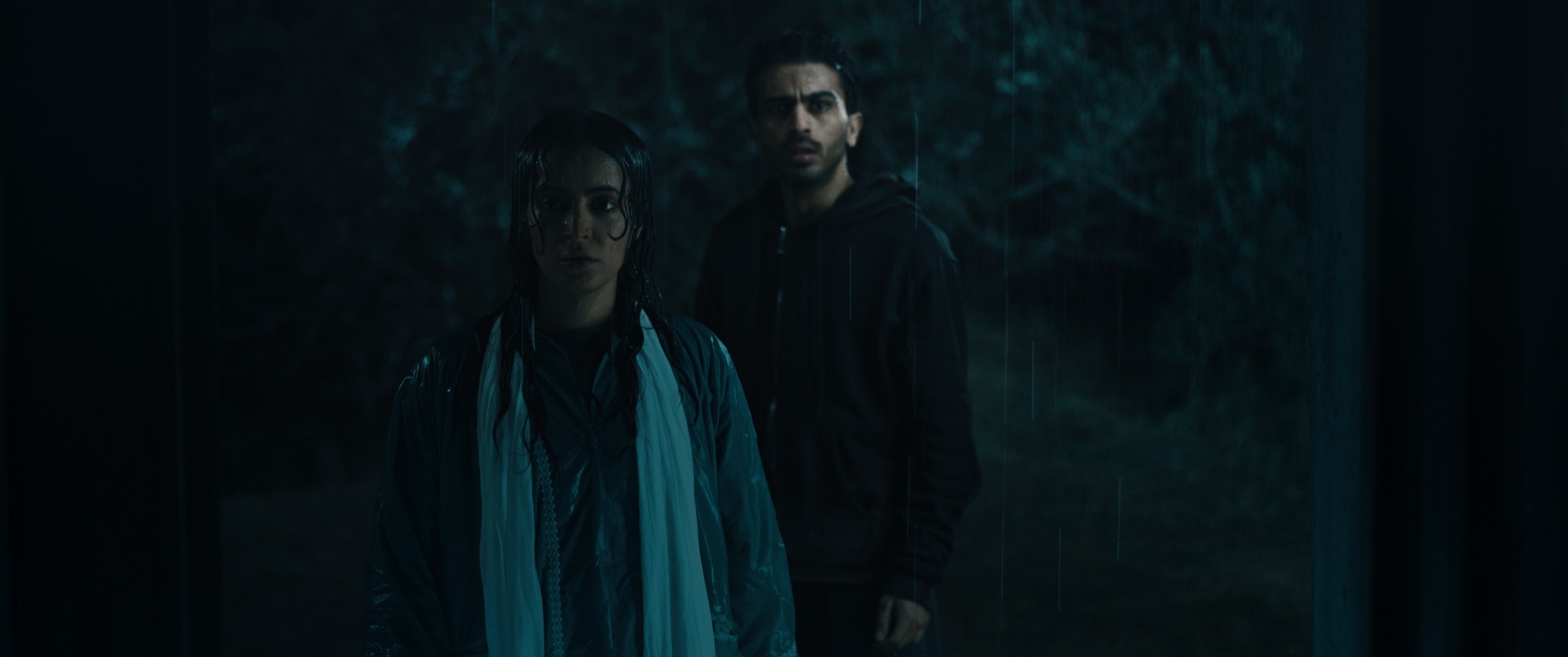
VERDICT: A skillful reworking of the classic horror trope featuring an unknown serial killer on the loose, ‘Traveller’s Hell’ is a witty and scary surprise.
Opening the Cairo Film Festival’s Midnight Screenings with a scream, Traveller’s Hell pits wits between a cool young lady driving through the mountains after dark and a nervous young stranger who answers nicely to the police description of a rampaging serial killer. As they size each other up and dodge sinister shadows in deserted gas stations dotting the hills, a duet ensues between the woman and her passenger in an entertaining twist on the psychological thriller.
When the film opens domestically on Nov. 19, it will already have an eager fanbase. It is closely adapted from a popular best-selling novel by Osamah Almuslim, who also wrote the screenplay. Entirely shot in the Kingdom of Saudi Arabia, in a less familiar area of dramatic mountain ranges and lush forests, it maintains a modern feeling that should help it find adventurous international audiences even beyond festivals like Cairo.
Of course, knowing the director is Hanaa Al Omair, the award-winning Saudi writer-director-producer who was behind Netflix’s first Saudi original series Whispers, as well as her films like The Complaint, Beyond Words and Swan Song, it is pretty sure some sophisticated misdirection is bound to lead the audience in the wrong direction. Gender roles also switch around, with the fearless driver of the car Yumna (Adwa Bader) constantly berating her quailing passenger Assem (Basil Al Sole) for his cowardice and inability to face his fears. Together they make an amusing contrast in outlooks and psychology, expressed in barbed comic exchanges.
As the story begins, the sunlight is just fading from a breathtaking mountain road. Yumna is on her cell phone warning someone who sounds like a concerned family member that she will soon lose the signal and not to worry if she doesn’t answer her phone. The first red flag. Soon she passes a stalled car on the narrow road; stops; asks the driver (it’s the sweet-faced Assem) what’s wrong. Second red flag – she gives him a lift with his empty gas can, on the condition that he rides in the trunk.
Genre logic dictates that Yumna has done a very bad thing and let the wrong one in. But instead of harboring doubts about the stranger, whose story about running out of gas has holes in it, she doubles down. Assem is soon deemed trustworthy enough to ride in the passenger seat beside her. At a police road block, he raises suspicion but they get through. The next time he’s challenged by a cop, he blurts out that Yumna is his sister, a claim that makes the officer – who happens to be the chief detective on the serial killer case – leer and laugh. Given the negligible role of law enforcement in the story, it is not too surprising that our travellers place little stock in their help when things get rough.
Indeed, the humor fades away in a dynamically shot scene at a ghostly gas station, where Yumna and Assem find all the doors are open – but no one is there. It is at this point that Yumna announces she has to use the bathroom, and even Sofian El Fani’s camera seems reluctant to follow her into the thick shadows around back and into the dark toilet. It is then that something shifts toward the supernatural and the nightmare begins.
In the final sequences, which are animated by almost constant terror, the odd relationship that Yumna and Assem have built up crumbles as the truth monstrously emerges. Both actors are in top form — Bader as the strong, self-controlled woman who hides a guilt-strewn past, Al Sole (known for his TV hit Al Asha Street) less admirably courageous but easier to identify with — putting a human face on a terrifying tale.
Director: Hanaa Al Omair
Screenwriter: Osamah Almuslim
Producer: Mahfouz Alzahrani
Cast: Adwa Bader, Basil Al Sole, Mohammed Ali, Shojaa Nashat, Aziz Gharbawi, Ahmed Elbayed
Cinematography: Sofian El Fani
Production design: Ahmed Baageel
Costume design: Badriah Alotaibi
Editing: Heba Othman
Production companies: MBc & Aflam Production (Saudi Arabia)
Venue: Cairo Intl. Film Festival (Midnight Screenings)
In Arabic
90 minutes