
Your Daughter
Ta Fille
VERDICT: In this brave, quietly feminist documentary, Sara Shazli turns the home videos of Egypt’s most famous movie family on her own mother, asking what a life in film cost the daughter left outside the frame.
Sara Shazli’s family filmed almost every part of their lives: Christmases, birthdays, film shoots, nights in Cannes. Yet this footage, almost an archival library, rarely caught any intimacy between Sara and her mother. Touching was something else. “We never kissed, hugged,” her mother, the producer and director Marianne Khoury, admits late in the new documentary Your Daughter, which premiered in the Horizons of Arab Cinema competition at the 47th Cairo International Film Festival.
In a home where the camera was synonymous with embraces, Shazli picks it up and turns it on the person who used to hold it — her mother. Shazli approaches this method in her brave and skillful documentary with brutal yet tender honesty.
Khoury was a trusted collaborator of her uncle Youssef Chahine, who lived in the apartment below and whose filmmaking “took up all the space.” Chahine never spared his family or himself. In An Egyptian Story (1982), his alter ego Yehia Shoukry Mourad, also a famous director, played by Nour El-Sherif, lies under anesthesia after a heart episode while a court is convened inside his chest. His child-self prosecutes the man he became, and other defendants include his mother, sister and wife. Khoury continued the tradition with Let’s Talk, which premiered in 2019, digging into the struggles of her mother and grandmother. In Your Daughter, it is arguably the third generation’s turn, and the first in which the person on the stand actually produced the film.
The film reads better next to Khoury’s documentary Let’s Talk (2019), where she holds the camera and questions her family about her own mother, Iris. Sara is one of those being questioned, and she is impatient in her answers. Together the two documentaries form a conversation between a mother and a daughter stretched across seven years. Neither film has the last word, and that may be the point.
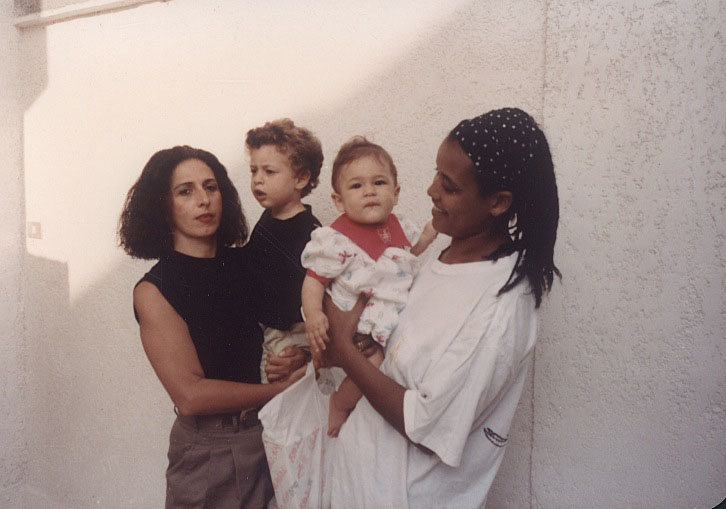
Home movies are rarely neutral. Someone decides what gets filmed, who gets filmed and most importantly, who stays out of the shot. Shazli, who also works as an archivist at Misr International Films, recuts the family footage until a gap shows. Her mother is pictured among the producers at Cannes; she is with whoever was looking after her that year. It was other women and helpers who helped raise Shazli and her brother.
At the kitchen table, the framing keeps mother and daughter apart. Khoury sits alone in the shot while Sara speaks from behind the lens: “I don’t have any nice memories of you and me.” Khoury doesn’t leave and doesn’t argue. She props her chin on her hand, picks up a scrap of paper, and admits she was always in a hurry. She counts her losses: “I didn’t have a mother, a sister, or an aunt. Nothing.” What follows is more two women comparing their childhoods rather than a family put on trial.
Those childhoods share a habit of escape. Khoury’s mother, Iris, loved the outdoors and poker and was rarely home. Khoury walked out of her first marriage overnight, and later agreed with Nabil Shazli that she would handle everything at home in exchange for a free hand at work. Her daughter fled to film school in Cuba, a place where she was “nobody’s daughter.” Shazli’s anger doesn’t vanish, but it widens. For the longest time she only saw her mother’s absence, not a woman who was searching for herself.
Shazli is open about the comfort she grew up in: a big apartment in Zamalek, one of Cairo’s best neighborhoods, a French school, film festivals, nannies and maids. “We lived in a bubble,” she says. “I was a stranger in my own country.” Some viewers will see a story about a small, French-speaking wealthy circle, and in a sense it is. But the film never suggests money should have made up for what was missing in these women’s lives, and it doesn’t ask for pity either. What Shazli wanted couldn’t be bought or handed over by someone else: a hand on her shoulder, attention, time. A privileged childhood can still be a lonely one and the film shows both; and indeed it remains kind of surreal that while discussing Shazli’s issues, her family, mother, and Chahine continues to cast a shadow.
Shazli’s complaint goes deeper than a mother who was often away. “I can’t stand you touching me,” she tells Khoury, adding that she did not have a similar experience with her father. Nevertheless the two women are not so different, because both as children wanted affection that wasn’t forthcoming and hence learn to protect themselves by pushing it away, even when it’s offered. Khoury, we discover, has the same habit. She admits that rarely saying kind things to her daughter was also a way of protecting herself. The two women learned to keep their distance as a shield.
Shazli films her pregnant body in low sunlight and shows the first weeks of breastfeeding with unusual honesty. Khoury changes too, in her own way. Holding the baby, she coos that the girl is calm because she’s on her grandma’s lap, then reassures her anxious daughter: “She knows you are her mama.” The warmth that Shazli missed as a child reaches her daughter through the grandmother, and Shazli films it without irony. Still, Khoury isn’t turned into a reformed woman. Moments later sitting beside her daughter as she breastfeeds the newborn, she gets busy on her phone with film business. Shazli keeps the scene in: work still finds a way in, even in the hospital room, and the film lets us see it without judging.
Shazli also warmly touches upon other women who helped raise her, such as her Ethiopian caregiver Woody, who moved to Canada in 2004. In fact, the documentary was originally conceived as Searching for Woody, a film about Shazli’s attempts to reconnect with a woman who was important in her upbringing, and whose labour contributed to making Khoury’s freedom as a female filmmaker possible.
Shazli does not end the film with a lesson. She has confronted her mother, understood her better, and even learned to hug her. Then she becomes a mother herself and finds the old question pointing at her: how “to be there without taking up all the space”, the words she once used for Chahine’s cinema, is now a warning to herself. How do you live your life without leaving your child behind? Khoury faced the same choices and made hers. Shazli doesn’t claim she will do better.
Ten years ago in 2016, I took one of my first film criticism workshops at Khoury’s Dahshur Residence, the creative retreat and space in Dahshur, Giza Governorate, overlooking Dahshur Lake and the Bent Pyramid. The workshop was organized by Marianne Khoury and led by the French critic Jean-Michel Frodon. Khoury was there, mostly listening to us young critics, journalists, and programmers who were just starting out, and sometimes sharing her own experience as a filmmaker and producer, and also, along with us, listening to Frodon’s stories about Cahiers du Cinéma, Godard and the critic’s eagerness to see the restored version of Shadi Abdel Salam’s The Mummy.
It is heartwarming to see the two women in Dahshur, where the film’s turning point comes. Previously, at the kitchen table in Cairo, Khoury sat alone, and was questioned from behind the camera. Now they sit side by side in the same frame, and Shazli steps out from behind the lens. At the railing, as the sun sets behind the trees, one of them says, “Let’s try to give each other a hug.” The camera keeps its distance and lets the embrace last. “That was a good idea,” Khoury says. “Let’s do that more often.”
So when they finally hug, it’s not a reward, nor a crescendo, but something they both still have to practice, and with the arrival of Shazli’s child there is some hope the circle can be broken.
The heart of this film isn’t the accusation: it’s a mother who stays at the table and listens. In this family, cinema has always been a way to learn from one another, and to criticize while giving each other the benefit of the doubt. Here, finally, it works between a mother and her daughter. She only asks, in the film’s last words, “Tell me, Mom, how to be a mother.” It’s a question that can’t be answered once and for all. It has to be lived day by day, week by week, month by month, the way Khoury lived it and the way her daughter is starting to.
Director, screenwriter: Sara Shazli
Cast: Sara Shazli, Marianne Khoury, Nabil Shazli, Youssef Shazli, Youssef Chahine, Tony Amer, Tara Amer
Cinematography: Mathilde Le Masson, Sara Shazli, Marianne Khoury, Nabil Shazli, Youssef Shazli, Youssef Chahine
Editing: Faustine Cros
Music: Marisol Cao Milán
Producer: Marianne Khoury
Production companies: Misr International Films (Egypt), Dérives (Belgium)
Contact: Misr International Films
Venue: Cairo International Film Festival (Horizons of Arab Cinema)
In French, Arabic, English
60 minutes