
Who Finances Arab Cinema?
.
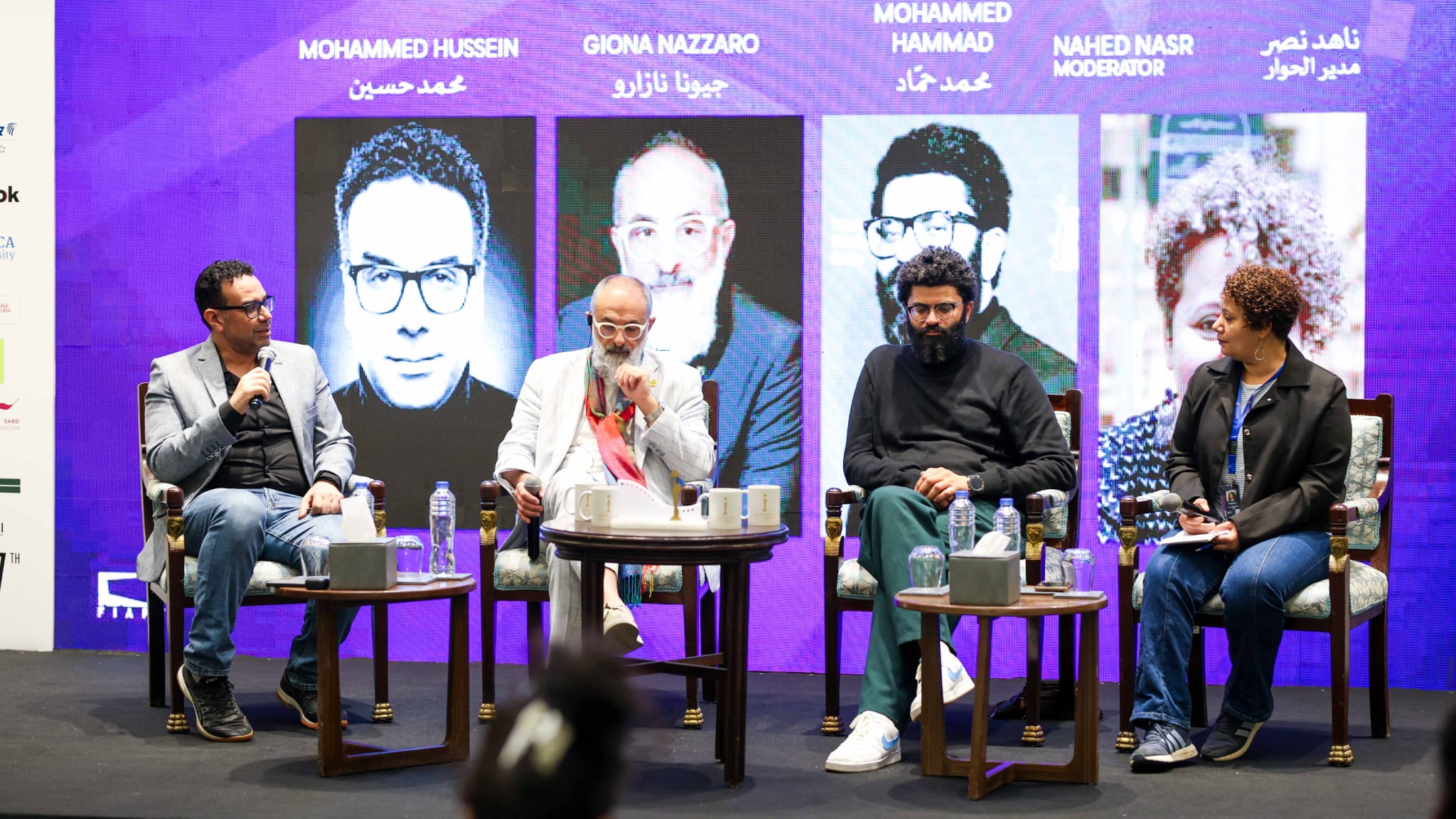
VERDICT: At Cairo Industry Days, Mohamed Hammad, Giona A. Nazzaro and Mohammed Hussein debate artistic freedom, international funding and the business of independent filmmaking.
The greatest obstacle facing independent Arab filmmakers may not be securing money to make their films, but finding audiences to watch them. This was among the central arguments emerging from a lively discussion at the 47th Cairo International Film Festival, where Egyptian filmmaker Mohamed Hammad, Locarno Film Festival artistic director Giona A. Nazzaro and Cairo Film Connection director Mohammed Hussein examined the relationship between financing, artistic independence and international distribution.
Moderated by Egyptian critic Nahed Nasr, the Cairo Industry Days panel, The Art of Getting Funded: Navigating Arab Film Financing, raised an uncomfortable question: are Arab filmmakers increasingly encouraged to tell the stories that international financiers and European festivals expect from them?
Hammad argued that Egypt’s independent cinema suffers from a structural distribution problem rather than simply a shortage of production funding. According to his estimates, the country produces between 100 and 150 independent short films annually, alongside approximately seven or eight independent features and documentaries. Yet many struggle to reach audiences, even after completion.
For filmmakers seeking international exposure, he explained, the available routes are frequently limited to securing a sales agent or gaining entry to a major festival. This dependence can influence creative decisions long before cameras start rolling, encouraging issue-driven narratives believed to appeal to European programmers while leaving comparatively little room for genre filmmaking.
Nazzaro challenged the suggestion that European festivals operate on predetermined thematic expectations. “We are not working according to an agenda,” he said of Locarno, explaining that disagreements among selection committee members are essential to programming. The festival has only 17 competition slots across 11 days, making rejection inevitable even for worthwhile films. He nevertheless acknowledged the political complexities surrounding European cultural financing, including resistance to spending public money on filmmakers from other countries.
For Nazzaro, artistic independence and business acumen are not contradictory but equally necessary. “A filmmaker needs to be the entrepreneur of himself,” he argued, warning that an unfavourable financing agreement can ultimately compromise the film itself. Directors must understand the financial structures supporting their work rather than leaving commercial decisions entirely to others.
He also urged filmmakers to regard producers and sales agents as potential collaborators rather than adversaries. A sympathetic producer can help translate an artistic vision into a viable project, while a supportive sales agent may build a relationship extending across several films. Making a second or third feature, he observed, can be even more difficult than completing the first.
Nasr challenged this view, questioning whether Western funding institutions sufficiently consider how their expectations may affect filmmakers’ freedom of expression.
Hussein acknowledged that international festival prestige can influence funding decisions, including within Arab institutions. He described the unease that regional project-development platforms sometimes appear to prepare films primarily for European festival recognition rather than their own audiences.
The debate unfolded against the backdrop of Cairo Film Connection’s 12th edition, which selected 16 projects from 193 submissions. The platform has previously supported films including Kaouther Ben Hania’s Four Daughters, which went on to receive an Academy Award nomination, and Tamer El Said’s In the Last Days of the City. Last year’s edition offered 37 awards worth nearly $300,000 in cash and services, illustrating both the opportunities available to Arab filmmakers and the competition surrounding them.
The discussion also came days after Cairo International Film Festival announced a strategic partnership with Saudi Arabia’s Red Sea Film Foundation. The agreement, unveiled on 17 November, will introduce a Red Sea International Film Festival Award at Cairo from 2027, alongside exchanges of programming, including Red Sea Fund-supported films, and restored classics. The partnership reflects expanding regional cooperation at a time when filmmakers are questioning whether existing industry structures adequately support their work and help films reach audiences.
Hussein offered a revealing example of how financing can directly alter a film’s content. Recalling an account shared by a filmmaker, he described how a funding body had required scenes to be shot in a particular country, compelling the production to incorporate a location that had not originally been part of the director’s vision.
Financial planning accounts for approximately one-third of Cairo Film Connection’s project evaluation, Hussein explained, alongside artistic material and the filmmaking team’s experience. He criticised applicants who inflate their budgets to make projects appear more ambitious, warning that unrealistic financing gaps can discourage supporters. A donor contributing $10,000 towards a $100,000 shortfall may see an opportunity to advance a project; the same contribution against a $2 million gap can seem inconsequential.
Hammad’s own experience offered an example of navigating these pressures. His second feature, Safe Exit, a psychological thriller exploring the trauma left by religious violence, premiered in the Panorama section of the 2026 Berlinale, a decade after his Locarno-selected debut Withered Green. It subsequently won the Golden Star for Best Narrative Feature at El Gouna Film Festival.
Hammad explained that he initially relied on smaller investors and silent partners to maintain creative control. Only after an advanced cut existed did additional financiers become interested, helping cover finishing costs including sound, colour grading and the DCP. The experience illustrated the paradox of independent production: financiers can become more willing to invest once filmmakers have already shouldered much of the financial risk.
The wider financing landscape has also expanded through regional institutions. Egypt’s submission for the 2027 Academy Award for Best International Feature, Abu Bakr Shawky’s The Stories, is among the productions supported by the Red Sea Fund, illustrating the growing role of Arab funding bodies in internationally oriented filmmaking.
Yet financing and festival recognition do not necessarily guarantee an audience. Hammad raised concerns about the economics of short-film distribution, describing arrangements in which filmmakers receive very little from sales negotiated through large catalogues. He disputed Nazzaro’s more collaborative vision of sales agents, arguing that commercial interests ultimately govern their relationships with filmmakers.
As an alternative, he proposed establishing a cooperative for Egyptian independent filmmakers, enabling them to share industry contacts, negotiate collectively and exchange information about licensing prices. He also called for greater public support for independent film exhibition in Egypt, pointing to the historical role of state cinema institutions.
Hussein reinforced that concern, warning that films sustained by grants and festival appearances, but unable to reach their intended viewers, leave unresolved financial gaps that threaten independent cinema’s long-term viability.
The discussion ultimately suggested that the future of Arab independent cinema depends on more than securing production grants or prestigious premieres. Filmmakers must learn to navigate the business of cinema without allowing commercial expectations to dictate their artistic choices, while the industry must develop distribution structures that allow their films to reach audiences beyond the festival circuit.