
A Jewish Problem
A Jewish Problem
VERDICT: Ron Rothschild’s self-interrogating documentary 'A Jewish Problem' weaves his Jewish Israeli-German family memory into a fearless meditation on how Jewish trauma, European guilt, and Palestinian erasure continue to mirror one another.
Ron Rothschild’s self-interrogating documentary A Jewish Problem moves between the filmmaker’s grandmother’s exile from Nazi Germany, his own complicity as a former Israeli army cameraman, and the historical displacement of Palestinians in 1948 and the present devastation in Gaza. Screened two weeks after a ceasefire was implemented in the currently war-torn Gaza, this documentary, which saw its world premiere at DOK Leipzig and competed in the German Documentary Film Competition, constructs a dense, self-interrogating essay on memory, guilt, and belonging.
Rothschild, an Israeli-German living in Berlin, who did his compulsory military service between 2007 and 2010, investigates his family’s former presence in Germany. For Rothschild, 1930s and 1940s Germany fabricated a “Jewish problem,” claiming that Jews were attempting to take over their homeland. The Palestinians, he adds, inherited “a real Jewish problem,” this time with Jewish immigrants displacing Palestinians, Rothschild argues.
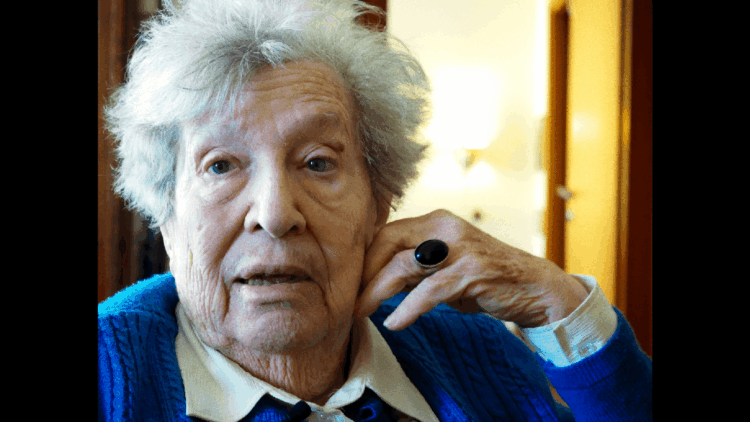
He interviews his grandmother, Ruth Rothschild, who was born in Seehausen in Saxony-Anhalt. At the age of seven, with the rise of Jewish persecution at the hands of the Nazis in the 1930s, she and her family escaped to Italy, and then to Palestine before the establishment of the state of Israel. Ruth remembers her longing for the German language, traditions, and even songs. She also remembers her days as a soldier in the “Independence War,” or the “Nakba,” as part of the Haganah forces, which participated in the expulsion of the Palestinians. As a director, Rothschild does not judge or confront his grandmother but attempts to understand her Zionism as someone who was forced to flee to a new society and pressured to “belong.”
Throughout Ruth’s testimony, or the part that we see, the only mention of the Palestinians is that of their beautiful houses and furniture left behind. Rothschild asserts, “Palestinians are systematically absent from Zionist narratives.” The silence of the grandmother is not malicious but structural, as her generation was not raised to incorporate the narrative of Palestinians. Rothschild uses these moments to interrogate how memory is built through omission and exposes the selective nature of remembrance.
This pressure to “belong” is also felt by Rothschild, who joins the military. He mentions his grandfather, who worked with the British drawing propaganda posters against the Nazis, and later made posters promoting the Zionist narrative of a Jewish Israeli state. Seventy years later, he inherits his task as a soldier to make the military attractive. Rothschild participated in the 2009 war in Gaza, during which, he states, many Palestinians were killed. This clear historical continuity—of creating a certain image of Israel—is broken by Rothschild, who decides to turn the camera back on that legacy and expose it. One piece of footage, shot by Rothschild and featured in the film, shows a raid on a Palestinian village to arrest a “boy,” blindfolding him and taking him to the back of a van. What looks like an episode of Cops, the American law enforcement TV show, turns into a haunting metaphor for what the camera (and conscience) cannot capture.
Rothschild makes the tough choice of speaking about the October 7, 2023 attacks on Israel, showing his struggle to process two simultaneous traumas—Israeli and Palestinian. In one scene, he narrates that an Israeli friend tells him, “We have exactly five minutes to grieve before our pain is used as an excuse for more violence,” a rare sentiment to be expressed in a film screened in Germany and funded by a German organization. This arc captures the moral compression of the film: grief is political, weaponized, and never private. Around the world, and in Germany, Jewish voices critical of the Israeli government and its military practices were not spared accusations of being anti-Semitic or self-hating Jews. Hence, they are stripped of any agency when it comes to their grief as well as their objection to the cycle of retaliation.
The documentary switches back and forth to Berlin’s Neukölln district, particularly Hermannplatz and Sonnenallee, called by locals “the Arab street,” where many shops, restaurants, and cultural centers have celebrated Arab culture since the early 2000s. The area is also home to many pro-Palestine protests. It’s a place where Rothschild enjoys taking his child to eat hummus but where he is also fearful to speak Hebrew. The slow-burn cinematography brilliantly captures his fears, honesty, dilemmas, and hopes for another reality where he can freely reveal to the Arab chef that he is Israeli.
Rothschild belongs to a generation of filmmakers who attempt to understand their positionality in the current sphere of trauma, memory, violence, exile and genocide, through understanding their families. Days after October 7th 2023, DOK Leipzig screened Lina Soualem’s Bye Bye Tiberias; then in 2024 it screened Yvann Yagchi’s documentary There Was Nothing Here Before. Rothschild does not promise nor offer a closure; finished before the current ceasefire, the film does not resolve guilt but features an ongoing process where millions are living with unresolvable histories, including him.
Director: Ron Rothschild
Script: Gil Rothschild
Cinematographer: Ron Rothschild, Julien Mayer, Masha Biller, Fion Mutert, Sina Aghazadeh
Editor: Astrid Hohle Hansen
Producer: Yusuf Celik
Sound Design: Vadim Mühlberg
Score:Georg Mausolf
Venue: at DOK Leipzig (German Competition).
In English, German, Hebrew
79 min