
Amman 2026: The Verdict
.
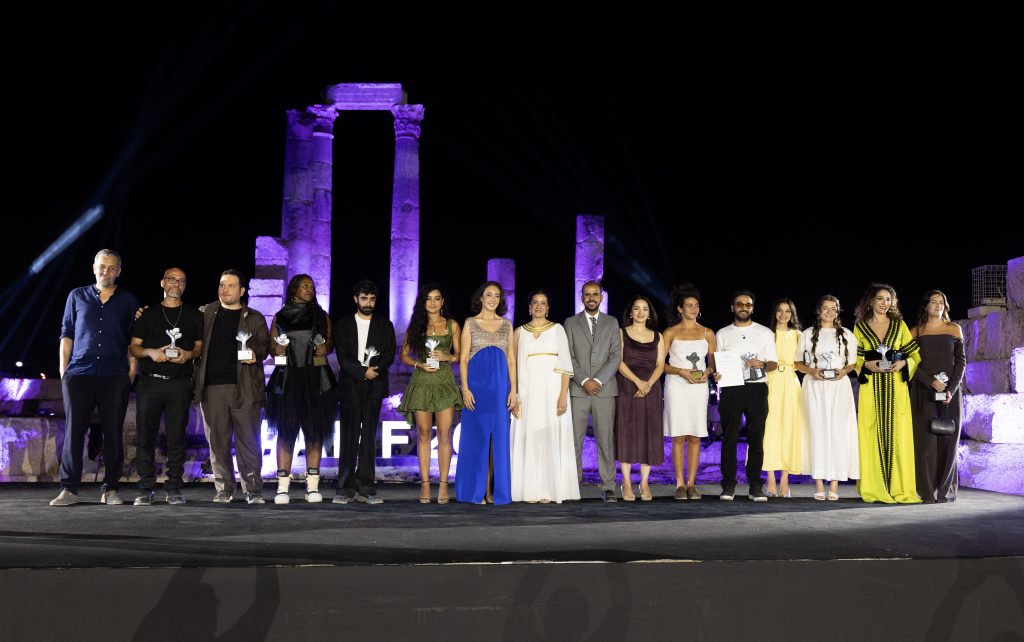
VERDICT: The Iran war menacing the Middle East was a no-show at Amman’s 7th festival.
Though the 7th Amman Intl. Film Festival – Awal Film unfolded from July 26 to Aug. 3 between negotiations and bombings in the Iran war, the conflict shaking the world remained backstage. Last year the invasion of Gaza and the Palestinian genocide had monopolized the conversation, but this round the festival and its attendees stuck to work-as-usual: screenings, talks, pitching sessions, and a forward look at future productions from the region. As festival director Nada Doumani underlined, whatever the military outcome might be, the festival would continue to support the film culture of Jordan and the Middle East.
As it happened, Iran repeatedly bombed the Muwaffaq Salti Air Base during the week, where a ballistic missile had killed two U.S. service members on July 17. Yet despite this area being little more than an hour’s drive from Amman, the guns of war remained unheard and unseen. The only reminder of the ongoing conflict (apart from a surprise test siren everybody got on their phone from the National Center for Security and Crisis Management) was the appearance of several drones at the closing ceremony, flown by the TV channel that was filming the event. With their flashing red and green lights and mosquito-like buzzing, the swooping drones added a surreal note to the spectacular venue of the Citadel high above the city, where awards were announced against the Roman ruins of the Temple of Hercules.
In the end it was an extremely quiet festival, more of a peaceful interlude in the Middle East hostilities than the calculated risk some festival guests had feared. Over 150 international film professionals and press guests attended, with only 6 or 7 invitees choosing to pass this round.
It gave the event the chance to reaffirm its mission to promote cinema for what Doumani calls “a regional platform that attracts voices from every direction.” Going beyond screenings and industry projects, the festival transmited a strong image of Jordan as a state where people of different backgrounds coexist peacefully and where cultural heritage is highly valued. It’s also a place that knows how to organize an international event without fuss and content itself, and its guests, with intimate gatherings between carefully selected professionals. It’s the easy, contained, smallish festival most participants would be sorry to see it grow out of.
The influence of Jordan’s royal family, who have supported the festival from the beginning, was once again a stabilizing element backing up Doumani’s team. Princess Rym Ali, the President and Co-founder, spoke at the opening and closing events and appeared at a number of other festival venues. Keenly aware of the “deep existential crisis” the region is going through, she noted how this year’s slogan “Beyond the Frame” offers a new way to look at the role of filmmaking and filmmakers. Pertinantly she quotes writer Toni Morrison: When the world is “bruised and bleeding”, “this is precisely the time when artists go to work…That is how civilisations heal.”
These broad ideals feel authentic in the Amman context and underscore the festival’s fundamentally serious nature. The film selection was placed in the hands of two new programmers, Fadi Haddad and Murad Abu Eisheh, who distributed 82 titles in an array of Arab and non-Arab sections.
The Black Iris award for an Arab Feature-Length Narrative went to the bittersweet Lebanese love story set during the war A Sad and Beautiful World directed by Cyril Aris, notable for its quiet composition and top-flight acting. The film also won the Audience Award as well as the prize for best First-Time Lead Actor, which went to Hasan Akil, making it a rare favorite for both the professional jury and the public.
An equally clear favorite emerged from the Arab Feature-Length Documentary section, where The Other Side of the Sun won three prizes for its recreation of life in a Syrian prison, in heart-breaking detail. The title is the nickname the inmates, who included director Tawfik Sabouni, gave to the infamous prison in which few survived. But the Black Iris was awarded to the Palestinian film Habibi Hussein by Alex Bakri, denouncing the power play when a German-funded project attempts to restore a film theater in the Jenin refugee camp.
Taking a look at the Arab Short Films, which The Film Verdict covered extensively this year, the Black Iris went to Algerian director Oumnia Hanader for her film Bimo. Finally, in the Non-Arab Feature Length Narrative section, the film Laundry directed by Zamo Mkhwanazi, a powerful study of privilege set in apartheid South Africa, took home the Black Iris as well as the Audience Award.