
An Interview With Pegah Ahangarani
An Interview With Pegah Ahangarani
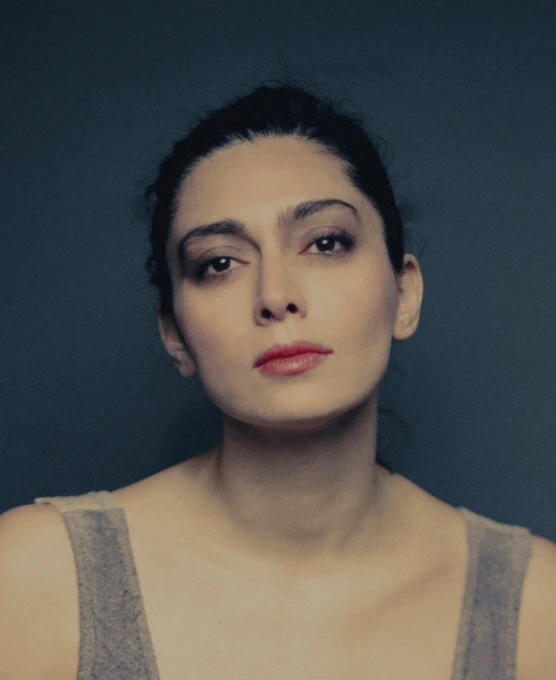
VERDICT: The director of 'Rehearsals for a Revolution' talks bringing the truth to light.
The best place to start with Pegah Ahangarani’s documentary Rehearsals for a Revolution — her stirring and personal portrait of resistance in Iran — is with a story she shares about a how a single picture opened her eyes to how she could speak truth to power as a director.
“One time I went to my grandmother’s house and I found some family albums there. I started looking through the photographs and I noticed in one a man who was standing next to my father, but his face had been scratched out,” Ahangarani said. “I asked my grandmother and my mother, ‘Who is this person?’ They told me, ‘He was your father’s best friend. He was executed after the revolution. He was a leftist.’ I asked them, ‘Why did you erase him?’ They said, ‘Because, we were afraid. We didn’t want to, leave any trace of him.’ I asked them, ‘Why didn’t you destroy the photo?’ They told me, ‘We don’t know.’ In that shocking moment I realized that maybe my grandmother left that photo there for me, maybe somewhere inside her, she was hoping that one day someone would look at the photo and ask her, ‘Who is this person?’ In that moment, I realized that maybe my responsibility as a filmmaker is to find some of these scratched-out faces and bring them back to life, back into the frame, give them a voice, [and] give them a face in our collective memory, in our collective history.”
With her latest film, she does just that. Utilizing a wealth of archival material, ranging from news broadcasts to on-the-ground smartphone footage, the documentary presents decades of political tumult in Iran through the lens of Ahangarani’s family. The result is a movie that challenges the governing version of the truth and delivers a powerful and distinct view of revolt across generations from inside Iran.
“In Iran we have…private archives, personal archives, and official ones,” she explained. “For example, for the 2009 Green Movement, I found a lot of footage from different sources, and some of them were filmed by ordinary people who participated in the protest. And the other ones [were from] the official archives. When you put these two different archives next to each other, you immediately feel the contradiction because there was some kind of distance in the official archives. They wanted to dehumanize the people. You feel that whoever is filming is a stranger. But as soon as you see a personal archive, [shot] by ordinary people who participated in the protest, in every camera shake, in every sudden movement, even in every out of focus image, you see humanity.”
Now living in exile in London, the filmmaker nevertheless feels a deep connection to the cycles of “hope and despair” Iranians have been living through. The transition hasn’t been easy and Ahangarani who still dreams of one day returning.
“I left my country with just one carry-on and as soon as I imagine [myself] as an immigrant who can’t go back to my country…I can’t accept [this],” she said. “You can’t imagine how difficult it is when you’re outside of your country and when you see your friends in the street, and you can’t get any news from them because there’s no internet [or] phone.”
“I can’t accept that I’m gonna [raise] my child outside of Iran. Maybe next year, me, my baby, and my husband will go back to Iran, and my daughter can see her grandmothers and my aunts and all of my family, and I hope she feels Iran is her homeland,” the director adds.
Rehearsals for a Revolution is an example of how the voice and view of the ordinary citizen can confront codified narratives. And for Ahangarani, these are necessary supplies in her work as a director, saying, “These are my materials, these are my tools, because I think these materials by themselves can challenge the authoritarian’s power, and stand against the official version of the history.”
“Rehearsals for a Revolution” plays in the Centrepiece section at TIFF. It will be released theatrically in the United States by Sony Pictures Classics.