
Arctic Link
.
VERDICT: Technology and nature are the opposites who attract to form the thematic core of Ian Purnell’s ‘Arctic Link’, screened at CPH:DOX.
Have we taken the Internet for granted? It’s a question that forms spontaneously, particularly for the younger generations (including yours truly, who would not be in a position to be writing this review – aptly enough, courtesy of a screener link – had the emergence of online spaces for film criticism not occurred), when confronted with a film such as Arctic Link, which explores an area of the world where instant and constant connectivity are not a given. Having premiered in CPH:DOX’s main competition, Ian Purnell’s feature-length documentary debut is sure to continue attracting attention thanks to its topic and thoughtful approach.
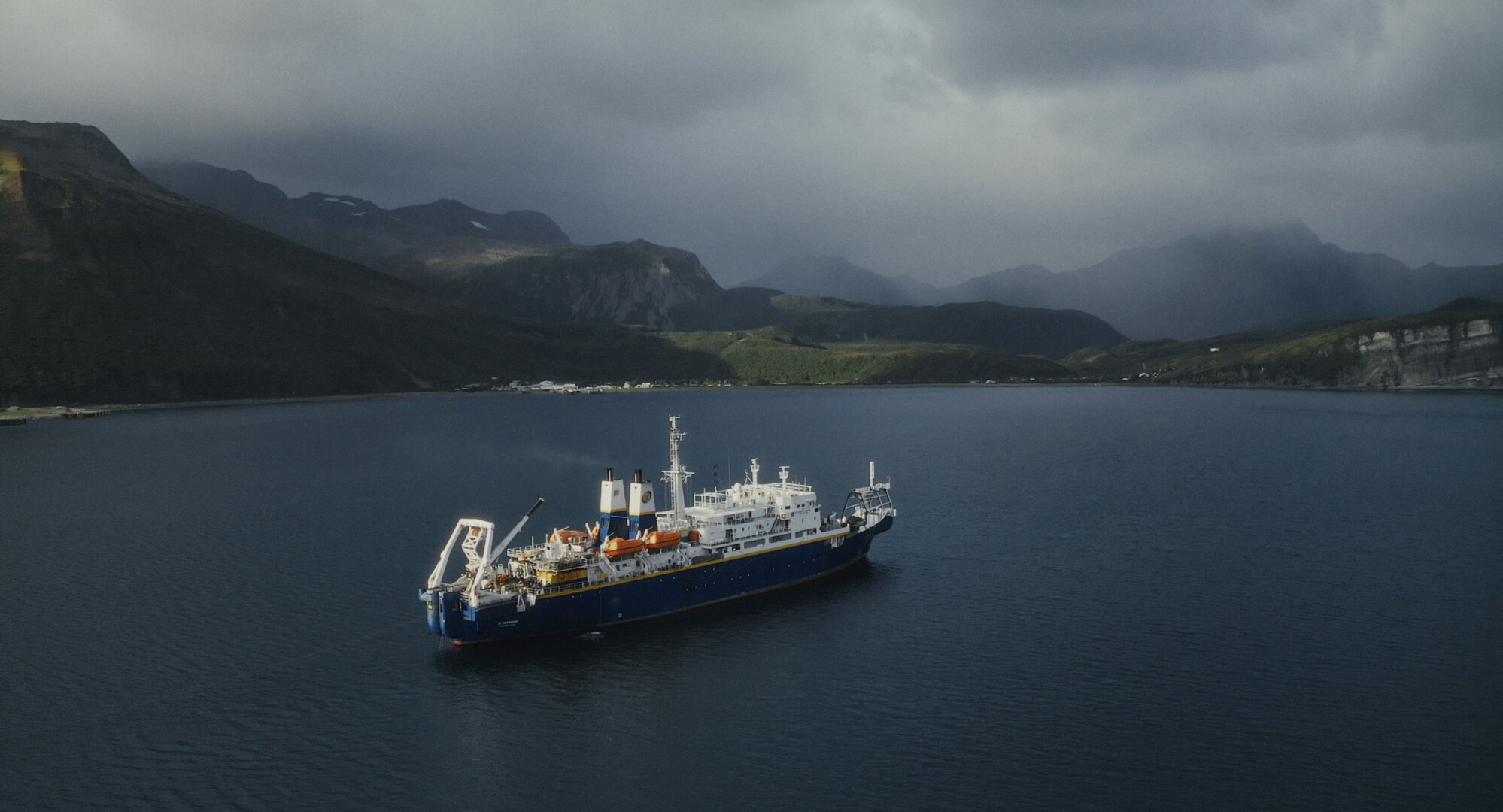
The action, for want of a better term, unfolds on two locations: one is the Aleutian Islands archipelago, situated in the Pacific Ocean and part of the US State of Alaska; the other is a ship heading to that area. Specifically, it’s a cable-laying vessel, entrusted with the job of making sure the remote community on the islands will have access to the Internet. One of the islanders, Gilmar, is very much looking forward to this, as the online world will provide him, the lone queer person within a radius of thousands of kilometers, with a link to a larger macrocosm he has only been able to dream of thus far.
Conversely, another island native, the young Indigenous woman Danika, is returning to the area after years of absence, hoping to pass on her connection to nature and ancestral culture to her children. However, she has legitimate doubts about its feasibility in a society increasingly dominated by an addiction to digital devices. Such devices are, naturally, a vital part of life on the approaching ship, as the Filipino crewmembers rely on their phones and intermittent signal availability to stay in touch with their families over the course of the long and sometimes perilous journey.
Documentaries always come with questions about just how unintrusive the filmmaking crew actually was since they needed to capture the required footage while the people on screen still got to go on with their everyday routines as though the camera – when they weren’t explicitly asked to address it – wasn’t there. Arctic Link is a particularly fascinating example of this, as the small crew had to shadow people in contexts that, under the wrong circumstances, could become exploitative (the islanders) or downright dangerous (the cable-laying operations). Per the press notes, the island portion we see is the result of two years’ worth of encounters prior to the start of filming, meaning the camera has essentially become part of the community and those who interact with it do so of their own volition, in a very natural fashion (coincidentally, another Swiss production that debuted around the same time – Tobias Nölle’s Tristan Forever, also set on a remote island – had to tackle similar practical and ethical concerns).
In fact, while technology is the main driving force of the narrative, even the scenes depicting the cable – the de facto physicalized version of the quintessentially ethereal Internet – have an eerie beauty to them, as this manmade monument (of sorts) to the digital landscape becomes a tangible, yet largely invisible part of the environment that surrounds us. And so, while it ostensibly allows people to connect with an outside world that has long eluded them, it also connects us – via Purnell’s quietly affecting journey to this remote corner of the Earth – with a spellbinding slice of nature most of us were unaware of, a microcosm that gets its moment in the spotlight while retaining its charmingly unassuming essence. Thus, the titular link takes on a spiritual connotation to go alongside the literal one.
Director, Screenwriter: Ian Purnell
Producer: Franziska Sonder
Cinematography: Marie Zahir
Music: Tobias Koch
Sound: Tobias Koch
Production companies: Ensemble Film GmbH, SRF Schweizer Radio und Fernsehen
World sales: Ensemble Film GmbH
Venue: CPH:DOX (DOX:Award Competition)
In English, Tagalog, Spanish
82 minutes