
Cairo 2025: The XR Experience
.
VERDICT: A new chapter begins for CIFF, as Cairo 2025 introduces festivalgoers to the world of immersive experiences and augmented reality.
“Cairo, a city layered with memory and possibility, offers the perfect setting for this encounter between the ancient and the futuristic. We invite you to watch, participate, inhabit, and reimagine through these immersive experiences.” This is how Nora Kahil, the New Media Programmer for the Cairo International Film Festival, describes the main novelty of Cairo 2025: the XR section (also featured in the Industry Days program), following in the footsteps of similar strands at events like Rotterdam and Venice.
The inaugural edition of Cairo’s XR is housed in the Hanager building, a stone’s throw from the festival’s main screening venue at the Opera House. Unlike its counterparts at other festivals, where each experience has its own space isolated from the rest, the Cairo version is structured like a single, long experience, where the user walks from one installation to the next along a predetermined path. It’s an intriguing choice, albeit one that makes the online booking system, where reservations are made in half-hour chunks, a bit baffling since some of the experiences run far longer than that (for comparison, the booking of the aforementioned Rotterdam and Venice programs is based on the individual installations).
Some technical kinks are also still in need of being worked on, particularly one experience that requires the user to download an app (a detail that is not mentioned in the project’s description on the festival website or in the catalogue), but those are normal growing pains for this inaugural foray into the world of virtual realities. And it is quite fitting that, after the first segment of Agnes Michalczyk’s Augmented Walls (where the app tells the story of the street art taken from Cairo’s Al Khalifa neighborhood), the work that eases the viewer into this universe is a relatively straightforward short film.
Said film is called Rebuilding Gaza, and it plays on a 360-degree screen. Dialogue-free and running three minutes, it imagines, via CGI, how the war-torn region may be reconstructed in the future, giving a certain visual poignancy to a very delicate subject. Directed by Karim Moussa, it’s one of four Egyptian projects in the XR lineup (out of seven experiences in total), Augmented Walls being one of the other three.
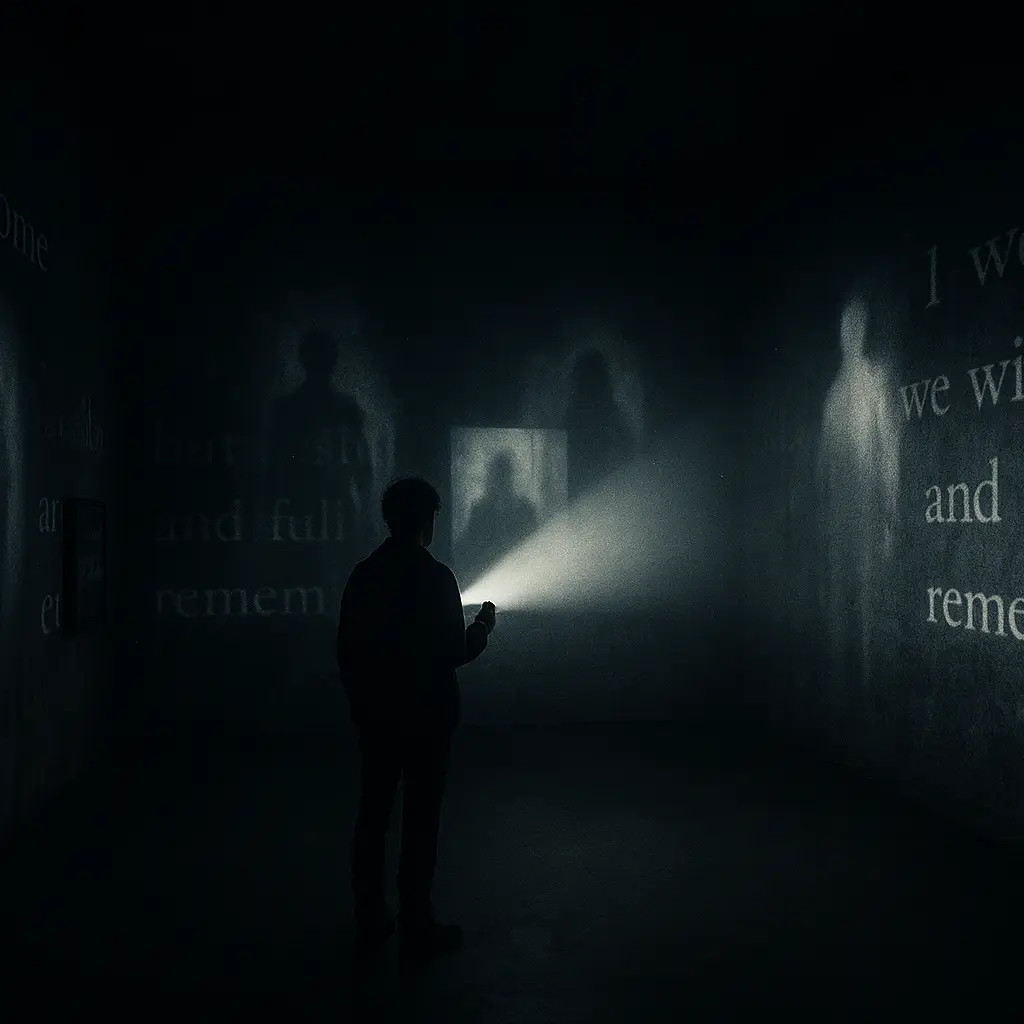
From there we move on to the third piece, Doaa Darwish’s In the Blink of Light. The most conceptually intriguing experience on display at the festival this year, it’s situated in a room wrapped in darkness, where the user is asked to illuminate a contraption with a flashlight. Depending on the area hit by the light, a screen on the wall shows fragments of images, sounds and texts, representing the fragility of memory and what we choose to retain or leave unseen and unheard. It’s a powerful slice of minimalism, conveying a lot with a very simple set-up.
The last four projects share the same larger space within the room, a slightly awkward logistical choice since one of them is designed for four users simultaneously. This is the final Egyptian experience on offer, called Timebound: Whispers of Osiris. The 90-minute duration may feel punishing for those who are not interested in the gaming component of immersive projects, but it should appeal to fans of escape rooms, as the concept is applied to a Pharaoh’s tomb where the players must solve various puzzles before their time runs out.
The other game hails from Belgium and is much simpler in execution: Ives Ageman’s Wall Town Wonders enables the user to transform their virtual living room into a proper town, filled with miniature characters. It’s a fun little example of mixed reality playfulness and, alongside the Egyptian escape room, the most fun one can have in that final stretch of the XR journey, as the remaining two installations, both previously shown in Venice, are – to differing degrees – a bit on the heavier side.
Bodies of Water, a Canadian creation, revolves around the user being in a 360-degree virtual environment that recreates the bottom of a swimming pool, where one observes as other bodies enter the pool and undergo a transformation, culminating in an enthralling dance. Bodies also play a role in The Man Who Couldn’t Leave, but with no dancing involved: the viewer is (not quite literally) thrown into a prison cell and listens to the recollections of A-Kuen and his friend A-Ching, two political detainees who suffered at the hands of the persecution occurring in Taiwan in the 1950s. This was the final experience this writer chose as part of the XR viewings, making it particularly apt to then reconnect with the outside world after all that time spent inside the Hanager building.