
Cairo’s Mohamed Tarek Looks Beyond Competition to Build New Audiences
.
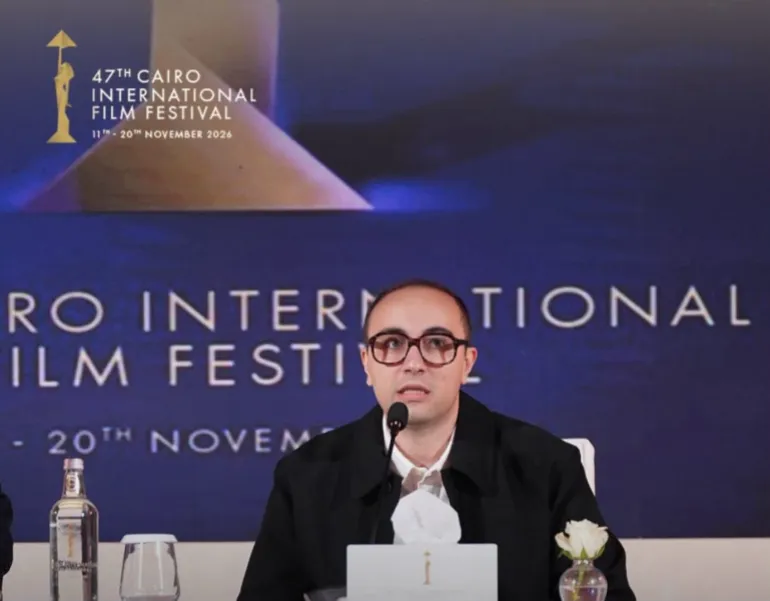
VERDICT: As the Cairo International Film Festival opens on Nov. 11, artistic director Mohamed Tarek reveals programming choices, regional disruptions, international partnerships and the growing popularity of classic cinema.
The Cairo International Film Festival (CIFF) is seeking to expand its audiences, strengthen international partnerships and reconsider traditional programming hierarchies as it prepares for its 47th edition, coinciding with its 50th anniversary since the curtains rose in 1976. For artistic director Mohamed Tarek, it offers an opportunity to rethink how films are selected, presented and experienced.
“We’re very open, very happy to increase the audience numbers. I think this is one of our main goals,” Tarek told The Film Verdict, explaining that Cairo’s population and diversity require a programme that appeals to different generations and cinematic tastes.
“I would rather not talk only about the main competition, because our goal this year is to give all the love that we can give to all of the competitions and the sections in the festival,” he said.
The selection comprises 145 films from 64 countries, including 17 world premieres. Tarek pointed to a programme that combines major international filmmakers like Hirokazu Kore-eda and eagerly awaited titles from Cannes, such as The Beloved and The Dreamed Adventure, with Egyptian and Arab premieres, documentaries, shorts and experimental works. The festival’s Horizons of Arab Cinema section includes the world premiere of the Iraqi film The Blind Ferryman, while the Midnight programme features the Saudi production Traveler’s Tales.
The programming diversity, Tarek explained, is central to the festival’s efforts to attract new audiences while maintaining its established cinephile following. He raised the question of how an established festival with a large audience can continue to grow.
Among the new initiatives is Cairo Kids, designed to introduce children and younger teenagers to cinema beyond conventional commercial animation. The revamped midnight programme, A Night’s Stroll, meanwhile, pairs contemporary films with classics.
“The festival has been, in some years, extremely nice for the cinephile only or for the industry professional only, but it has always been a bit serious,” Tarek acknowledged. “We wanted to be more fun, more inclusive and more audience-appealing,” while demonstrating that independent cinema is not necessarily inaccessible.
The festival is also expanding its New Wave talent programme, bringing together around 100 emerging filmmakers and critics from more than 20 Egyptian governorates, alongside Arab participants residing in Egypt. The initiative includes film criticism and mentoring sessions with international and regional industry professionals, including cinematographer Frida Marzouk, editor Kutaiba Barhamji and Locarno artistic director Giona Nazzaro. Tarek described the programme as an attempt to establish a more comprehensive platform for emerging talent rather than a series of individual workshops.
Geographical expansion is another priority. Alongside the Cairo Opera House and multiplexes, screenings will take place at standalone venues, including the historic Tahrir Cinema and the arthouse cinema Zawya in Downtown Cairo. Other locations include the Zamalek Cinema, Ewart Hall at the American University in Cairo and VOX Cinemas at Mall of Egypt and City Centre Almaza.
“When you put the films in other cinemas, we are not only having more screening venues,” Tarek explained. “We are introducing the festival to the people who go to these cinemas already.”
The festival’s Egyptian selection includes the world premiere of Ahmad Abdalla’s BerleeN and Ashgan El-Hamus’s Al Baraneya, arriving from Venice.
For Tarek, BerleeN is further evidence of the artistic sensibility Abdalla established in Microphone, particularly his treatment of urban spaces and marginalized characters. He sees the film’s portrayal of Berlin as challenging Egyptian perceptions of the German capital as an idealized destination.
Al Baraneya, meanwhile, employs largely nonprofessional performers and a documentary-like approach to explore experiences rooted in the director’s Dutch-Egyptian family origins.
Both films, Tarek suggests, represent a shift in Egyptian filmmaking away from grand political statements, toward intimate human experiences.
“[in these films] we are looking into human beings, we are looking into feelings rather than statements,” he said. “History is not only big events, but it’s the people living, how they feel.”
Tarek also singled out Sara Shazli’s documentary Your Daughter, which explores the filmmaker’s relationship with her mother, producer Marianne Khoury, and the emotional consequences of her absence during Shazli’s childhood. The film examines motherhood and intergenerational trauma, questioning idealized representations of maternal relationships. For Tarek, it offers another example of how contemporary Egyptian filmmakers are increasingly turning toward personal histories and family experiences.
The anniversary edition will also welcome prominent international figures, including Mauritanian-Malian filmmaker Abderrahmane Sissako and Italian director Matteo Garrone, who will receive honorary Golden Pyramid awards for lifetime achievement and participate in masterclasses.
Moroccan-French filmmaker Nabil Ayouch chairs the International Competition jury, whose members include Chinese actress Fan Bingbing and Belgian director Laura Wandel. French-Spanish director Óliver Laxe is also scheduled to give a masterclass.
Tarek acknowledged that some international guests had initially expressed concerns about travelling to Egypt amid regional tensions in Iran and Gaza. Nevertheless, he pointed to the participation of filmmakers including Asif Kapadia, Guillaume Nicloux and Ayouch as evidence of the festival’s ability to attract international talent despite the uncertainty affecting the wider region.
Regional developments have also affected Cairo’s programming. Following the postponement of Saudi Arabia’s Red Sea International Film Festival, CIFF incorporated approximately three films that might otherwise have screened elsewhere.
Nevertheless, Tarek rejects the idea that the disruption represents a straightforward advantage.
“We are very saddened whenever another festival gets postponed,” he said, stressing the importance of cultural platforms across the Middle East. “Hopefully it will soon be back, even if it puts more competition on our side.”
International cooperation remains a priority. CIFF is continuing its relationship with the Shanghai Film Festival through the Belt and Road initiative, while a new collaboration with Durban Talents will bring an emerging film critic to Cairo.
The festival also explored sharing a world premiere with Tallinn Black Nights. Although that initiative did not materialize, several films are circulating between the two events.
“We really believe as a team in circulating films between different festivals and not only screening them in one festival,” Tarek said.
Financial limitations remain an obstacle to expanding CIFF’s international reach. Tarek acknowledged that international press participation has not increased significantly, with the festival instead prioritizing buyers and distributors.
“Additionally, we put some more focus on the distributors and buyers, because they were actually lacking from the festival,” he explained.
Meanwhile, strong audience interest in restored classics has prompted changes to the festival’s screening arrangements. The Opera House’s Main Theater, traditionally associated with the International Competition, will also host classics, shorts and special screenings.
“We had more freedom, to be honest,” Tarek said of the programming decisions. “Freedom in how we curate the films, and freedom in how we put them in front of audiences.”
He argued that allowing outside expectations and criticism to dictate programming decisions could leave curators “paralyzed,” emphasizing the importance of experimentation even at the risk of controversy. “Even if you get criticized for these things, at least you try,” he said.
The approach follows last year’s successful experiment with short films in the Opera House’s Grand Theater, where screenings attracted full houses.
“Classics are very popular right now,” Tarek observed, suggesting that audiences increasingly see older films as a source of pleasure and discovery.
For the artistic director, cinema’s value should not be determined by a film’s premiere status, competition placement or production year.
“Great cinema exists in 1920, 1950, 1970. It’s not only the cinema of today that really matters,” he said, invoking the popularity of classical music concerts as a parallel. “Why not cinema?”