Chronovisor
Chronovisor
VERDICT: Kevin Walker and Jack Auen’s eerie, stylish techno-horror debut draws us through a library wormhole into a ‘70s scandal around a Benedictine monk’s memory-recording machine.
In Chronovisor, the eerie and stylish debut feature of US directing and writing duo Kevin Walker and Jack Auen, an obsessive French academic who devours rare books in a New York library late into the night gets in over her head when she digs around for records of the rumoured invention of a machine for replaying the complete collective memory of humankind on a screen the size of a television. The film had its world premiere in the Bright Future competition of the Rotterdam International Film Festival.
The story draws on an actual scandal from the ‘70s in which Father Pellegrino Ernetti, a Benedictine monk and musicologist, claimed to have seen the Crucifixion of Christ through a device — the Chronovisor — he created alongside twelve physicists, with a screen the size of a television. Elegantly weaving in an assemblage of actual articles and essays on the curious story, the techno-horror is a fitting parable for our era of disputed facts, conspiracy theories, and identity-consuming virtual realms. In this bibliophilic mystery with shades of Umberto Eco, the only red blood splurge comes from a papercut. With a build-up of suspense that is more cerebral than splashy, it is unlikely to find broad appeal beyond arthouse tastes, though its creeping dread pays off with a gripping finale with the hypertextual chills of a grown-up The Blair Witch Project for urbane bookworms.
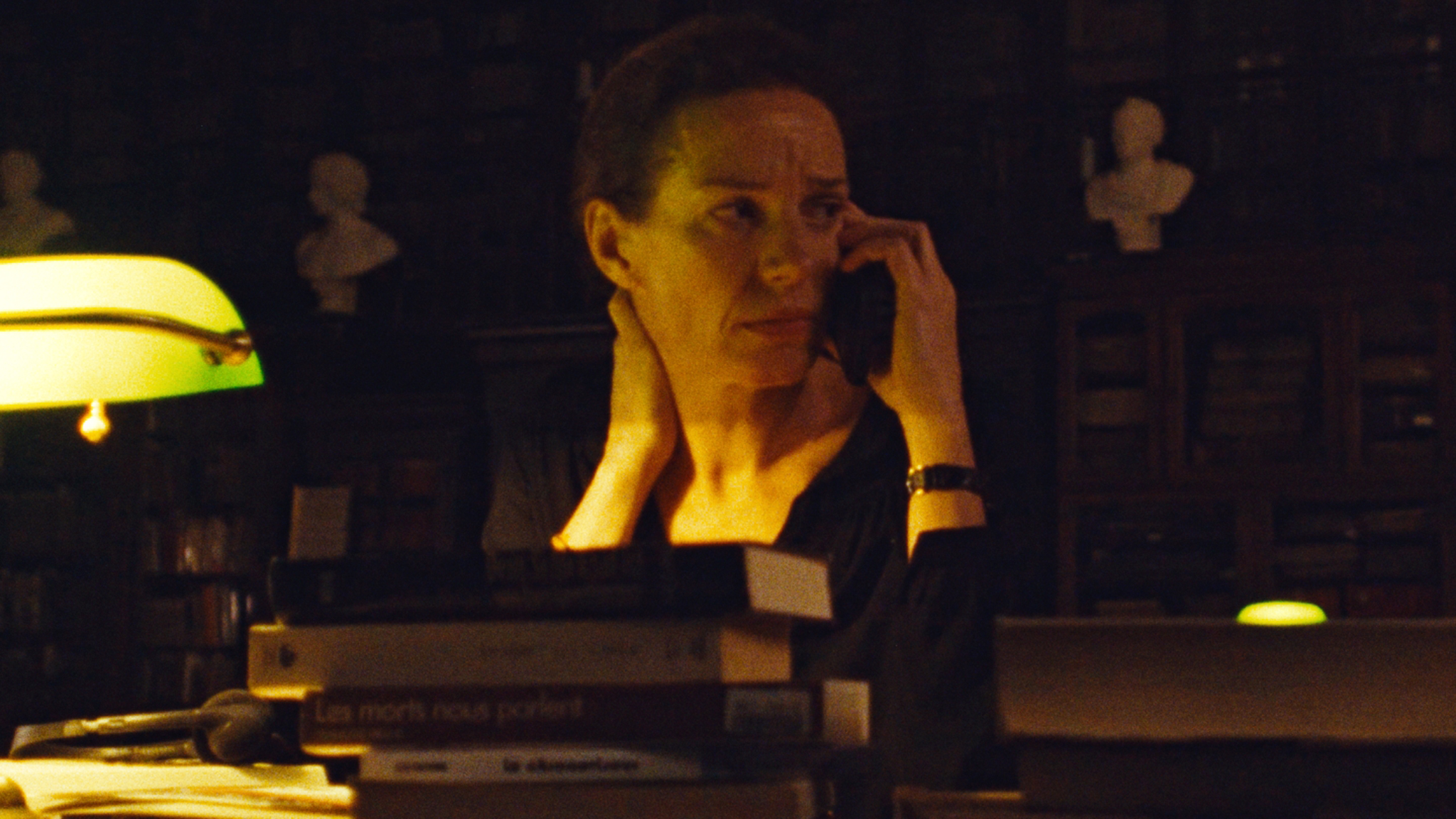
An actual professor of behavioural sciences, Anne-Laure Sellier, is convincingly cast as Beatrice Courte, a scholar of neuroscience and memory at Columbia University. She spends occasional evenings in the low-lit campus bar with other academics, where they expound to each other in monologues about their pet specializations, rather than really connecting in conversation. Her prime attention is reserved for her research materials, and the solitary hours she spends collecting the thoughts and experiences of others. Initially, it seems this focus by Walker and Auen on the walled-off, egotistically acquisitive nature of elite knowledge-seeking might not be the stuff of pulse-racing cinema, yet this ivory-tower seclusion and detachment from everyday concerns quickly become the condition from which the horror takes hold.
The world of academia has rarely looked so seductive, the mahogany wood and green reading lamps of the dark library, shot on gorgeously textured 16mm, combining with cassette recordings and highlighted passages that directly immerse us in the stored traces of the past. Romantic nostalgia for analogue methods, and a time of arcane secrets when information was not at one’s fingertips via a search engine, infuses every frame. The Gregorian chants that so captivated Ernetti, which Beatrice plays in her apartment, add to the drama and foreboding.
An exacting personality who will do anything for a breakthrough, Beatrice dangles the lure of fictional awards over the phone as a means to get callbacks from sources who might divulge more about the mysterious Chronovisor, suspected to have been stolen before it could be disassembled and stored. Ernetti himself went missing after the Vatican, concerned the device might interfere with interpretations of Scripture, tried to suppress the invention and all records of it. As she works through her contact list of European bigshot thinkers once associated with Ernetti, she comes to a Portuguese physicist said to have been ruined by his experience with the machine, which not only captures memories of the past, but causes them to merge with the minds of those who use it, destroying their sense of identity. Her field trip to chase this lead takes us far beyond the confines of the university — and deep into the ambiguity between layers of reality, and between the worlds of the living and the dead.
This is a spine-tingling and uncanny film that resonates with the vastly expanding powers of networked space and artificial intelligence today, and fears of the erosion of privacy and human autonomy by our inability to control the sheer power of technology contained within a screen in our pocket. It is also, ultimately, a sly and playful reflection on the power of cinema itself, not unlike the Chronovisor, as a portal onto other worlds that can be deceptive and intoxicating.
Directors, screenplay, editing: Kevin Walker, Jack Auen
Producer: Jason Zuriff
Cinematographer: Leo Zhang
Editor: Danielius Kokanauskis
Cast: Anne-Laure Sellier
Production Design: Alex Pena
Sound Design: Eric Zhang
Music: Gustav Holst
Production company: Cosmic Salon Films (USA)
Sales: Cosmic Salon
Venue: Rotterdam (Bright Future Competition)
In English, French, German, Italian
99 minutes