
Dream of Another Summer
Dream of Another Summer
VERDICT: Winner of the Next Wave award at CPH:DOX, 'Dream of Another Summer' is filmmaker Irene Bartolomé’s poetic, pensive and powerful ode to the traumatized Lebanese capital of Beirut.
So tragic has contemporary Lebanese history been, that a cataclysmic explosion that nearly tore its capital apart just six years ago – leaving hundreds dead, thousands injured and many more homeless – is now at risk of falling completely off the radar. With Dream of Another Summer, Beirut-based Spanish filmmaker Irene Bartolomé has delivered a moving cinematic eulogy about a catastrophe of as much historical significance as Israel’s calamitous military onslaught against Lebanon in the past three years.
While it mirrors Chantal Akerman’s approach in observing and narrating personal experiences of urban malaise, and haunted by post-traumatic visions of a ruined country which wouldn’t be out of place in Ghassan Salhab’s 1998 classic Phantom Beirut, Bartolomé’s first feature takes a more intimate approach in exploring how the 2020 Port of Beirut blasts shattered Lebanon’s national psyche and its dysfunctional politics.
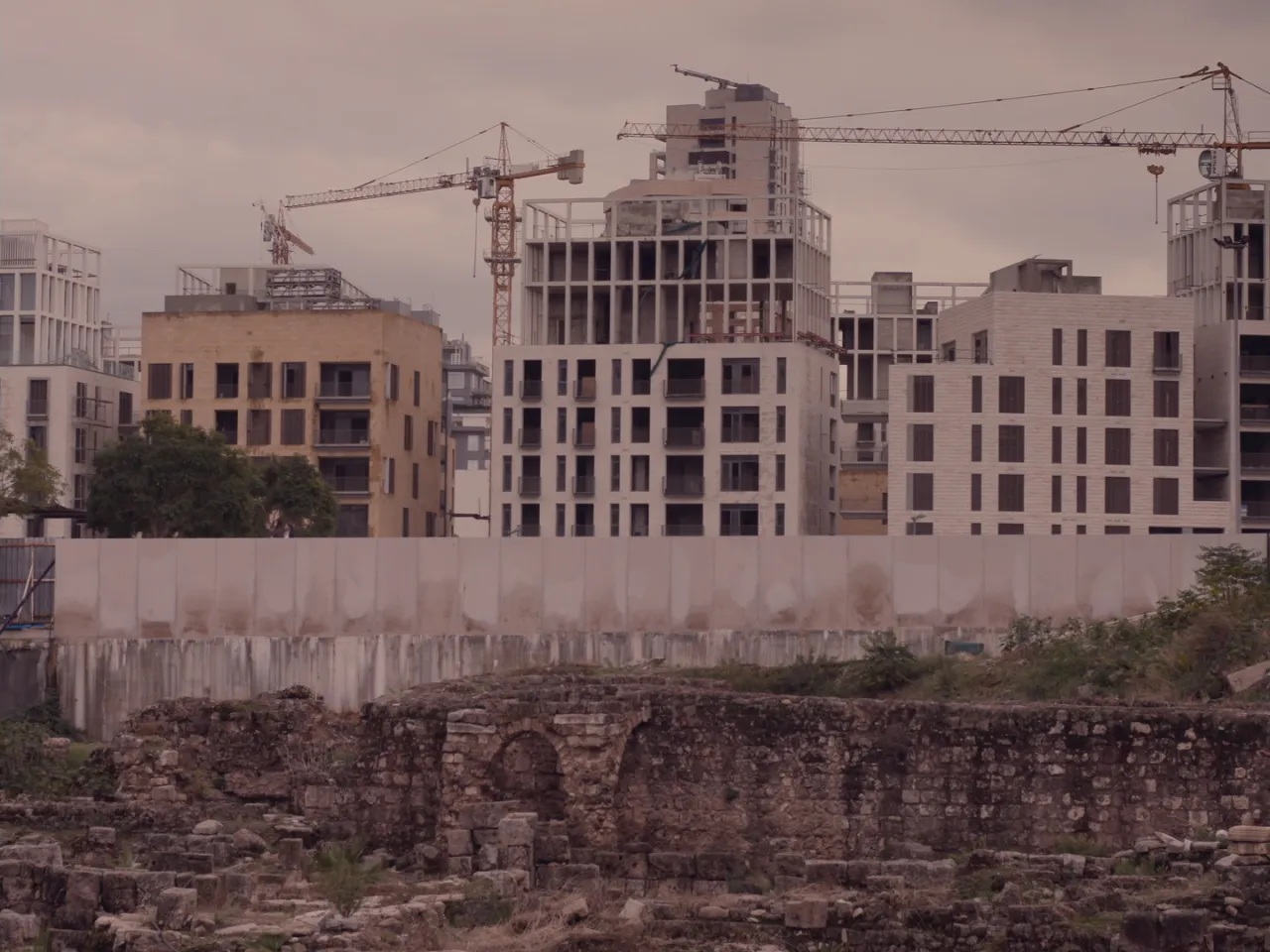
Revolving around an unseen fictional Spanish filmmaker’s attempt to make sense of Beirut’s post-explosion ambience, Dream of Another Summer relays the melancholy and anxiety in the city through static shots of street life unspooling in a landscape marked by architecture that could be seen as majestic, muddled and mangled. We witness empty seaside boulevards lined by upscale condos in the early hours of the morning; then people going to work on cluttered inner-city streets with their overhanging electric wiring and multilingual signage. From above, we see cars and people moving along roads banked by careening buildings during daytime. On the ground at night, grocers wait anxiously for business at their shop, while others sip their tea as they listen distractedly to TV news programmes about the rising cost of living.
In parallel to these snapshots of her surroundings, Alicia’s own personal struggles are illustrated by images of her recently refurnished and still barren apartment. She struggles to write down her own thoughts and feelings on the blank pages of her notebook, and a close-up of her hands breaking open a juicy pomegranate could be either another image from her quotidian life or an allegory of her own physical and psychological breakdown. All this plays out in her voicemails: from her landlord, who provides her with a detailed rundown of the repairs on the blast-stricken flat, and also the sound of her partner who probes her about her decision to leave home again for Beirut. All this serves to heighten Alicia’s own doubts (and guilt) about her return to a city she abandoned at a time of crisis.
A recurrent visual motif in those interior shots is that of a flapping window, one so severely damaged by the shockwave of the blasts that it couldn’t be fixed properly. As if swung about by an invisible spirit wandering in and out of the apartment, the swaying metallic frame seems to evoke a ghostly presence in and above the city. The eeriness of that echoes Alicia’s computer-generated rendering of the storage towers which were considered Ground Zero of the 2020 explosions. Over those fuzzy, spectral visual reincarnation of grain silos which have either been pulverised or are now nearing collapse, an engineering expert tells Alicia (again, off-screen in a telephone conversation) about his dilemma about supporting the demolition of this dangerous structure, and his strong sentiment about the upkeep of this ruin as a symbol for the fight for political responsibility, social justice and “a trace of our civilisation”.
Being at once a visual chronicle of what Beirut looked like in the not-so-distant but very different past, and a recording of the frustrations and fears of a people fatigued by years of corruption and chaos, Dream of Another Summer offers a counterpoint to films seeking to tackle Lebanese politics and history through drama (such as international hits such as Ziad Doueiri’s The Insult and Mounia Akl’s Costa Brava, Lebanon), documentary (Myriam El Hajj’s Diaries from Lebanon) or collage (as in Lana Daher’s monumental found-footage film Do You Love Me?).
Drawing from the font of fine footage filmed by Pôl Seif, Bartolomé and her Lebanese co-editor Sandra Fatté has constructed a narrative rich with connections and contrasts. Especially towards the end, that is, when the documentary pivots away from fatalism with close-ups of people talking animatedly to each other in a café: a sign that the resilience of the Lebanese people cannot be defeated. Their time will come, Bartolomé seems to suggest with this denouement; sometime in another summer, maybe, but it doesn’t have to happen only as a dream.
Director, screenwriter: Irene Bartolomé
Producers: Pere Marzo, Elie Kamal, Irene Bartolomé
Executive producer: Francina Verdés
Cast: Sylvain Perdigon, Nesrine Khodr, Cecilia Bartolomé Pina
Cinematography: Pôl Seif
Editing: Sandra Fatté, Irene Bartolomé
Music: Kinda Hassan
Sound: Philippe Ciompi
Production companies: Colibrí Studio, Lemu Helu, The Attic Productions
World sales: Colibrí Studio
Venue: Jeonju International Film Festival (International Competition)
In English, Arabic, Spanish and Catalan
70 minutes