
Egypt’s Golden Age of Cinema Finds a New Generation in Cairo
.
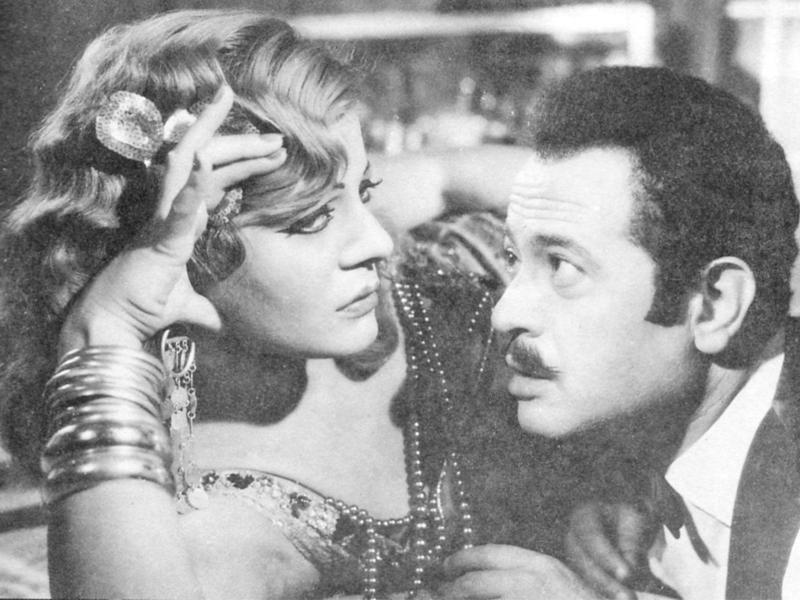
VERDICT: From political dramas to feminist comedies, restored Egyptian films are drawing young audiences to the Cairo International Film Festival, bringing the country's movie past back into the conversation.
There were barely any empty seats at Cairo’s Hanager Cinema on Thursday evening. Yet the film on the screen was not a hot new Egyptian release or an international festival hit, but a black-and-white production made 60 years ago. And most of the audience were young Egyptians who had come to watch Cairo 30, Salah Abu Seif’s 1966 political drama about poverty, corruption and the price of getting ahead in life.
Based on Naguib Mahfouz’s 1945 novel Cairo Modern, Cairo 30 was arguably among the first Egyptian films to push for a socialist solution to the country’s eternal problems: class struggle, societal decay and corruption. Directed by Abu Seif, the godfather of realist Egyptian cinema and an admirer of Soviet realism, with a script by socialist intellectual Lutfi al-Kholi, it was released during the politically engaged artistic climate of the 1960s.
Its protagonist, Mahgoub (Hamdy Ahmed), is a poor university graduate who has little interest in morality or political ideals. His answer to almost everything is “Tuz!” (roughly translated, “fuck it”). When he accepts an arrangement to marry a powerful official’s mistress in return for a government job and a comfortable apartment, the film asks whether he was born selfish or made that way by poverty and humiliation.
Six decades later, Mahgoub’s world is still familiar to Egyptian audiences.
The film is among 29 restored Egyptian productions presented at the 47th Cairo International Film Festival, where younger viewers are rediscovering films they may have previously encountered only on television or through clips online.
For Hanan Al-Saed, 35, the screening brought back Friday evenings with her mother, now 70, when the family would gather around the television to watch an old Egyptian film.
“We used to watch a black and white film every Friday and have a lot of nostalgia about the old buildings, how people dressed, and how the actors looked like, even in the films where they were popular or in working-class neighbourhoods,” she said.
“People were always decent and funny, unlike the commercial films these days.”
The mother also remembers going with her family to Cinema Metro in downtown Cairo in the 1960s, where they watched Soviet films, Westerns and Egyptian productions. Watching Cairo 30 in a movie theater again was, for her, a particularly nice experience.
The festival’s selection includes Henry Barakat’s The Sin (1965), about a farm labourer whose life is destroyed by poverty and violence, Abu Seif’s The Second Wife (1967), which attacks the power of a village mayor, and Palace of Desire (1967), another Mahfouz adaptation exploring the changing lives of a Cairo family. Other titles include Khan al-Khalili, The Rebels, My Wife and the Dog and Something of Fear.
There are comedies too. Fatin Abdel Wahab’s My Wife, the General Manager (1966), starring Shadia (the actress who is honored on this year’s festival poster) and Salah Zulfikar, follows a husband whose wife unexpectedly becomes his superior at work. The comedy comes from his wounded masculine pride, his colleagues’ reactions and the changing balance of power between the couple.
Salma, an art student, booked her ticket for the film because of its treatment of women.
“The feminism in this film is very progressive despite its limitations,” she said, comparing it with “the objectification and sexism that is now out in the open in some of the films that are produced now.”
For me, this was the golden age of cinema in Egypt, and it remains a source of pride and an inspiration for filmmakers, writers and academics.
The restorations have also changed my own appreciation of these films. There are scenes, small details and even lines of dialogue that I had watched or heard many times before without paying much attention to them. Seeing them restored, with clearer images and sound, feels almost like watching a different film.
I remember watching Sergio Leone’s The Good, the Bad and the Ugly on a black-and-white VHS recording from Channel 2 of Egyptian national television, complete with Arabic subtitles. Years later, watching it in a restored high-definition edition was an entirely different experience. Suddenly, there were details in the landscapes, faces and compositions that I had never appreciated before. This is the kind of opportunity that the restorations at CIFF are now giving Egyptian audiences with their own film heritage.
Cinema has always been one of the strongest elements of Egyptian popular culture. It helped spread the Egyptian dialect across the Arab world, introduced catchphrases that people still use in everyday conversations, and made its actors household names from Morocco to the Gulf. A figure like Adel Imam, for example, is known and appreciated by generations of Arab audiences.
What made Egyptian cinema so popular was not simply the talent of its stars and directors. There was a determination to support cinema at the state level, and that support was not just financial. Filmmakers were sent abroad to study, institutions were established, and directors had room, within limits, to engage with the worries and anxieties of the society they lived in.
Filmmakers were also able to organise professionally, compete with one another and participate in a lively cinematic culture. Much of that institutional support and professional environment is missing today, although the appetite for cinema among Egyptians is clearly still there.
This does not mean the golden age was free of problems. Censorship was a major issue then, just as it is now.
Hussein Kamal’s Something of Fear (1969) is a good example. Set in an imagined Egyptian village, the film is a direct criticism of dictatorship through the character of Atris, a powerful man who terrorises the inhabitants.
In one memorable scene, Fouada, played by Shadia, leads a rebellion without making a speech or organising a protest. She simply opens the water gates that Atris has closed to punish the villagers.
The film faced censorship difficulties, and the frequently repeated story is that President Gamal Abdel Nasser himself had to give his final approval for its release. More than half a century later, it is still referenced when Egyptians discuss authoritarianism. Fouada’s silhouette, appropriately, appears on this year’s festival poster.
For Omar Mohamed, an accountant, seeing young people interested in these films is a welcome change. He becomes upset when his nieces, nephews and other teenagers in his family dismiss Egyptian films as trashy or commercial and say they would rather watch Hollywood and Netflix productions.
“When I am at the festival and see many young people in a screening hall watching a film whose entire cast has passed away, I feel positive,” he said.
Festival artistic director Mohamed Tarek has noticed the same enthusiasm.
“I think classics are becoming increasingly popular, particularly among young audiences,” he told The Film Verdict. “People are rediscovering films that they may have known only through television or smaller screens.”
Tarek also pointed to festivals such as Il Cinema Ritrovato in Bologna, where older films attract enthusiastic contemporary audiences. “Great cinema did not begin in 2026,” he said. “It existed in the 1920s, the 1950s and the 1970s, and those films remain important today.”
The festival is also trying to make the Cairo Opera House more accessible. For much of the year, the venue is associated with intellectuals, cultural elites and expensive opera performances. During CIFF, however, its screening halls welcome students, younger audiences and people who might otherwise have little reason to visit.
Critics have played a part in the renewed interest too, moving beyond writing long pieces about film history to recommending titles on social media, discussing them with younger audiences and encouraging people to see them on the big screen.
For Kareem, a political science graduate, the screenings also raise questions about who owns Egypt’s film heritage.
“Nowadays we see logos of companies owned by the Gulf countries on Egyptian classic films when they are screened by local Egyptian TV stations, which is not right,” he said. “This archive and this identity should be owned by Egyptian institutions.”
The popularity of these screenings is encouraging, but there is another gap that Egyptian cinema needs to address in the coming years: the distance between local audiences and what is commonly called aflam mahraganat, or “festival films”, which are often dismissed as slow, difficult or unclear.
The filmmakers of Egypt’s golden age were not always subtle. Some relied heavily on symbolism, others on political preaching. Yet they made films about things their audiences recognised: poverty, work, marriage, corruption, ambition and the everyday absurdities of Egyptian society.
Some contemporary Egyptian filmmakers could learn something from that relationship, making films that are more relatable to audiences at home rather than concentrating on what might appeal to badge-holders at Cannes, Berlinale, Venice and Locarno.
After all, a full hall watching Cairo 30 sixty years after its release is a reminder that Egyptian audiences have never necessarily been afraid of serious cinema. They want to see themselves in it.