
Hotel Utopia
Hotel Utopia
VERDICT: A team of digital nomads dream of creating a shared paradise in an abandoned Bulgarian hotel in this engaging, amusing, slightly elusive debut feature by German documentary director Julia Groteclaes.
An ambitious scheme to establish an idyllic community of “digital nomads” in a crumbling former ski resort hotel in Bulgaria is the subject of Hotel Utopia, an engaging first full-length feature by young German documentary maker Julia Groteclaes. The director’s closely observed style in this impressive film-school diploma project is deadpan and detached, with minimal editorial slant, though her light-touch tone is laced with droll satire and understated social critique.
A world premiere in the German Competition section at DOK Leipzig this week, Hotel Utopia should enjoy plenty more festival play, though its open-ended narrative and lack of major dramatic twists will mean it has more word-of-mouth specialist appeal than wider breakout potential. Groteclaes has described the film as a study of power structures, made with feminist intent. But it also plays as a very human story about loneliness, alienation and community collapse in the online age.
The main protagonist is Matthias Zeitler, a German entrepreneur who specialises in creating co-working and co-living communities for digital nomads, those rootless tech-savvy professionals who can work online from anywhere in the world. His latest project is Co-Living Semkovo, bringing together over 100 investors to transform a semi-derelict former Communist-era resort hotel in the mountains of southwestern Bulgaria into a shared residential retreat. The dream they are buying falls somewhere between a chosen family, holiday apartment and giant party commune. There is rich scope here for mocking these moneyed bohemians, tax-avoiding jet-setters and digital snake-oil salesmen, but Groteclaes is admirably restrained. On camera, Zeitler can be pompous and pushy, but also affable and funny. Hotel Utopia certainly does not paint him as a simplistic villain figure.
Tracking the project from soon after its 2022 launch, Groteclaes blends close observational footage of Zeitler with various people in his orbit, notably his deputy Marc, who slowly reveals himself as a nervous, depressive misfit behind his multi-lingual charm and perma-grinning demeanour. Among the potential investors, exiled Ukrainian Anna also emerges as an endearingly sensitive outsider searching for meaning in a cold, hard world. “I thought you were Russian,” Marc tells her at one point. “Russia thinks I’m Russian,” she fires back smartly.
Groteclaes also spends time with Bulgarian natives living in this rustic forest backwater. Her main point of contact here is gruff grandfather Johnny, who previously worked as a caretaker, security guard and ski teacher during the hotel’s 1980s Cold War heyday. Despite some wary cynicism towards these western capitalist interlopers, Johnny and his drinking buddies cautiously welcome their renovation project, not least because it will bring jobs and money to their economically depressed region. “I hope they are not scammers,” his brother warns. “You close your eyes and they lie…”
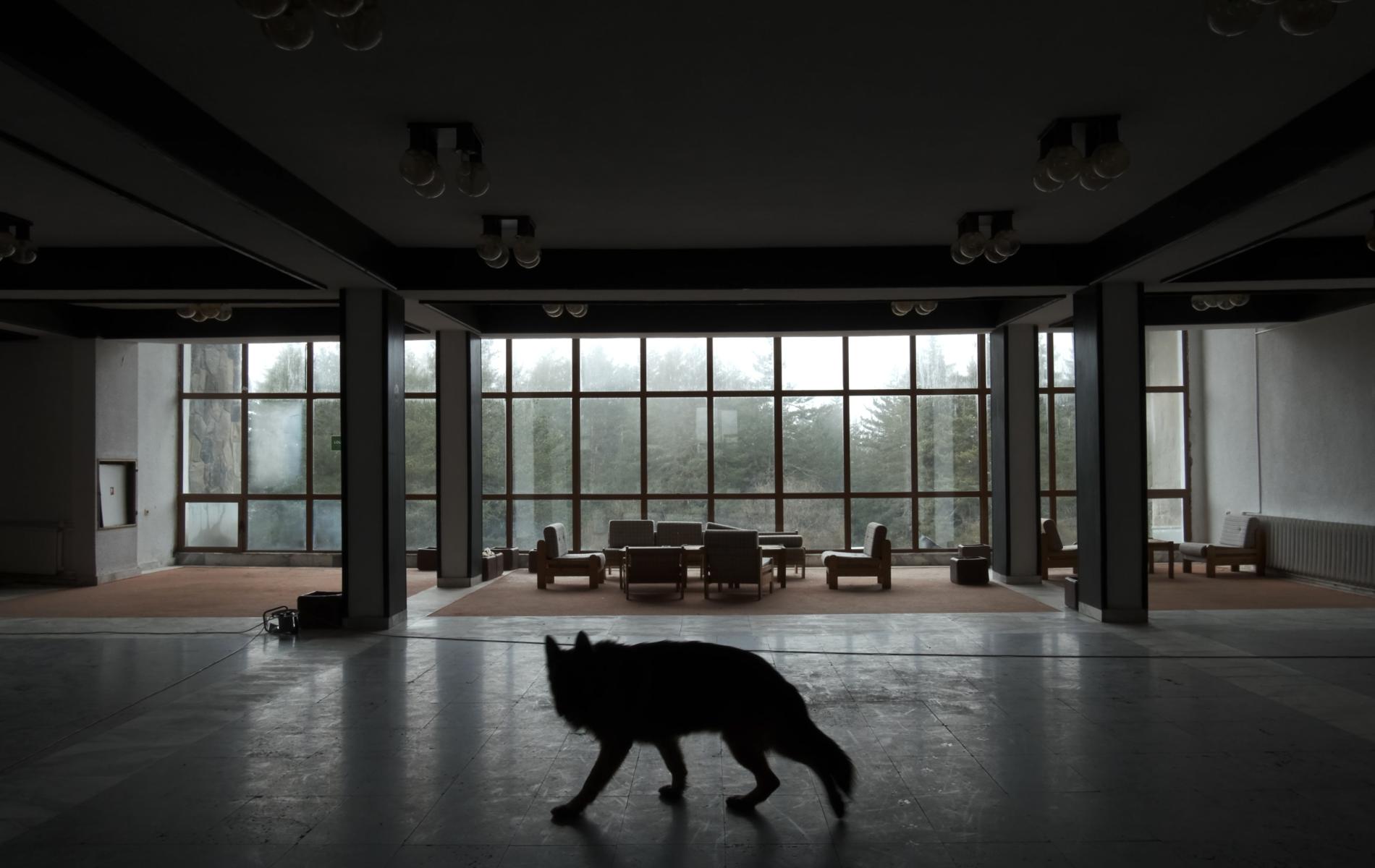
For a character-driven documentary, Hotel Utopia is too light on biographical context. Groteclaes could have included much more personal detail on Zeitler and his background chorus of associates. Besides a few teasing hints, we learn very little about their families, history, political beliefs, psychological motives and so on. Even so, this is a handsome film overall, intercutting human interactions with alluringly lyrical shots of bonfires, snowscapes, moons sailing across mountain ridges, and more. A strikingly dramatic scene featuring a wolf wandering through the hotel’s empty lobby is a great flourish.
Inevitably, any film about a proposed man-made paradise contains an unspoken promise of delivering the exact opposite. As Ursula K. LeGuin observed, “every utopia contains a dystopia, every dystopia contains a utopia.” Groteclaes certainly frames Zeitler’s ambitious passion project with a healthy degree of skepticism, her roving camera constantly measuring the reality gap between his overblown marketing spiel and the hotel’s drab, dark, slightly forlorn air. The blowhard property salesmen in David Mamet’s Glengarry Glen Ross spring to mind here.
As the project begins to take shape, throwing up buried tensions and personality clashes, we almost expect some kind of Fyre Festival-level implosion. Marc even jokes about Zeitler being a “cult leader” who demands a stressful “positive attitude bubble” from his team. But despite a few crossed wires and spiky asides, Hotel Utopia does not evolve into a real-life disaster movie. Of course, spectacular failure would have made for a more impactful cinematic finale, a satisfying bonfire of the vanities. Instead what emerges is a humane, nuanced, subtle, slightly melancholy group portrait of lost souls yearning for connection in an increasingly disconnected world. And this story is not over yet. Spoiler alert: Co-living Semkovo remains a work-in-progress project today, with an active website seeking investors.
Director: Julia Groteclaes
Cinematography: Sina Diehl, Philip Mallmann, Paul Ader, Julia Groteclaes
Editing: Wolfgang Purkhauser
Music: Jonas Vogler
Producers: Frank Carsten Walter, Manuel Rees, Hannah Buhr
Production company: Paradoks (Germany)
Venue: DOK Leipzig (German Documentary Competition)
In English, German, Bulgarian
86 minutes