
I Love You, I Leave You
.
VERDICT: Mental health receives a very personal approach from Moris Freiburghaus, whose film ‘I Love You, I Leave You’ is rooted in friendship.
How attached should one get to their subjects when making a documentary? It’s a question that’s always been part of the intricacies of cinema rooted in the real world, and I Love You, I Leave You is a peculiar take on the matter, in that the whole starting point is the existing friendship between the director and the protagonist, which predates any film project involving the two of them. And that friendship may prove the key ingredient in helping the film travel beyond Swiss borders, after it’s already proven itself at the Zurich Film Festival where it won both the main prize in the Documentary Competition and the Audience Award.
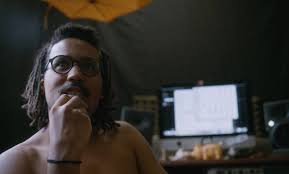
The film deals with Dino Brandão, a Swiss German musician of Angolan descent. When we first see him, he’s actually in Angola, the first time he’s made such a trip in fifteen years, to give a concert in the homeland of his father. Emotions are sky high, to the point of triggering a manic episode. Upon returning to Switzerland, he relies on friends and family, who want to make sure he doesn’t end up in a psychiatric hospital again. But there are moments where Brandão turns into his own worst enemy, quite harrowingly so, and even director Moris Freiburghaus, his longtime close friend, finds himself examining their bond under a new, emotionally charged light.
I Love You, I Leave You is a peculiar film, its title perfectly embodying the dual nature of the project and how it brings Freiburghaus and Brandão’s friendship to the screen: on the one hand, the latter is credited as a co-writer (meaning the two of them figured out the structure together after filming was done) and also as the writer of the score, his second composing credit after previously working on Lisa Brühlmann’s family drama When We Were Sisters; on the other, the movie doesn’t shy away from showing just how troubled he can get on his worst days (of which there’s more than one following the inciting incident), and how it affects those closest to him.
This is a work that doesn’t just wear its heart on its sleeve, but its style too: by putting their friendship front and center, Freiburghaus adopts a malleable style that is equal parts precise and frantic, reflecting the ups and downs of Dino’s mental journey in sometimes painful detail (the sound work is masterful, particularly in a scene where filmmaker and subject are talking on the phone, and we witness Dino being taken away by the police solely through the audio that the director hears on his end). It’s raw and honest, never exploitative, as it tackles the contradictions of a close relationship being tested in unprecedented ways.
It’s a trip through the looking glass for both Freiburghaus and Brandão, a journey from which neither of them will emerge completely unscathed, although it will have strengthened their bond both spiritually and artistically. Their catharsis becomes that of the audience, turning an achingly personal premise into a meditation on mental health that all viewers can, to some degree, relate to, regardless of their walks of life.
Director: Moris Freiburghaus
Screenwriters: Moris Freiburghaus, Dino Brandão
Cast: Dino Brandão, Iseh Kissacah, Moris Freiburghaus, Tillmann Ostendarp
Producers: Fabiana Seitz, Moris Freiburghaus, Leon Schwitter
Cinematography: Ramón Königshausen
Music: Dino Brandão
Sound: Kathleen Moser, Katharina Pfennich
Production companies: Sabotage Filmkollektiv GmbH
World sales: Sabotage Filmkollektiv GmbH
Venue: Zurich Film Festival (Documentary Competition)
In French, English, Portuguese, German
94 minutes